
Moneilema
Say, 1824
cactus longhorn beetles, cactus beetles
Species Guides
6- Moneilema annulatum(cactus beetle)
- Moneilema appressum
- Moneilema armatum(Black Cactus Longhorn Beetle)
- Moneilema blapsides(cactus beetle)
- Moneilema gigas(Giant Cactus Longhorn Beetle)
- Moneilema semipunctatum(cactus borer beetle)
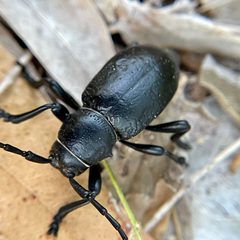
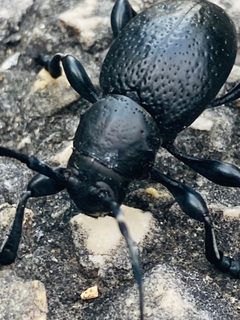
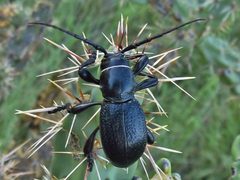
Moneilema is a of large, flightless, black longhorn beetles to North American deserts. The genus contains twenty distributed across the western United States and northern Mexico. and larvae are exclusively associated with cacti in the Opuntioideae, including prickly pears (Opuntia) and chollas (Cylindropuntia). The beetles are notable for their remarkable mimicry of darkling beetles in the genus Eleodes, including similar appearance and defensive -standing despite lacking chemical defenses.
Pronunciation
How to pronounce Moneilema: //ˌmoʊnəˈiːləmə//
These audio files are automatically generated. While they are not always 100% accurate, they are a good starting point.
Identification
Flightless beetles with , hardened forewings forming a single shell—derived from the name (Greek: moneilema = single cloak). Large, bulky, jet-black bodies with rounded and due to reduced wing musculature. typically long, often exceeding body length. Distinguished from similar darkling beetles (Eleodes) by cerambycid structure and association with cactus . Some possess diagnostic pronotal features: M. armatum has small lateral spines on pronotum and smooth lacking ; M. gigas is among the largest species.
Images
Habitat
Arid and semi-arid desert environments, specifically associated with cactus . Found in Sonoran Desert, Chihuahuan Desert, and western Great Plains at elevations generally below 1500 m, though some occur at higher elevations in Madrean sky islands.
Distribution
Western United States and northern Mexico. Range extends from Colorado and Kansas south through New Mexico, Oklahoma, and Texas into northern Mexico and Baja California. Some show northward range expansions associated with Pleistocene climate changes.
Seasonality
Most active during mid to late summer, with typically emerging during summer monsoon season. Some in central and southern Mexico reported active year-round.
Diet
feed on cactus tissues, including surface feeding on pads and stems. Larvae bore into cactus roots and stems.
Host Associations
- Opuntia - primary prickly pear cacti
- Cylindropuntia - primary cholla cacti
- Ferocactus gracilis - barrel cactus, recorded for M. michelbacheri
- Astrophytum asterias - endangered star cactus, recorded for M. armatum
- Pachycereus marginatus - organ pipe cactus, recorded for M. variolare
- Sclerocactus - threatened/endangered cacti
Life Cycle
Larvae develop within cactus stems and roots, boring tunnels that sometimes cause mortality. emerge from host plants. Specific developmental timing varies by and locality.
Behavior
Slow, clumsy locomotion due to flightlessness. When disturbed, raise in -standing posture—mimicking defensive of chemically-protected Eleodes darkling beetles. This mimicry is behavioral and morphological but lacks chemical defense backing. Adults are primarily , feeding on cactus surfaces at night.
Ecological Role
Herbivores specializing on cacti; larval boring can weaken or kill susceptible cactus individuals. Serve as prey for various desert , with their mimicry providing protection through deception.
Human Relevance
Occasional pests in cactus gardens and ornamental nurseries. Some threaten rare and endangered cactus species, including Sclerocactus and Astrophytum asterias.
Similar Taxa
- EleodesDarkling beetles that Moneilema closely mimics in appearance, slow movement, and defensive -standing posture; distinguished by -level characters including structure and exposure.
- DorcadionOld World cerambycid with similar flightlessness and ; relationship previously suggested but now considered due to similar subterranean, root-feeding habits in arid environments.
Sources and further reading
- BugGuide
- Wikipedia
- GBIF taxonomy match
- iNaturalist taxon
- NCBI Taxonomy
- Catalogue of Life
- Cactus beetle redux! | Beetles In The Bush
- Cover Photo—The Coleopterists Bulletin 71(4) | Beetles In The Bush
- Q: How do you photograph cactus beetles? | Beetles In The Bush
- Bug Eric: ID Tip: Ground Beetle or Darkling Beetle?
- 2018 New Mexico/Texas Insect Collecting Trip “iReport” | Beetles In The Bush
- Best of BitB 2013 | Beetles In The Bush
- Moneilema semipunctatum (cactus borer beetle).
- Range expansions in the flightless longhorn cactus beetles,Moneilema gigasandMoneilema armatum, in response to Pleistocene climate changes
- NEW HOST AND ELEVATION RECORDS FOR MONEILEMA APPRESSUM LECONTE (COLEOPTERA: CERAMBYCIDAE: LAMIINAE)
- Behavior and characterization of Moneilema variolare (Coleoptera: Cerambycidae), a new pest to Pachycereus marginatus
- SCIENTIFIC NOTE: A New Host Plant Record for Moneilema variolare Thomson in México (Coleoptera: Cerambycidae: Lamiinae)
- A New Host Plant Record, the Endangered Star Cactus, Astrophytum asterias (Zuccarini) Lemaire, for Moneilema armatum LeConte (Coleoptera: Cerambycidae: Lamiinae)
- Plant associations for adult Moneilema michelbacheri Linsley (Coleoptera: Cerambycidae), including a new host plant record, the Barrel Cactus (Ferocactus gracilis Gates), in Baja California, México
- Phylogeography of the longhorn cactus beetle Moneilema appressum LeConte (Coleoptera: Cerambycidae): was the differentiation of the Madrean sky islands driven by Pleistocene climate changes?