
Moneilema armatum
LeConte, 1853
Black Cactus Longhorn Beetle, Armed Cactus Longhorn Beetle
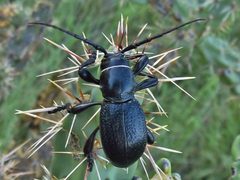
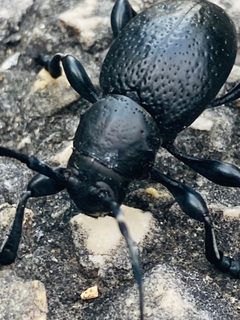
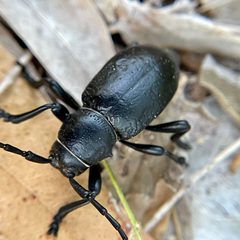
Moneilema armatum is a flightless, jet-black longhorn beetle to North American desert regions. are large, bulky, and slow-moving, with reduced wings and a distinctive habit of raising their when disturbed—a defensive posture convergent with darkling beetles. The feeds exclusively on cacti in the Opuntia and related opuntioids, with larvae boring into stems and roots while adults feed externally on pads and stems. genetic studies reveal pronounced geographic structure, with northern and southern clades separated near the Arizona-Sonora border, indicating long-term isolation in Pleistocene refugia followed by post-glacial range expansion.
Pronunciation
How to pronounce Moneilema armatum: /ˌmɒn.eɪˈliː.mə ɑːrˈmeɪ.təm/
These audio files are automatically generated. While they are not always 100% accurate, they are a good starting point.
Identification
Distinguished from other Moneilema by: (1) small but distinct lateral spines on pronotum (absent in M. gigas); (2) smooth pronotum lacking large punctures except at margins (M. gigas has more uniformly punctate pronotum); (3) lack of on . Convergent resemblance to Eleodes darkling beetles, but distinguished by long , cylindrical body form, and association with cacti. Flightlessness and slow, clumsy movement also characteristic.
Images
Habitat
Warm desert environments, particularly Sonoran Desert and adjacent regions. Associated with stands of Opuntia and other opuntioid cacti. Found in shortgrass prairie with scattered cactus, juniper-oak-pinyon woodland with cactus understory, and open desert scrub. Elevation range from low desert to moderate elevations in foothills.
Distribution
Southwestern United States and northern Mexico. Core range in Sonoran Desert extending from southern Arizona and northern Sonora southward. Genetic data indicate northern and southern clades separated near Arizona-Sonora border, with evidence of post-glacial range expansion from multiple Pleistocene refugia. Records from Colorado, Oklahoma, Texas, New Mexico, Arizona, and Mexico.
Seasonality
active during warmer months, with observations spanning late spring through summer. Peak activity likely coincides with cactus growth and flowering periods. One observation notes activity in late June.
Diet
Strictly herbivorous, feeding on cacti in Opuntioideae. feed externally on cactus pads and stems, creating feeding damage that may serve dual purpose of nutrition and oviposition site preparation. Larvae bore into cactus stems and roots, feeding internally. Infested plants often appear unthrifty with black masses of hardened exudate along stems.
Host Associations
- Opuntia macrorhiza - primary prairie pricklypear
- Opuntia camanchica - primary tulip pricklypear
- Opuntia phaeacantha - primary brown-spined pricklypear
- Cylindropuntia imbricata - primary cholla cactus; prefer chollas over prickly pears
- Astrophytum asterias - star cactus; new record,
Life Cycle
Complete . Larvae are stem and root borers within cactus , tunneling through tissues and causing characteristic black exudate masses at feeding sites. presumably occurs within host plant. emerge and feed externally on host cacti. Flightlessness restricts , contributing to pronounced genetic structure.
Behavior
Flightless; move by slowly and clumsily among cactus spines. When disturbed, raises in defensive posture resembling Eleodes darkling beetles—likely Batesian or Müllerian mimicry. Adults often found resting on cactus pads, using spines for protection. Slow movement and reliance on host defense suggests low pressure when on cacti. activity suggested by collection records at night.
Ecological Role
Primary consumer and herbivore of Opuntia cacti. Larval boring may weaken plants and create entry points for . feeding damage may influence cactus growth form and . Serves as prey for specialized capable of exploiting cactus defenses. likely tied to cactus abundance and condition.
Human Relevance
Minor potential as pest of ornamental cacti. Subject of phylogeographic research demonstrating impacts of Pleistocene climate change on desert biota. Photographed and collected by entomologists, with techniques for safe handling developed due to hazardous plant. New host record on endangered star cactus (Astrophytum asterias) raises conservation considerations.
Similar Taxa
- Moneilema gigasLarger with unarmed pronotum (lacking lateral spines) and more uniformly punctate pronotum; similar flightless cactus-associated
- Eleodes spp.Convergent appearance and defensive posture—both black, cylindrical, and raise when disturbed; distinguished by length, body shape, and (Eleodes ground-dwelling, not cactus-associated)
- Coenopoeus palmeriAnother cactus-associated cerambycid; distinguished by different body form and preferences
More Details
Phylogeography
Mitochondrial studies reveal M. armatum exhibits pronounced genetic structure with distinct northern and southern clades separated near the Arizona-Sonora border. This pattern indicates long-term isolation in separate Pleistocene refugia followed by post-glacial range expansion. The flightless habit has restricted , preserving genetic signatures of historical climate-driven range shifts.
Photography challenges
The presents unusual photographic difficulties due to its hazardous plants. Successful techniques include: using long forceps to reposition beetles onto exposed surfaces; detaching cactus pads for controlled positioning; bracing arms against camera equipment to stabilize shots; and shooting upward against sky backgrounds to minimize clutter. The 's slow movement and reluctance to flee when on cacti facilitates in situ photography despite spiny defenses.
Sources and further reading
- BugGuide
- Wikipedia
- GBIF taxonomy match
- iNaturalist taxon
- NCBI Taxonomy
- Catalogue of Life
- Cerambycidae | Beetles In The Bush | Page 6
- Q: How do you photograph cactus beetles? | Beetles In The Bush
- Trogidae | Beetles In The Bush
- First collecting trip of the season! | Beetles In The Bush
- May | 2023 | Beetles In The Bush
- Range expansions in the flightless longhorn cactus beetles,Moneilema gigasandMoneilema armatum, in response to Pleistocene climate changes
- A New Host Plant Record, the Endangered Star Cactus, Astrophytum asterias (Zuccarini) Lemaire, for Moneilema armatum LeConte (Coleoptera: Cerambycidae: Lamiinae)