
Phloeosinini
Nüsslin, 1912
Genus Guides
3- Chramesus(crenulate bark beetles)
- Dendrosinus(crenulate bark beetles)
- Phloeosinus(cedar bark beetles)
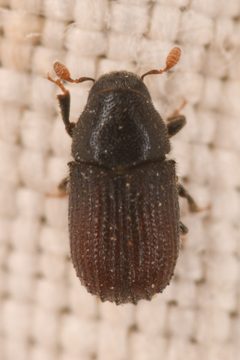
Phloeosinini is a tribe of bark beetles within the Scolytinae, comprising at least 16 including the economically significant genus Phloeosinus. Members are wood-boring beetles primarily associated with conifer across five : Araucariaceae, Cupressaceae, Pinaceae, Podocarpaceae, and Taxaceae. The tribe includes with potential that are readily transported internationally via wood products and packaging materials.
Pronunciation
How to pronounce Phloeosinini: //ˌfloʊ.iˌɒsəˈnaɪnaɪ//
These audio files are automatically generated. While they are not always 100% accurate, they are a good starting point.
Identification
Tribe-level identification requires examination of morphological characters distinguishing Phloeosinini from other scolytine tribes, including features of the , pronotum, and elytral declivity. Members of the type Phloeosinus are characterized by deeply , coarse reticulate frontal and prothoracic surfaces, and deeply V-shaped basal margin of the .
Images
Habitat
Conifer forests and plantations; development occurs inside tissues of live plants, timber, wood products, and wood-packaging materials. Specific occupy wetland plains, coastal areas, and montane regions up to 1,400 m elevation.
Distribution
Global distribution with native ranges across multiple continents; many have established outside native ranges through international trade in logs, wood packaging materials, bonsai, and ornamental plants.
Diet
Phloem and sapwood feeding; and larvae bore inside plant tissues and develop within conifer . Feeding occurs in dead wood or living plant parts including branches and trunks.
Host Associations
- Araucariaceae - primary
- Cupressaceae - primary includes Metasequoia glyptostroboides
- Pinaceae - primary
- Podocarpaceae - primary
- Taxaceae - primary
Life Cycle
Development occurs entirely within plant tissues; larval stage takes place protected inside wood, enabling survival during transport. Specific duration and developmental stages vary by and environmental conditions.
Behavior
create small circular entrance holes (<0.5 mm diameter) in branches. Larval development inside plant tissues facilitates passive across continents via global trade. Some exhibit -dependent tunneling , with gallery length proportional to density. Attack behavior varies between native and invaded environments, with potential to shift to phylogenetically related or completely different host species.
Ecological Role
Economically important pests of native forests and agricultural crops globally; significant impacts on conifer and plantations. Some threaten survival of endangered relictual tree species.
Human Relevance
Major phytosanitary concern due to cryptic and ease of international transport in wood products. Often evade detection at ports of entry. Cause substantial economic damage to forestry, timber production, and ornamental plant industries.
Similar Taxa
- HylastiniBoth are conifer-associated scolytine tribes; distinguished by morphological characters of and pronotum
- HylurginiOverlapping conifer range; separated by tribal-level morphological features and gallery patterns
- IpiniSimilar wood-boring in conifers; distinguished by antennal club structure and pronotal shape
- PolygraphiniShared and general ; differentiated by specific morphological characters and associations
Sources and further reading
- BugGuide
- Wikipedia
- Phloeosinus metasequoiae sp. nov. (Coleoptera, Curculionidae, Scolytinae, Phloeosinini), a new insect pest of Metasequoia glyptostroboides in China
- The first host plant dataset of Curculionidae Scolytinae of the world: Hylastini LeConte, Hylurgini Gistel, Ipini Bedel, Phloeosinini Nusslin, Polygraphini Chapuis