
Parcoblatta
Hebard, 1917
North American Wood Cockroaches
Species Guides
12- Parcoblatta americana(Western Wood Cockroach)
- Parcoblatta bolliana(Boll's Wood Cockroach)
- Parcoblatta caudelli(Caudell's wood cockroach)
- Parcoblatta desertae(Desert Wood Cockroach)
- Parcoblatta divisa(Southern Wood Cockroach)
- Parcoblatta fulvescens(Fulvous Wood Cockroach)
- Parcoblatta lata(Broad Wood Cockroach)
- Parcoblatta notha(Arizona Wood Cockroach)
- Parcoblatta pennsylvanica(Pennsylvania Wood Cockroach)
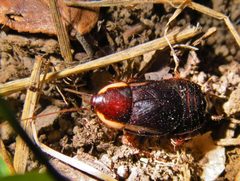
Parcoblatta is a of 12 of native North American wood cockroaches. Males are typically winged and attracted to lights, while females have reduced wings and are flightless. Species in this genus are abundant in pine forests of the southeastern United States and serve as important prey for the endangered red-cockaded woodpecker. Several species use a unique macrocyclic lactone (parcoblattalactone) for mate attraction.
Pronunciation
How to pronounce Parcoblatta: /ˌpɑrkoʊˈblætə/
These audio files are automatically generated. While they are not always 100% accurate, they are a good starting point.
Identification
Males possess fully developed wings enabling , whereas females have reduced, non-functional wings. in wing development is a key diagnostic feature distinguishing Parcoblatta from many other . Attraction to light sources in males can aid in detection and identification.
Images
Habitat
Deciduous and pine forests, particularly in the southeastern United States coastal plain. Found under bark, in decaying wood, and associated with dead standing trees. occupy forested areas with abundant woody debris.
Distribution
North America; primarily distributed across the eastern and central United States, with records from North Carolina, South Carolina, Ohio, Missouri, Kansas, Wisconsin, and Texas.
Seasonality
Active during spring; emerge and become reproductively active following seasonal warming. Calling in females commences several days after adult , with P. lata females beginning calling behavior 6 days post-emergence.
Life Cycle
Nymphs develop in forest floor debris and under bark, maturing through multiple instars. Sexual maturation requires several days after . Females exhibit calling to attract mates, with production increasing from 1- to 7-day-old virgin females and declining after mating.
Behavior
Females perform calling restricted to the scotophase (dark phase), consisting of repeated raising and lowering of the with occasional exposure of the genital vestibulum. Males use -capable wings to locate females attracted by volatile . Males exhibit involving wing elevation and body vibration; females actively mount males during copulation. Males sometimes amputate female during mate handling.
Ecological Role
Important prey item for the endangered red-cockaded woodpecker (Picoides borealis), constituting over 50% of dietary in some . Serves as for including Ampulex canaliculata, which uses wood cockroaches as prey for larval development.
Human Relevance
Monitoring of P. lata has been proposed as an index of suitability for red-cockaded woodpecker conservation and forest management. Synthetic (parcoblattalactone) has been developed for population monitoring of multiple Parcoblatta in pine forest .
Similar Taxa
- PeriplanetaBoth are with some winged males, but Periplaneta are larger, associated with human structures rather than native forests, and lack the pronounced in capability seen in Parcoblatta.
- EctobiusBoth are in Blattellidae with forest-dwelling , but Ectobius is primarily Palearctic in distribution whereas Parcoblatta is to North America.
More Details
Sex Pheromone Chemistry
Parcoblatta lata females produce a unique macrocyclic lactone , (4Z,11Z)-oxacyclotrideca-4,11-dien-2-one (parcoblattalactone), representing a previously unknown pheromonal structure for . This compound attracts multiple Parcoblatta , highlighting chemical diversity in cockroach olfactory communication.
Parasitoid Relationships
The cockroach wasp Ampulex canaliculata ( Ampulicidae) specializes on Parcoblatta as prey. The stings the in a thoracic nerve center, inducing hypokinesia (slowed movement and loss of escape reflex), then leads the 'zombie' roach to a cavity and lays an on it.
Sources and further reading
- BugGuide
- Wikipedia
- GBIF taxonomy match
- iNaturalist taxon
- NCBI Taxonomy
- Catalogue of Life
- Bug Eric: Wasp Wednesday: Ampulex canaliculata
- Bug Eric: City Nature Challenge 2023 Recap
- Biological Parameters of Reproduction in Parcoblatta Cockroaches (Dictyoptera: Blattellidae)
- The Mating Behavior of Parcoblatta Fulvescens (Saussure and Zehntner) (Blattaria, Blaberoidea, Blattellidae, Blattellinae)
- Behavioral and Electrophysiological Evidence for Volatile Sex Pheromones in Parcoblatta Wood Cockroaches
- Unusual macrocyclic lactone sex pheromone of Parcoblatta lata , a primary food source of the endangered red-cockaded woodpecker
- Life History and Habitat Associations of the Broad Wood Cockroach, <I>Parcoblatta lata</I> (Blattaria: Blattellidae) and Other Native Cockroaches in the Coastal Plain of South Carolina