
Parcoblatta lata
Brunner von Wattenwyl, 1865
Broad Wood Cockroach
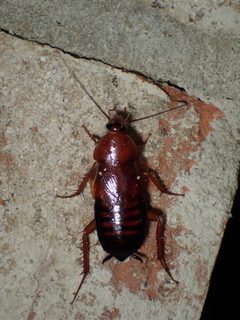
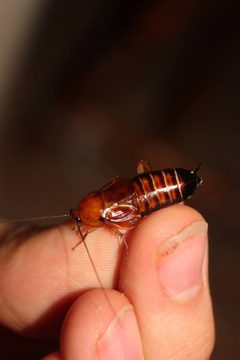
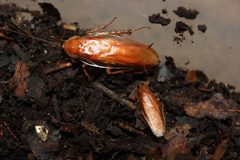
Parcoblatta lata, the broad wood , is one of the largest in the Parcoblatta. It is native to the eastern United States and is particularly notable as a primary food source for the endangered red-cockaded woodpecker, comprising more than half the of this bird's diet. The species has been studied for its unusual macrocyclic lactone , parcoblattalactone, which has potential applications in monitoring cockroach for conservation purposes.
Pronunciation
How to pronounce Parcoblatta lata: /ˌpɑrkoʊˈblætə ˈleɪtə/
These audio files are automatically generated. While they are not always 100% accurate, they are a good starting point.
Identification
Males distinguished by long, wide tegmina extending beyond . Females distinguished by short tegmina ending at second segment and disproportionately large, rounded pronotum. Larger and more robust than most . approximately 4 mm × 9 mm with slightly curved seam and row of about 30 evenly spaced knobs.
Images
Habitat
Forests and grasslands. to pine forests of the southeastern United States. Also found in grassland and shrub in Kansas and low-lying mesic hammocks in Florida. Has been reported indoors, at lights, and under wooden signs on trees.
Distribution
Eastern United States: Alabama, District of Columbia, Delaware, Florida, Georgia, Illinois, Indiana, Iowa, Kansas, Kentucky, Louisiana, Maryland, Mississippi, Missouri, North Carolina, Oklahoma, South Carolina, Tennessee, Texas, and Virginia.
Diet
Has been observed eating cambium, flower petals, and sap. Male specimens have been found in pitcher plants (Sarracenia flava), leading to speculation that winged may seek nectar as an energy source for .
Host Associations
- red-cockaded woodpecker (Picoides borealis) - preyComprises more than 50% of of woodpecker's diet; primary food source for this
Life Cycle
measures approximately 4 mm × 9 mm. Females produce ootheca with slightly curved seam bearing about 30 evenly spaced knobs.
Behavior
Females emit volatile, long-distance to attract mates, assuming a characteristic calling posture by alternately raising and lowering the body through longitudinal bending and straightening. Males fly to female locations. component identified as parcoblattalactone [(4Z,11Z)-oxacyclotrideca-4,11-dien-2-one], a macrocyclic lactone. is methanogenic (methane-producing).
Ecological Role
Critical prey item for the endangered red-cockaded woodpecker. levels may serve as an index of suitability for woodpecker conservation. Methanogenic metabolism contributes to carbon cycling in forest .
Human Relevance
Subject of research for conservation monitoring; synthetic developed for assessing Parcoblatta . Occasionally found indoors but not considered a significant pest . Potential for forest management and assessment.
Similar Taxa
- other Parcoblatta species12 in share general wood ; P. lata distinguished by larger size and specific chemistry
- Ectobiidae family members-level characteristics of tegmina structure and body plan; P. lata distinguished by size and patterns
More Details
Pheromone chemistry
Parcoblattalactone [(4Z,11Z)-oxacyclotrideca-4,11-dien-2-one] is a previously unidentified natural product and represents a novel pheromonal structure for , distinct from classes used by other cockroach .
Conservation significance
Because in red-cockaded woodpeckers is strongly affected by seasonal and spatial changes in availability, monitoring P. lata could serve as a useful index of suitability for woodpecker conservation efforts.
Sources and further reading
- BugGuide
- Wikipedia
- GBIF taxonomy match
- iNaturalist taxon
- NCBI Taxonomy
- Davis Bee Sanctuary: The Place to 'Bee' | Bug Squad
- Bug Eric: Wasp Wednesday: Ampulex canaliculata
- Bug Eric: April 2011
- Bug Eric: City Nature Challenge 2023 Recap
- Bug Eric: What is, and is NOT, a Japanese Beetle
- Wolbachia in Cockroaches: A New Paradigm for Urban Pest Management?
- Unusual macrocyclic lactone sex pheromone of Parcoblatta lata , a primary food source of the endangered red-cockaded woodpecker
- Life History and Habitat Associations of the Broad Wood Cockroach, <I>Parcoblatta lata</I> (Blattaria: Blattellidae) and Other Native Cockroaches in the Coastal Plain of South Carolina