
Blattellinae
Karny, 1908
wood cockroaches
Genus Guides
6- Attaphila
- Blattella
- Ischnoptera(Narrow-winged Cockroaches)
- Parcoblatta(North American Wood Cockroaches)
- Pseudomops
- Symploce
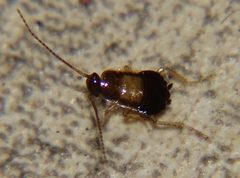
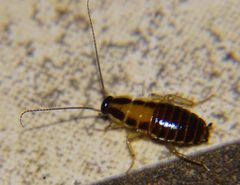
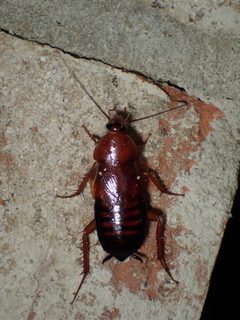
Blattellinae is a of Ectobiidae containing approximately 70 . It includes the globally distributed German cockroach (Blattella germanica), a major household pest, as well as several such as those in Hololeptoblatta and Miriamrothschildia. The subfamily exhibits diverse ecological adaptations, with members occupying ranging from wetlands and grasslands to caves and human dwellings.
Pronunciation
How to pronounce Blattellinae: //blætɛˈlaɪniː//
These audio files are automatically generated. While they are not always 100% accurate, they are a good starting point.
Identification
Blattellinae can be distinguished from other Ectobiidae by genital characters, particularly male paraprocts, styles, and of the right complex. Diagnostic features include the shape and spine distribution of male genital structures. Some exhibit distinctive morphological adaptations, such as the saltatorial Saltoblattella montistabularis.
Images
Habitat
Highly variable across . Carbrunneria cattana has been observed in Cattana Wetlands, Queensland. Johnrehnia notata is frequently attracted to lights and enters human dwellings. Paratemnopteryx include cave-dwelling forms. The encompasses wetland, grassland, cave, and .
Distribution
Global distribution with strong representation in Australia, South America, North America, and North Africa. Carbrunneria cattana is known from Far North Queensland, Australia. Litoblatta are recorded from Argentina. Loboptera species are predominantly to Morocco, with one species (L. decipiens) showing wider distribution and L. ovolobata extending into western Algeria.
Behavior
Males of at least some produce to attract females from a distance, as observed in Parcoblatta fulvescens. Courtship involves antennal contact and wing raising by males, followed by female mounting and feeding on male tergal gland secretions during copulation. Mating is inhibited by light and occurs in darkness. Multiple matings with same or different partners have been observed. Some species are strongly attracted to artificial light sources.
Human Relevance
Blattella germanica is a major global household pest causing significant public health and economic concerns. Johnrehnia notata in Australia causes concern among residents when it enters dwellings due to its resemblance to the German cockroach. Some serve as type locality indicators for conservation designations, such as Carbrunneria cattana from Cattana Wetlands.
Similar Taxa
- PseudophyllodromiinaeBoth are of Ectobiidae; distinguished by different male genital characters and ecological preferences. Parectoneura queenslandica, previously associated with Blattellinae descriptions, belongs to Pseudophyllodromiinae.
More Details
Conservation Status
The includes in the Hololeptoblatta and Miriamrothschildia, indicating significant conservation concern for certain lineages despite the pest status of Blattella germanica.
Taxonomic Complexity
The large Carbrunneria has unresolved taxonomic problems requiring further study. The 's classification has undergone revision, with the historically referred to as 'Blattellidae' now recognized as Ectobiidae.
Sources and further reading
- BugGuide
- Wikipedia
- iNaturalist taxon
- Catalogue of Life
- New cockroaches from Far North Queensland, Australia (Blattodea: Ectobiidae: Blattellinae; Pseudophyllodromiinae)
- Revision of the Loboptera species of Morocco (Blattaria: Blattellidae: Blattellinae)
- The Mating Behavior of Parcoblatta Fulvescens (Saussure and Zehntner) (Blattaria, Blaberoidea, Blattellidae, Blattellinae)
- Four new species of Litoblatta from Argentina with a key to species based on males (Blattaria: Ectobiidae: Blattellinae)
- New species of Australian cockroaches in the genusParatemnopteryxSaussure (Blattaria, Blattellidae, Blattellinae), and a discussion of some behavioural observations with respect to the evolution and ecology of cave life