
Parcoblatta fulvescens
(Saussure & Zehntner, 1893)
Fulvous Wood Cockroach
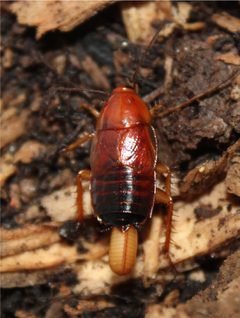
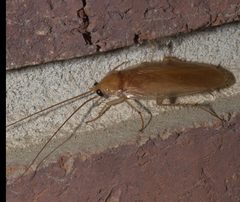
Parcoblatta fulvescens, the fulvous wood , is a small wood cockroach measuring approximately 13 mm in length. Males are slender with long tegmina and uniform pale brownish-yellow coloration, while females are shorter with reduced tegmina and more variable reddish-brown patterning. The species exhibits distinctive mating involving male calling through abdominal vibration and including wing-raising. It is to the eastern United States with possible occurrence in southern Canada, occupying diverse forested from deciduous woods to pine barrens.
Pronunciation
How to pronounce Parcoblatta fulvescens: /pɑrkoʊˈblætə fʊlˈvɛsɛnz/
These audio files are automatically generated. While they are not always 100% accurate, they are a good starting point.
Identification
Males distinguished from P. uhleriana by pale (vs. dark), longer pronotum with less distinct disc impressions, narrower tegmina, and different and anal styles . Females distinguished from P. virginica by larger size, more robust build, wider coloration differences, supra-anal plate with converging lateral edges to acute apex, more convex caudal edge of sixth abdominal segment, and more spines on cephalic . Distinguished from P. lata by smaller size and less transverse pronotum. larger than P. virginica with slightly narrower spacing of vertical divisions. Two color forms documented in Kansas: dark olive gray to brown (Riley County) and light golden brown to tan (Flint Hills near Manhattan).
Images
Habitat
Occupies diverse forested and woodland edge including heavy barrier-beach forest, pine-barrens undergrowth (typical or heavy and grassy), borders of pine barrens, swamp edges, heavy deciduous forest, and heavy oak woods. In Florida: mesic hammock, xeric hammock, scrub, and sand hill habitats. Microhabitats include under dead leaves, pine needles (particularly beneath shortleaf pine), logs, beneath loose bark. Nocturnally active individuals may be found wandering at night.
Distribution
Eastern United States: Alabama, Arkansas, District of Columbia, Florida, Georgia, Illinois, Indiana, Iowa, Kansas, Maryland, Mississippi, Missouri, New Jersey, New York, North Carolina, South Carolina, Virginia, and Texas. Possibly Canada: Ontario (status as native or unclear).
Life Cycle
() bean-shaped, very dark brown, approximately 8.5 mm long by 3.8 mm wide, with curved seam edge bearing about 40 small crimps or folds. Developmental details beyond ootheca not documented.
Behavior
Males perform calling using abdominal vibration to attract females. Courtship involves approach, antennal contact, and wing-raising displays by males. Copulation follows successful pairing after stereotyped pre-copulatory sequence. Nocturnally active, may be found wandering at night. Individuals found under cover objects (dead leaves, pine needles, logs, loose bark) during day.
Ecological Role
Prey for including Ampulex canaliculata (Ampulicidae), which uses P. fulvescens as favored . Contributes to nutrient cycling in forest floor through consumption and processing of decaying plant matter.
Human Relevance
Documented as prey of cockroach wasp Ampulex canaliculata, which exhibits remarkable behavioral manipulation of . Not known as significant household pest; primarily restricted to natural forest .
Similar Taxa
- Parcoblatta uhlerianaMales appear very similar; distinguished by dark (vs. pale in P. fulvescens), shorter pronotum with more distinct disc impressions, broader tegmina, and different and anal styles . Historical confusion led to P. fulvescens being treated as southern variety P. uhleriana fulvescens until 1910.
- Parcoblatta virginicaFemales can be confused; P. virginica females are smaller, less robust, less variable in coloration, have supra-anal plate with straight lateral edges converging to more acute apex, less convex caudal edge of sixth abdominal segment, and fewer spines on cephalic . smaller with different spacing of vertical divisions.
- Parcoblatta lataFemales can be confused; P. lata females are much larger and more robust with more transverse pronotum.
More Details
Color Variation
Two distinct color morphs regularly collected in Kansas: dark olive gray to brown variety from Riley County, and light golden brown to tan variety from slopes of Flint Hills pastures near Manhattan.
Historical Taxonomy
treated as southern variety of P. uhleriana (as P. uhleriana fulvescens) in 1910 due to male morphological similarity; elevated to full species status based on diagnostic differences in color, pronotum proportions, tegmina width, and genitalic structures.
Prey of Parasitoid Wasps
Favored prey of Ampulex canaliculata, a cockroach wasp that employs remarkable behavioral manipulation: sting to thoracic nerve center eliminates reflex, allowing to lead 'zombie' roach to cache site using as 'reins'.
Sources and further reading
- BugGuide
- Wikipedia
- GBIF taxonomy match
- iNaturalist taxon
- NCBI Taxonomy
- Encyrtid Holdings | Entomology Research Museum
- Bug Eric: Wasp Wednesday: Ampulex canaliculata
- Bug Eric: City Nature Challenge 2023 Recap
- The Mating Behavior of Parcoblatta Fulvescens (Saussure and Zehntner) (Blattaria, Blaberoidea, Blattellidae, Blattellinae)