
Parcoblatta virginica
(Brunner von Wattenwyl, 1865)
Virginia wood cockroach
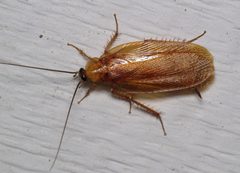
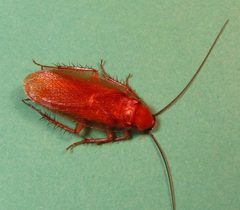
Parcoblatta virginica, the Virginia wood , is a small woodland cockroach measuring approximately 10 mm as an . It is native to deciduous forest in eastern North America, where it inhabits leaf litter and decaying wood. The species exhibits strong in wing development and coloration. Unlike many cockroach species, it is not a household pest and cannot survive indoors due to low humidity requirements.
Pronunciation
How to pronounce Parcoblatta virginica: //ˌpɑrkoʊˈblætə vərˈdʒɪnɪkə//
These audio files are automatically generated. While they are not always 100% accurate, they are a good starting point.
Identification
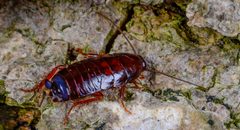
Distinguished from other Parcoblatta by combination of small size (~10 mm), in wing development (males fully winged, females brachypterous), and dark-stained in . Males are orangish; females range from rusty brown to almost black. The solid green without markings mentioned in some sources appear to apply to Tetracha virginica (tiger ), not this species.
Images
Habitat
Deciduous forest floor, specifically leaf litter and rotting wood. Dependent on moist microhabitats provided by decomposing organic matter. Cannot persist in dry indoor environments.
Distribution
Eastern North America: Ontario, Canada and eastern United States. Documented from Alabama, Connecticut, Florida, Georgia, Illinois, Indiana, Iowa, Kansas, Kentucky, Maine, Maryland, Massachusetts, Michigan, Minnesota, Missouri, Nebraska, New Jersey, New York, North Carolina, Oklahoma, Pennsylvania, Rhode Island, South Dakota, Texas, Vermont, Virginia, and Wisconsin.
Diet
Decomposer; feeds on decaying organic matter in leaf litter and rotting wood. Specific dietary components not documented.
Life Cycle
Hemimetabolous development with , nymph, and stages. Nymphs observed in brown to black coloration, transitioning to adult coloration. () production documented in females. Detailed developmental timing and instar number not specified in available sources.
Behavior
decomposer active in moist forest floor . May occasionally wander into human dwellings but cannot establish indoor due to humidity requirements.
Ecological Role
Decomposer in forest , contributing to breakdown of leaf litter and rotting wood. Prey item for , particularly Ampulex canaliculata (cockroach wasp), which has been documented to use Parcoblatta as primary .
Human Relevance
Not a household pest; incidental indoor occurrences are non-viable due to humidity limitations. No documented economic or medical significance. Serves as important for native , contributing to ecological research on host-parasitoid relationships.
Similar Taxa
- Other Parcoblatta speciesSeveral Parcoblatta share similar woodland habits and male wing development; P. virginica distinguished by small size (~10 mm), specific coloration patterns, and geographic range.
- Domestic cockroach species (e.g., Blattella germanica, Periplaneta americana)P. virginica is smaller, sexually dimorphic in wing development, associated with outdoor woodland rather than human structures, and lacks the established indoor pest status of domestic .
More Details
Parasitoid relationships
Documented as primary for Ampulex canaliculata, a cockroach wasp ( Ampulicidae) that hunts wood cockroaches in deciduous forests. The stings the to induce partial paralysis, then leads it to a cavity where an is deposited.
Taxonomic note
placement varies between sources: Ectobiidae (GBIF) versus Blattellidae (iNaturalist, NCBI, Wikipedia). This reflects ongoing taxonomic revisions in .
Sources and further reading
- BugGuide
- Wikipedia
- GBIF taxonomy match
- iNaturalist taxon
- NCBI Taxonomy
- Dashing caterpillars predicting weather: Woolly bears, Pyrrharctia Isabella; yellow bears, Spilosoma virginica; and leopard moths, Hypercompe scribionia — Bug of the Week
- Bee Fly Parasitism of Tetracha virginica | Beetles In The Bush
- Carpenter bees defending territories: Large carpenter bee, Xylocopa virginica — Bug of the Week
- Guardians of the galleries: Male Eastern Carpenter Bees, Xylocopa virginica — Bug of the Week
- The Third of Florida’s Three Metallic Tiger Beetles | Beetles In The Bush
- Bug Eric: Wasp Wednesday: Ampulex canaliculata