
Ampulex canaliculata
Say, 1823
cockroach wasp
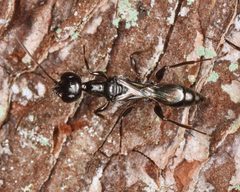
Ampulex canaliculata is a small cockroach wasp in the Ampulicidae, native to eastern North America. Females hunt wood cockroaches in the Parcoblatta, using a specialized sting to induce a state of weak paralysis that eliminates the prey's escape reflex. The then leads the subdued to a pre-existing cavity, lays an on it, and entombs it to serve as living food for the developing larva.
Pronunciation
How to pronounce Ampulex canaliculata: //æmˈpjuːlɛks ˌkænælɪkjʊˈleɪtə//
These audio files are automatically generated. While they are not always 100% accurate, they are a good starting point.
Identification
Distinguished from other by its small size, -like appearance, and spotted wing pattern. Separated from the only other North American Ampulex , A. ferruginea (restricted to Florida and Texas), by geographic range. Most likely to be observed running on tree trunks rather than flying. The combination of diminutive size, ant mimicry, and spotted wings is diagnostic within its range.
Images
Appearance
Small , 10–12 mm in length. Body form and coloration resemble an more than a typical wasp. Wings are relatively short for the body and display a spotted pattern that intensifies ant-mimicry appearance.
Habitat
Deciduous forests. are frequently found running up and down tree trunks, particularly dead standing trees (snags) that also harbor wood prey.
Distribution
Eastern United States, west to Wisconsin, Missouri, and Kansas. Present in Canada (Ontario).
Seasonality
Active in spring; emerge and hunt during this period.
Host Associations
- Parcoblatta - preyWood cockroaches in this are the favored prey. The does not consume the directly; rather, the paralyzed serves as food for the developing larva.
Life Cycle
Female lays a single on a paralyzed that has been cached in a pre-existing cavity. The larva hatches and consumes the living , eventually pupating and emerging as an .
Behavior
Females hunt by searching tree trunks for . Upon finding prey, the uses her and to clamp the edge of the roach's pronotal shield while curling her beneath to sting a nerve center on the side of the . This sting eliminates the roach's reflex while keeping it alive and mobile. The wasp then grips the roach's in her jaws and walks backward, leading the victim to a cavity. Sometimes amputates the roach's long antennae to improve control. The wasp is much more likely to be seen running than flying.
Ecological Role
of wood cockroaches; regulates of Parcoblatta in deciduous forest .
Human Relevance
No direct economic or medical significance. Occasionally noted by entomologists and naturalists due to its remarkable hunting . The is relatively common but easily overlooked due to its small size and -like appearance.
Similar Taxa
- Ampulex compressaLarger, metallic green (emerald cockroach wasp or jewel wasp) with different geographic range (Ethiopian, Oriental regions, Australia, Hawaii, and other islands); hunts Periplaneta americana rather than Parcoblatta species.
- Ampulex ferrugineaThe only other North American Ampulex , distinguished by restricted distribution to Florida and Texas.
- Ants (Formicidae)A. canaliculata exhibits strong mimicry in body form, size, and movement; spotted wing pattern and of running on tree trunks in search of prey help distinguish it.
More Details
Taxonomic History
Formerly placed in Sphecidae, now recognized in its own family Ampulicidae. One of two Ampulex in North America.
Ant Mimicry Function
The -like appearance, including spotted wing pattern and running , likely provides protection from that avoid ants.
Sources and further reading
- BugGuide
- Wikipedia
- GBIF taxonomy match
- iNaturalist taxon
- Catalogue of Life
- Bohart Museum Halloween Party: A Night of Frights and Delights! | Bug Squad
- Bug Eric: Wasp Wednesday: Ampulex canaliculata
- Fantastic Bugs and Where to Find Them (Hint: Chicago)
- Swimmer’s Itch: what causes this neglected snail-borne disease?