
Ampulex
Jurine, 1807
cockroach wasps, jewel wasps
Species Guides
2- Ampulex canaliculata(cockroach wasp)
- Ampulex ferruginea
Ampulex is a large of -hunting in the Ampulicidae, comprising over 130 concentrated in tropical regions of the Old World. Fewer than 15 species occur in the New World, and fewer than 5 are native to Europe or the United States. The genus is notable for its specialized : females sting cockroaches with venom that induces a state of hypokinesia—suppressed escape response and reduced locomotion without paralysis—then lead the subdued to a shelter, lay on its legs, and seal it inside where the larva consumes the living host. The emerald jewel wasp Ampulex compressa is the best-studied species and has spread globally alongside its host cockroaches.
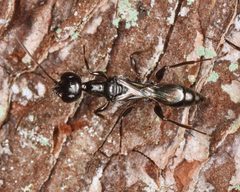
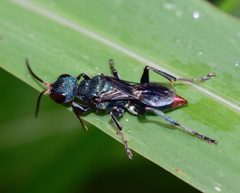
Pronunciation
How to pronounce Ampulex: //æmˈpjuːlɛks//
These audio files are automatically generated. While they are not always 100% accurate, they are a good starting point.
Images
Habitat
are found in diverse environments from tropical forests to urban areas, with use tied to availability. Ampulex compressa has been observed using pre-existing cavities and burrows for host concealment. Ampulex canaliculata has been observed running on tree trunks in deciduous forests where its wood cockroach prey occur.
Distribution
distribution with strong tropical concentration. Most occur in the Old World tropics. Fewer than 15 species known from the New World. Fewer than 5 species native to Europe or the United States. Ampulex compressa has spread virtually worldwide where its (especially Periplaneta) occur, including Hawaii and various Pacific islands. Ampulex canaliculata ranges across the eastern United States west to Wisconsin, Missouri, and Kansas. Ampulex ferruginea is recorded from Florida and Texas.
Host Associations
- Periplaneta americana (American cockroach) - primary Primary of Ampulex compressa; is an endoparasitoid
- Periplaneta (genus) - for Ampulex compressa
- Parcoblatta (wood cockroaches) - primary Favored prey of Ampulex canaliculata in deciduous forests
Life Cycle
Based on detailed studies of Ampulex compressa: hatches approximately 3 days after oviposition onto mesothoracic leg; larva develops through three instars—first two ectoparasitoid, third exclusively endoparasitoid after entering host body cavity during ; larva pupates within host carcass inside a complex three-layered cocoon constructed from silk and a brittle inner substance; cocoon structure provides defense against by other . Cocoon volume, mass, and duration are sexually dimorphic, with these metrics predictive of sex before . Only females produce venom.
Behavior
Females perform an elaborate, largely innate -handling sequence requiring no learning: sting in specific nerve centers (thoracic ganglia or ) to induce hypokinesia; use and to grasp host pronotum; sometimes amputate host to facilitate control; grip remaining antennae like reins and walk backward, leading the compliant but living host to a pre-existing cavity; oviposit on host leg; seal host inside using debris. Larvae exhibit rapid feeding , consuming host tissues selectively while sparing vital organs until late in development, and complete cocoon construction rapidly to avoid .
Ecological Role
Specialized of ; control agent for cockroach . Larvae sanitize host environment using antimicrobial secretions, potentially reducing microbial competition in sheltered .
Human Relevance
Ampulex compressa serves as a major research model for neurobiology and venom pharmacology due to its precise manipulation of via CNS-targeted venom. The venom contains novel compounds including tachykinins and ampulexins with potential pharmaceutical applications. The has been featured in museum exhibits and educational programs highlighting . No significant economic importance as agent due to host specificity and limited impact.
Similar Taxa
- Sphecidae (thread-waisted wasps)Formerly classified together; Ampulicidae now recognized as distinct based on and
- Crabronidae (digger wasps)Related apoid with different cocoon and associations
- Ammophila and other SphecidaeSuperficially similar slender but hunt caterpillars or spiders rather than , lack hypokinesia-inducing venom, and do not lead prey to nests
Sources and further reading
- BugGuide
- Wikipedia
- GBIF taxonomy match
- iNaturalist taxon
- NCBI Taxonomy
- Catalogue of Life
- Bohart Museum Halloween Party: A Night of Frights and Delights! | Bug Squad
- Bug Eric: Wasp Wednesday: Ampulex canaliculata
- Fantastic Bugs and Where to Find Them (Hint: Chicago)
- Life History of the Emerald Jewel Wasp Ampulex compressa
- Quantitative aspects of behaviour and reproduction in the Jewel wasp Ampulex compressa
- The venom of Ampulex Compressa—effects on behaviour and synaptic transmission of cockroaches
- Developing the venome of the parasitoid wasp Ampulex compressa (778.4)
- Cocoon morphology of the cockroach-hunting apoid wasp Ampulex compressa (Fabricius) (Hymenoptera, Ampulicidae).
- Figure 5 from: Arvidson R, Landa V, Frankenberg S, Adams ME (2018) Life History of the Emerald Jewel Wasp Ampulex compressa. Journal of Hymenoptera Research 63: 1-13. https://doi.org/10.3897/jhr.63.21762
- The Cocoon of the Developing Emerald Jewel Wasp (Ampulex compressa) Resists Cannibalistic Predation of the Zombified Host
- Faculty Opinions recommendation of Larvae of the parasitoid wasp Ampulex compressa sanitize their host, the American cockroach, with a blend of antimicrobials.
- Multifaceted Defense against Antagonistic Microbes in Developing Offspring of the Parasitoid Wasp Ampulex compressa (Hymenoptera, Ampulicidae)
- Octopamine partially restores walking in hypokinetic cockroaches stung by the parasitoid waspAmpulex compressa
- Figure 7 from: Arvidson R, Landa V, Frankenberg S, Adams ME (2018) Life History of the Emerald Jewel Wasp Ampulex compressa. Journal of Hymenoptera Research 63: 1-13. https://doi.org/10.3897/jhr.63.21762
- Host‐Handling Behavior: An Innate Component of Foraging Behavior in the Parasitoid WaspAmpulex compressa
- Neuromodulation of the escape behavior of the cockroach Periplaneta americana by the venom of the parasitic wasp Ampulex compressa
- Bioinformatic and Functional Analysis of Venom from the Jewel Wasp Ampulex compressa
- Egg-laying behavior and morphological and chemical characterization of egg surface and egg attachment glue of the digger wasp Ampulex compressa (Hymenoptera, Ampulicidae)
- Behavioral recovery profiling of cockroaches stung by the venomous wasp Ampulex compressa.
- Chromosome-level genome assembly of Ampulex clypecomplana Chen & Li (Hymenoptera: Ampulicidae).