
Periplaneta
Burmeister, 1838
Species Guides
5- Periplaneta americana(American cockroach)
- Periplaneta australasiae(Australian cockroach)
- Periplaneta brunnea(brown cockroach)
- Periplaneta fuliginosa(smokybrown cockroach)
- Periplaneta japonica(Japanese cockroach)
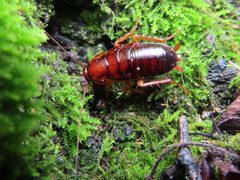
Periplaneta is a of large in the Blattidae, containing several with distributions that have become significant urban pests worldwide. The genus includes well-known species such as Periplaneta americana (American cockroach), Periplaneta lateralis (Turkestan cockroach), and Periplaneta japonica (Asian cockroach). These species are characterized by their relatively large size, flattened bodies, and long . Many Periplaneta species have been spread globally through human commerce and travel, with some showing remarkable adaptability to diverse climates including cold-tolerant species capable of surviving freezing temperatures.
Pronunciation
How to pronounce Periplaneta: //ˌpɛrɪˈplænɪtə//
These audio files are automatically generated. While they are not always 100% accurate, they are a good starting point.
Identification
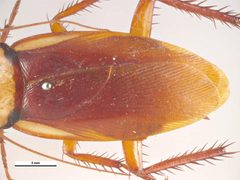
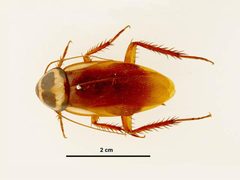
within Periplaneta can be distinguished from other by their larger body size (typically 25-40 mm in ), reddish-brown to dark brown coloration, and well-developed wings in both sexes of most species. The pronotum usually features a pale margin or distinctive pattern. Males typically have longer wings than females, often extending beyond the . Periplaneta species differ from Blattella (which includes smaller species like the German cockroach) and Blatta (which includes the Oriental cockroach with reduced wings in females) by size and wing development. Specific species identification requires examination of coloration patterns, body proportions, and male genitalia.
Images
Habitat
in this occupy diverse ranging from tropical to temperate regions. Most are associated with human structures, thriving in sewers, basements, kitchens, and other moist, warm environments with access to food. Some species, such as Periplaneta lateralis, are primarily outdoor inhabitants found in water meter boxes, compost piles, leaf litter, and cracks in concrete. Periplaneta japonica has been documented surviving outdoors in freezing temperatures and snow, a notable departure from the typically warmth-dependent .
Distribution
distribution due to human-mediated . Native ranges are generally tropical and subtropical regions of Africa, Asia, and the Americas. Periplaneta americana originated in Africa and spread worldwide. Periplaneta lateralis is native to Central Asia and has established in the southwestern United States since 1978. Periplaneta japonica, native to Asia, was first confirmed in the United States in New York City in 2012. GBIF records indicate presence across China and multiple regions of the United States.
Behavior
Individual Periplaneta americana exhibit measurable personality differences in thigmotactic (preference for wall contact versus open spaces), which affects fleeing responses to disturbances. Highly thigmotactic individuals remain closer to walls and show slower reaction times to light stimuli (approximately 27 seconds) compared to low-thigmotaxis individuals (approximately 7 seconds). These behavioral differences may provide evolutionary benefits for collective fleeing responses. Infected individuals of Periplaneta brunnea and P. americana show behavioral alterations when parasitized by the acanthocephalan Moniliformis moniliformis, though specific alterations are not detailed in available sources.
Human Relevance
Several Periplaneta are significant urban pests that contaminate food, spread , and trigger allergic reactions. They are commonly used in entomological education and public outreach, notably in the UC Davis Roach Races held annually since 1992, where American race in modified track systems for public entertainment. The Turkestan cockroach (P. lateralis) is commercially reared and sold as food for insectivorous pets. Some species serve as research organisms for studies on , parasitology, and insect physiology.
Similar Taxa
- BlattaSimilar large body size and general , but Blatta typically show reduced or absent wings in females and different pronotal patterns.
- BlattellaBoth are with pest , but Blattella species are notably smaller (10-15 mm) with different coloration and preferences.
- ShelfordellaTurkestan cockroach was historically classified as Periplaneta lateralis but moved to Shelfordella; show similar size and outdoor preference but differ in genital and female wing reduction.
Sources and further reading
- BugGuide
- Wikipedia
- GBIF taxonomy match
- iNaturalist taxon
- NCBI Taxonomy
- Catalogue of Life
- A New Cockroach in Town? | Bug Squad
- 'R' Is for Roaches at UC Davis Picnic Day | Bug Squad
- Who Introduced the Roach Races to UC Davis? | Bug Squad
- Unwelcome guests in Hawai’i: American cockroach, Periplaneta americana, German cockroach, Blattella germanica, and Western yellowjacket, Vespula pensylvanica — Bug of the Week
- Explorer or Wallflower? Study Shines Light on Cockroach Personalities
- Cold-tolerant Cockroach from Asia has been Found in New York
- A Comparison of Behavioral Alterations in the Brown Cockroach, Periplaneta brunnea, and the American Cockroach, Periplaneta americana, Infected with the Acanthocephalan, Moniliformis moniliformis