
Periplaneta australasiae
(Fabricius, 1775)
Australian cockroach
Periplaneta australasiae, the Australian , is a peridomestic cockroach closely associated with human environments. It is the most common outdoor cockroach in southern Florida and has been introduced to many regions worldwide through human activity. The species typically inhabits outdoor areas but may enter buildings, particularly in warm, humid climates. It is known to compete with the American cockroach (Periplaneta americana) where their ranges overlap, with P. americana generally due to larger size. Males respond to female and show cross-reactivity to from P. americana.
Pronunciation
How to pronounce Periplaneta australasiae: //ˌpɛrɪpləˈniːtə ɔːˌstreɪləˈzeɪiː//
These audio files are automatically generated. While they are not always 100% accurate, they are a good starting point.
Identification
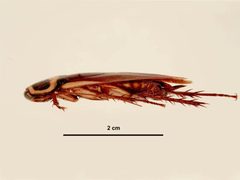
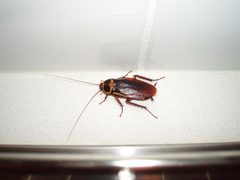
Can be distinguished from the American (Periplaneta americana) by the presence of a distinctive yellow margin on the pronotum, which P. americana lacks. Smaller than P. americana. Females can be distinguished from female oriental cockroaches (Blatta orientalis) by cream-colored markings along the edges behind the and around the short, rounded wings.
Images
Habitat
Primarily peridomestic and outdoor; most common outdoor in southern Florida. Typically stays outdoors in leaf litter, compost, and garden areas but may venture inside buildings, especially in warm, humid conditions. In temperate regions such as Scotland, restricted to heated indoor such as glasshouses and cannot survive outdoors.
Distribution
Native to tropical and subtropical regions; introduced worldwide through human commerce. Established in southern Florida, United States. Recorded in Scotland at Glasgow Botanic Gardens, Edinburgh Botanic Gardens, and other indoor locations. Present in Malaysia, Hawaii, and the Galápagos Islands. Distribution closely tied to human transport and heated indoor environments in temperate zones.
Behavior
Males exhibit sexual in response to female-produced (G-7). Males also respond behaviorally and physiologically to periplanone-A, the sex pheromone of Periplaneta americana, though not to periplanone-B. Shows with P. americana, typically being displaced due to smaller size.
Human Relevance
Considered a peridomestic pest. May enter homes and buildings from outdoor . Serves as for the Evania appendigaster, which lays in . Monitored in pest surveillance programs, including AI-assisted detection systems. Subject of behavioral research on communication.
Similar Taxa
- Periplaneta americanaLarger size; lacks yellow pronotal margin; produces periplanone-A and periplanone-B versus G-7 in P. australasiae; typically in competitive interactions
- Blatta orientalisFemale oriental cockroach resembles female P. australasiae but lacks cream-colored markings behind and on wing edges; different preferences
More Details
Pheromone biology
The G-7 produced by P. australasiae females is chemically similar to periplanone-A from P. americana, explaining cross-attraction between . This has been demonstrated through both behavioral assays and electroantennogram recordings.
AI detection in surveillance
P. australasiae is one of several targeted by emerging computer vision systems for automated pest monitoring. YOLO-based object detection models have been trained to identify this species on sticky traps, though (Blattella germanica) dominated detections in Malaysian food premises surveys.
Sources and further reading
- BugGuide
- GBIF taxonomy match
- A New Cockroach in Town? | Bug Squad
- 'R' Is for Roaches at UC Davis Picnic Day | Bug Squad
- How Artificial Intelligence is Helping Automate Cockroach Surveillance in Cities
- Bug Eric: Wasp Wednesday: Evaniidae
- Unwelcome guests in Hawai’i: American cockroach, Periplaneta americana, German cockroach, Blattella germanica, and Western yellowjacket, Vespula pensylvanica — Bug of the Week
- Explorer or Wallflower? Study Shines Light on Cockroach Personalities
- Australian Cockroach Periplaneta australasiae Fabricius (Insecta: Blattodea: Blattidae)
- Cockroaches (Dictyoptera) of Glasgow Botanic Gardens with a summary of the known distribution of Periplaneta americana (Linnaeus, 1758) and P. australasiae (Fabricius, 1775) in Scotland
- Behavioral and Electroantennogram Responses of Male <i>Periplaneta australasiae</i> to Sex Pheromones of Conspecies and <i>Periplaneta americana</i> コワモンゴキブリ雄の同種-およびワモンゴキブリ-性フェロモンに対する行動反応と触角電図反応