
Evania appendigaster
(Linnaeus, 1758)
blue-eyed ensign wasp
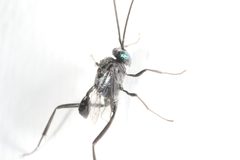
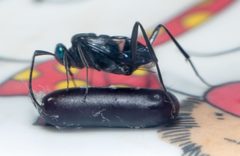
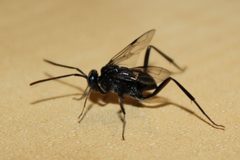
Evania appendigaster is a in the Evaniidae, commonly known as the blue-eyed ensign wasp. It is one of the larger ensign wasps, with forewings reaching about 7 mm and body length up to 11 mm. The is a solitary oothecal parasitoid that attacks the of multiple species. It likely originated in Asia and has become widespread globally, particularly in tropical, subtropical, and temperate urban environments.
Pronunciation
How to pronounce Evania appendigaster: //iːˈveɪniə əˌpɛndɪˈɡæstər//
These audio files are automatically generated. While they are not always 100% accurate, they are a good starting point.
Identification
Distinguished from other ensign wasps by the wide separation between the first and second sections of the . The combination of black body, bright turquoise , and relatively large size for the aids recognition. The shape and flaglike posture are characteristic of Evaniidae but specific coxal separates this from .
Images
Appearance
Body black with contrasting bright turquoise in living specimens. Forewings up to approximately 7 mm; body length up to 11 mm. Abdominal petiole attached high on the body, with the laterally compressed and oval to nearly triangular in shape, held flaglike. Distinguished from other Evaniidae by the wide separation of the first and second sections of the .
Habitat
Strongly associated with urban and domestic environments, particularly indoors in buildings. Occurs in greenhouses and tropical indoor environments. Tied to the presence of ; not typically found in natural outdoor away from human structures.
Distribution
Likely native to Asia; now widespread throughout the tropics and subtropics and in many temperate regions. Recorded from Europe (Hungary), Middle East (Palestine, Saudi Arabia), Pacific (Hawaii, Fiji), Americas (Gulf and Atlantic States, Arizona, California), and West Indies (Jamaica, Guadeloupe). First U.S. record from Washington, DC in 1879. Most common along the Atlantic Seaboard and Gulf Coast of North America.
Seasonality
In Saudi Arabia, emerge in February, May, and October, indicating at least three to four per year. Generation time and periods vary with temperature.
Diet
Larva consumes all within a single . has been observed feeding on honeydew secreted by aphids on plants such as cottonwood, parsley, and fennel.
Host Associations
- Periplaneta americana - of American cockroach
- Periplaneta australasiae - of Australian cockroach
- Periplaneta brunnea - of brown cockroach
- Blatta orientalis - of Oriental cockroach
- Melanozosteria soror - of whitemargined ; previously Cutilia soror
- Neostylopyga rhombifolia - of harlequin cockroach
Life Cycle
Female deposits one per . Larva passes through five instars, distinguished by : first instar with small sharp teeth for opening cockroach eggs; second and third with longer tridentate gauntlet-shaped mandibles; fourth and fifth with thicker bidentate mandibles. Larva consumes all eggs within the ootheca, reaches about 8 mm, then pupates. emerges by cutting a hole in the ootheca. Adult lifespan two to three weeks. At least three to four per year under favorable conditions.
Behavior
Exhibits a start-and-stop gait with characteristic bobbing or waving of the . Female oviposition involves lying on her side with legs braced against the , extending the ovipositor, and penetrating the tough after approximately 30 minutes of effort. Pre-oviposition includes antennal drumming on the ootheca surface and tapping with the ovipositor to locate an appropriate site. Post-oviposition, the female cleans her ovipositor, wings, and .
Ecological Role
agent of . rates of 25–29% have been recorded for Periplaneta americana . Along with Aprostocetus hagenowii, may contribute to suppression of cockroach populations in urban environments. Faster time relative to cockroaches provides population advantage.
Human Relevance
Candidate for biological pest control of ; can be reared in laboratory conditions for release. Not commercially available as of 2010. Presence in buildings often noticed by occupants, leading to identification requests. Competes with Aprostocetus hagenowii for oothecal .
Similar Taxa
- Aprostocetus hagenowiiAlso a of ; competes for same ; tends to have higher rates and up to six per year versus three to four for E. appendigaster
- Other Evaniidae speciesShare flaglike posture, but E. appendigaster distinguished by coxal , larger size, and bright turquoise
More Details
Taxonomic synonymy
Eight previously described Indian have been synonymized under E. appendigaster: E. abrahami, E. agraensis, E. johni, E. nurseana, E. rubrofasciata, E. simlaensis, E. trivandrensis, and E. unipunctata.
Oviposition preference
Females exhibit preference for oothecal ages most vulnerable to , potentially maximizing success.
Temperature dependence
Development and rates are temperature-dependent; laboratory studies have characterized thermal requirements for mass rearing.
Sources and further reading
- BugGuide
- Wikipedia
- GBIF taxonomy match
- iNaturalist taxon
- NCBI Taxonomy
- Catalogue of Life
- Bug Eric: Wasp Wednesday: Evaniidae
- Researchers Find New Wasp Species with Unique Folding Fore Wings
- A Cockroach Egg Parasitoid, Evania appendigaster (Linnaeus) (Hymenoptera: Evaniidae)
- First California Record of the cockroach ootheca parasitoid, Evania appendigaster (Linnaeus, 1758) (Hymenoptera: Evaniidae)
- On the Parasites and Predators of the Cockroach. II.—Evania appendigaster (L.)
- Cockroach Oothecal Parasitoid, Evania appendigaster (Hymenoptera: Evaniidae) Exhibits Oviposition Preference Towards Oothecal Age Most Vulnerable to Host Cannibalism
- Water balance profiles, humidity preference and survival of two sympatric cockroach egg parasitoids Evania appendigaster and Aprostocetus hagenowii (Hymenoptera: Evaniidae; Eulophidae)
- Effects of different temperatures on the life history of Evania appendigaster L. (Hymenoptera: Evaniidae), a solitary oothecal parasitoid of Periplaneta americana L. (Dictyoptera: Blattidae)
- Feasibility of cold-stored Periplaneta americana (Dictyoptera: Blattidae) oothecae for rearing the oothecal parasitoids Aprostocetus hagenowii and Evania appendigaster (Hymenoptera: Eulophidae; Evaniidae): Effect of ootheca age and storage duration
- Présence d’Evania appendigaster (Linné, 1758) en Guadeloupe (Hymenoptera, Evaniidae)
- Review of the Indian Species of Evania (Hymenoptera: Evanioidea: Evaniidae)