
Evaniidae
ensign wasps, nightshade wasps, hatchet wasps, cockroach egg parasitoid wasps
Genus Guides
4- Evania(ensign wasps)
- Evaniella
- Hyptia
- Prosevania
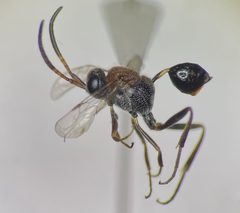
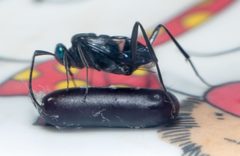
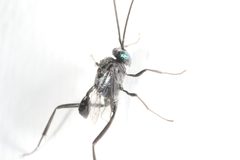
is a of solitary commonly known as ensign wasps, nightshade wasps, or hatchet wasps. The family comprises approximately 20 extant containing over 400 described , with a nearly distribution excluding polar regions. Evaniidae are immediately distinctive among Hymenoptera due to their unique : the metasoma () is attached very high on the propodeum, well above the hind , and is connected by a long, one-segmented, tube-like petiole. The "ensign wasp" derives from the characteristic habit of these wasps to jerk their small, flag-like metasoma up and down while . All known evaniid larvae are specialized parasitoids that develop inside the () of (Blattodea), consuming the .
Pronunciation
How to pronounce Evaniidae: /ɛvəˈnaɪ.i.aɪdiˌi/
These audio files are automatically generated. While they are not always 100% accurate, they are a good starting point.
Identification
The combination of a small metasoma attached high on the propodeum via a long, tubular petiole, a high and heavily sclerotized mesosoma with ridged and pitted surface, and the characteristic "ensign" of bobbing the while distinguishes from all other Hymenoptera. The can be confused with the related Aulacidae and Gasteruptiidae (together forming Evanioidea), but these families differ in details of mesosomal structure and wing venation. Within Evanioidea, Evaniidae are distinguished by their specialized and the associated morphological adaptations.
Images
Appearance
possess a highly distinctive body plan among Hymenoptera. The metasoma is small and attached very high above the hind on the propodeum, connected by a long, one-segmented, tube-like petiole. The metasoma is compressed laterally over most of its length (segments 2–8). The mesosoma is high, short, and heavily sclerotized with a ridged and pitted surface. The is largely immovable, attaching to the mesosoma on a short neck. are usually 13-segmented and do not differ sexually between males and females. The ovipositor is short and thin. Wing venation shows several : deeply separated jugal lobes in fore- and hindwings, loss of cross- on the forewing, and hindwings retaining only medial, cubital, and part of the costal vein with all others lost. Some exhibit unique transverse forewing folding, the first known instance in insects.
Habitat
occupy diverse across their nearly range, from tropical to temperate regions. Many are associated with human-modified environments, particularly where their are abundant. Species such as Evania appendigaster are regularly encountered inside buildings searching for cockroach prey. Others inhabit leaf-litter environments, forest edges, and various natural terrestrial habitats. The is absent from polar regions.
Distribution
have a nearly distribution, occurring on all continents except Antarctica and in most major landmasses except polar regions. The has been documented from tropical and subtropical regions worldwide, with extensions into temperate zones. Two , Evania appendigaster and Prosevania fuscipes, have achieved essentially worldwide distributions through human-mediated associated with their introduced . The fossil record documents Evaniidae from the Late Jurassic to the present, with significant Cretaceous radiation and numerous amber inclusions from the Cretaceous through Miocene.
Diet
have been observed feeding on nectar from flowers and on honeydew secreted by aphids. The larval diet consists exclusively of ; larvae are obligate that develop within cockroach , consuming the eggs.
Host Associations
- Blattodea - All known evaniid larvae are of , developing inside
- Periplaneta americana - of Evania appendigaster
- Periplaneta australasiae - of Evania appendigaster
- Blatta orientalis - of Evania appendigaster
- Blatta - of
- Periplaneta - of
Life Cycle
are solitary with a direct tied to . The female locates a cockroach (ootheca) and inserts her ovipositor to deposit a single , either into a egg or between eggs within the ootheca. The wasp larva hatches quickly and consumes the cockroach eggs, eventually pupating within the ootheca. The wasp chews its way out of the ootheca to emerge. Some females can oviposit into oothecae still carried by the female cockroach, while others attack only dropped, completed oothecae. Wasps appear able to detect previously parasitized oothecae and avoid , either through detection of prior oviposition or through cannibalistic larval competition.
Behavior
exhibit a distinctive "start-and-stop" gait with constant vertical movement of the metasoma, the that gives them their "ensign wasp." When active, the jerk the metasoma up and down in a bobbing motion. are frequently encountered in buildings where are present. Some show host specificity and with particular cockroach lineages, while others are less discriminating and attack of appropriate size regardless of host species. Females search for oothecae by haltingly across substrates, probing cracks and crevices with their .
Ecological Role
function as specialized agents of through their larval stage. While they rarely attain population sizes sufficient for effective biocontrol of pest cockroaches, they contribute to natural suppression of cockroach populations. Their association with cockroaches, which are often more abundant in human settlements, makes them regular inhabitants of anthropogenic environments where many other are absent.
Human Relevance
have potential value as agents for pest , though they are not commercially available for this purpose. Two (Evania appendigaster and Prosevania fuscipes) have become through human-mediated transport. are harmless to humans and are sometimes noticed indoors when searching for cockroach prey. The has been the subject of significant phylogenetic and taxonomic research, with recent studies revising higher-level classification and estimating divergence times.
Similar Taxa
- AulacidaeSuperficially similar due to shared Evanioidea superfamily; distinguished by different associations (wood-boring beetles and wood wasps rather than ), and details of mesosomal structure and wing venation
- GasteruptiidaeSuperficially similar due to shared Evanioidea superfamily; distinguished by different associations (bees and rather than ), and details of mesosomal structure and wing venation
- IchneumonidaeAulacidae (related to ) are often mistaken for ichneumon wasps due to general body form and ovipositor use; distinguished by high abdominal attachment point characteristic of Evanioidea
- CeraphronidaeRelated in the putative clade containing Evanioidea, Megalyroidea, Trigonaloidea, and Ceraphronoidea; distinguished by and
More Details
Evolutionary History
likely originated over 150 million years ago, with the superfamily Evanioidea arising during the Upper Triassic or Lower Jurassic. The stem Evaniidae are estimated to have arisen during the Upper Jurassic, with the crown group originating near the Cretaceous-Paleogene boundary. The underwent significant evolutionary radiation during the Early Cretaceous (134.1–141.1 Mya), with most extant diverging near the K-T boundary. The fossil record is extensive, with about 10 genera and twice as many known from the Late Jurassic through Miocene, including numerous amber inclusions. Some Cretaceous were formerly separated as Cretevaniidae but are now regarded as Evaniidae.
Taxonomic History
Before 1939, served as a 'wastebin ' for any with unusual . The Aulacidae and Gasteruptiidae were subsequently separated from Evaniidae. These three families, together with extinct groups, constitute the superfamily Evanioidea. The Evanioidea appear to be close relatives of Megalyroidea, Trigonaloidea, and particularly Ceraphronoidea, with these four superfamilies potentially forming a clade. Recent phylogenetic studies have resulted in significant taxonomic revisions, with Parevania and Papatuka synonymized under Zeuxevania, and Acanthinevania synonymized under Szepligetella, involving the transfer of 50 .
Unique Morphological Specializations
Some African (Trissevania and Afrevania) exhibit the first known instance of transverse forewing folding in insects, where the forewings fold along a line between the front and back wing margin rather than longitudinally. This may protect wings during development inside the cramped environment of or during activity in leaf-litter environments. The relatively simple wing-folding mechanism has potential applications in bio-inspired technologies, including morphing systems in aerospace vehicle research and expandable structural systems in space missions.
Host Specificity and Coevolution
specificity and with lineages have played significant roles in the evolution of some ensign wasp lineages. However, other are less discriminating and will attack almost any of appropriate size. This variation in host specificity has likely contributed to the evolutionary diversification of the .
Sources and further reading
- BugGuide
- Wikipedia
- GBIF taxonomy match
- iNaturalist taxon
- NCBI Taxonomy
- Catalogue of Life
- Bug Eric: Wasp Wednesday: Evaniidae
- Researchers Find New Wasp Species with Unique Folding Fore Wings
- Bug Eric: Beetle Bonanza
- Coleoptera | Beetles In The Bush | Page 10
- crypsis | Beetles In The Bush
- Bug Eric: Wasp Wednesday: Aulacids
- Multi-gene phylogeny and divergence estimations for Evaniidae (Hymenoptera)
- Review of the Indian Species of Evania (Hymenoptera: Evanioidea: Evaniidae)
- A Cockroach Egg Parasitoid, Evania appendigaster (Linnaeus) (Hymenoptera: Evaniidae)
- An ensign wasp in Late Eocene amber from Ukraine (Hymenoptera: Evaniidae)
- Présence d’Evania appendigaster (Linné, 1758) en Guadeloupe (Hymenoptera, Evaniidae)
- Multi-gene phylogeny and divergence estimations for Evaniidae (Hymenoptera)
- Figure S14: Estimated divergence times for Evaniidae under a normal distribution
- The second species of Sorellevania Engel, 2006 (Evanioidea: Evaniidae) from the mid-Cretaceous Burmese amber
- Figure 3: Simplified chronogram showing estimated divergence times for Evaniidae with six fossil calibrations and maximum clade ages under a lognormal distribution.
- Description of a new species of Zeuxevania Kieffer (Hymenoptera: Evaniidae) from India with a key to species