
Neostylopyga rhombifolia
(Stoll, 1813)
Harlequin Roach, Harlequin Cockroach
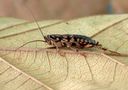
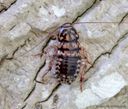
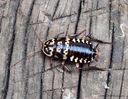
Neostylopyga rhombifolia, commonly known as the harlequin roach, is a flightless in the Blattidae. measure 20–27 mm in length and display distinctive black and yellow coloration. Both sexes lack functional wings: forewings are reduced to small lobes and hindwings are absent. The species has been introduced globally to tropical and subtropical regions through human trade and is considered , frequently inhabiting houses where it is regarded as a pest. Its native range is believed to be tropical Asia, though this remains unconfirmed.
Pronunciation
How to pronounce Neostylopyga rhombifolia: /ˌniː.oʊˌstaɪl.oʊˈpaɪɡə ˌrɒmbɪˈfoʊliə/
These audio files are automatically generated. While they are not always 100% accurate, they are a good starting point.
Identification
Distinguished from other by the combination of complete flightlessness (no hindwings, reduced forewings), small body size (under 30 mm), and bold black and yellow patterning. The reduced wing lobes separate it from fully winged Blattidae and from wingless but differently colored pest such as the oriental cockroach (Blatta orientalis). The harlequin pattern is distinctive among common household roaches.
Images
Appearance
are 20–27 mm long. Both sexes are flightless with forewings reduced to two small lobes (tegmina) and hindwings completely absent. Body exhibits striking black and yellow patterning. Females are typically larger and more robust than males.
Habitat
; occurs in and around human dwellings, particularly houses. Thrives in tropical and subtropical climates. Specific microhabitat preferences within structures are not well documented.
Distribution
Introduced globally throughout tropical and subtropical regions including North America, Oceania, Southern Asia, Middle America, and widespread across Brazil (all states). Original native range unknown but hypothesized to be tropical Asia.
Behavior
Produces a strong-smelling chemical defense, amyl acetate, which has been described as resembling almond, cherry, pear, or banana extracts. This defensive secretion is released when the insect is disturbed.
Human Relevance
Considered a household pest due to its habits. Popular in the pet trade because of its distinctive coloration. Global distribution directly linked to human commerce and trade.
Similar Taxa
- Blatta orientalisAlso flightless with reduced wings, but lacks harlequin coloration (uniform dark brown to black) and is larger (25–33 mm)
- Other BlattidaeMost retain fully developed wings capable of ; none exhibit the distinctive black and yellow patterning of N. rhombifolia
More Details
Mitochondrial genome
The complete mitochondrial was sequenced and published in 2016.
Chemical defense
Amyl acetate production is a documented defensive compound; the specific behavioral context of its deployment has not been detailed in primary literature.