
Parcoblatta americana
(Scudder, 1900)
Western Wood Cockroach
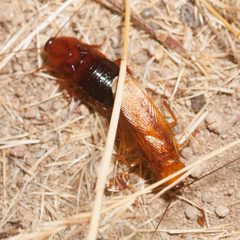
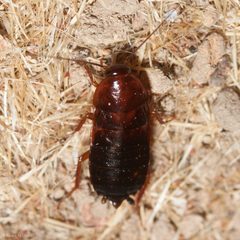
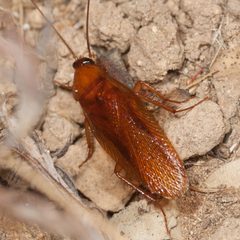
Parcoblatta americana, the western wood , is a native to Mexico and the western United States. The species exhibits significant in wing development: males possess fully developed tegmina and wings, while females have greatly reduced tegmina and lack hind wings entirely. Both sexes display considerable color variation, ranging from dark brown or blackish to pale yellowish or reddish tan in males, and from reddish orange to dark brown or black in females. The species has been documented in association with nests and pack rat houses.
Pronunciation
How to pronounce Parcoblatta americana: /ˌpɑːrkəˈblætə əˌmeɪrɪˈkænə/
These audio files are automatically generated. While they are not always 100% accurate, they are a good starting point.
Identification
Males distinguished from other Parcoblatta by the small quadrate tuft of agglutinated hairs on the back of the abdominal segment (P. zebra has a much broader tuft with further segment specialization; P. virginica has minute scattered hairs over a large area rather than a tuft). Females distinguished from P. bolliana (the only other female Parcoblatta with similarly reduced tegmina and no hind wings) by: less compact body form; spacing noticeably wider than antennal socket spacing; tegmina with visible venation (few traces in P. bolliana); supra-anal plate normally produced with side edges converging to sharply rounded apex (weakly produced with broadly rounded apex in P. bolliana).
Images
Appearance
Medium-sized wood with pronounced . Males: fully developed tegmina and wings; coloration varies from shining dark brown or blackish to pale yellowish to slightly reddish tan; tegmina translucent regardless of body color; ocelli yellowish tan; with small quadrate tuft of agglutinated hairs on back of segment. Females: tegmina reduced to lobe-like lateral pads, no hind wings; coloration ranges from shining reddish orange or brown (slightly darker dorsally on abdomen) to shining dark brown or black with blackish brown underparts; ocelli tannish. Both sexes show significant size and color variation attributed to environmental aridity.
Habitat
Occurs in chaparral, grassland, oak woodland, and coastal sage scrub. Found under rocks, in rotting wood, and in nests. Documented in nests of Veromessor chicoensis harvester ants, where both sexes reside during the day and emerge at night to feed on debris piles. Nymphs recorded from Neotoma pack rat houses. One observation of feeding on apple six feet above ground. males sometimes perch on chaparral plants at night.
Distribution
Mexico and western United States: recorded from Oregon, California, Nevada, and Arizona. Single indoor record from Klickitat County, Washington.
Seasonality
active early to mid summer in California's Santa Monica Mountains. Females and nymphs remain on ground year-round.
Diet
Feeding habits poorly documented; observed feeding on debris around nests and on fallen fruit (apple). Likely detritivorous based on associations.
Host Associations
- Veromessor chicoensis - commensalBoth sexes reside in nests during day, emerge at night to feed on debris pile around nest
- Neotoma - commensalNymphs recorded from pack rat houses in Orange County, California
Life Cycle
with , nymph, and stages. Nymphs found on ground under rocks, in rotting wood, and in nests. Adult males live separately from females and nymphs. Specific duration of developmental stages unknown.
Behavior
males attracted to light. Both sexes exhibit daily movement pattern: reside in nests during day, emerge at night to forage. Adult males perch on vegetation at night. Females and nymphs remain ground-dwelling.
Ecological Role
Decomposer in woodland and scrub . Serves as prey for specialized including Ampulex canaliculata, which paralyzes and provisions wood cockroaches for its larvae.
Human Relevance
Minimal direct interaction; single record of indoor occurrence in Washington. Not considered a household pest. Used as research subject in entomological studies.
Similar Taxa
- Parcoblatta zebraOnly other male Parcoblatta with abdominal tuft of agglutinated hairs; distinguished by broader tuft with further segment specialization versus small quadrate tuft in P. americana
- Parcoblatta virginicaMale has single specialized abdominal area but with minute scattered hairs over large area rather than agglutinated tuft
- Parcoblatta bollianaOnly other female Parcoblatta with greatly reduced tegmina and no hind wings; distinguished by compact form, spacing, tegminal venation, and supra-anal plate shape
More Details
Color variation
Significant size and color variation in both sexes attributed to environmental conditions, particularly aridity effects
Historical description
Original 1917 description by Morgan Hebard based on 14 male and 7 female specimens
Sources and further reading
- BugGuide
- Wikipedia
- GBIF taxonomy match
- iNaturalist taxon
- NCBI Taxonomy
- A New Cockroach in Town? | Bug Squad
- Who Introduced the Roach Races to UC Davis? | Bug Squad
- 'R' Is for Roaches at UC Davis Picnic Day | Bug Squad
- Bug Eric: Wasp Wednesday: Ampulex canaliculata
- Deerly departed: food for flesh-recycling carrion beetles - Margined carrion beetle, Oiceoptoma noveboracense, and American carrion beetle, Necrophila americana — Bug of the Week
- Unwelcome guests in Hawai’i: American cockroach, Periplaneta americana, German cockroach, Blattella germanica, and Western yellowjacket, Vespula pensylvanica — Bug of the Week