
Veromessor
Forel, 1917
Veromessor Harvester Ants
Species Guides
3- Veromessor andrei(Andre's Harvester Ant)
- Veromessor lariversi(Ira La Rivers' Harvester Ant)
- Veromessor pergandei(black harvester ant)
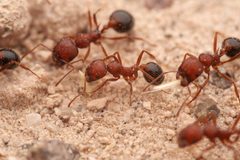
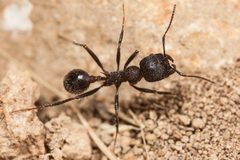
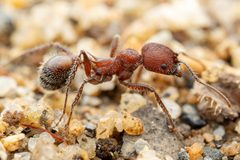
Veromessor is a of North American harvester ants comprising ten , all to western and central North America. The genus was revived from synonymy with Messor by Ward et al. (2015). These ants exhibit striking ecological and morphological diversity despite the small number of species, including variation in colony size, foraging strategies, mating , and colony founding modes. They serve as important ecological models, with some species studied extensively for their navigation systems and social .
Pronunciation
How to pronounce Veromessor: //ˌvɛroʊˈmɛsɔr//
These audio files are automatically generated. While they are not always 100% accurate, they are a good starting point.
Identification
Veromessor can be distinguished from the related Messor by morphological characters established in the 2015 taxonomic revision. Key diagnostic traits among species include variation in psammophore development (a structure of long hairs on the used for carrying sand grains), propodeal spine length, size and structure, and degree of . Worker body size varies considerably across species. Species-level identification requires examination of workers, queens, and males, with keys available in Johnson et al. (2022).
Images
Habitat
Arid and semi-arid regions of western North America, including creosote bush scrub, chaparral, and desert grasslands. Greatest occurs in California. Specific associations vary by : some occupy sandy soils at low elevations, others range into higher elevations. The spans environments from the hottest, most arid portions of North America to more mesic western areas.
Distribution
to western and central North America. Range extends from the Baja California peninsula and American Southwest northward, with Veromessor lobognathus reaching as far northeast as North Dakota. distributions are concentrated in California, Arizona, Nevada, and adjacent regions, with some species showing narrow endemic ranges.
Seasonality
occur primarily in summer for most . Exceptions include V. julianus and V. pergandei, which fly from late winter to early spring (mid-February to late March). Foraging activity generally tracks temperature and moisture availability in desert environments.
Diet
Strict granivores. collect and consume seeds from a wide range of plant , with preferences varying among species and affecting plant composition. Some species prefer seeds of weedy plants over crop species.
Life Cycle
Colony founding varies by and geography: single queens (haplometrosis) in some areas, multiple unrelated queens (pleometrosis) in others. Pleometrosis in V. pergandei enhances production and colony survival under harsh, desiccating conditions. Mating occurs during , with non- mating 30-50 m above ground in V. pergandei. Colony sizes range from fewer than 1,000 workers in most species to over 50,000 in V. andrei, V. julianus, and V. pergandei. Colonies are long-lived, persisting 10-20+ years.
Behavior
Foraging strategies include solitary foraging and column foraging (group foraging with ). V. pergandei uses polarized light for navigation and exhibits sophisticated trail-following with switching and backtracking when displaced. Some produce defensive secretions including benzaldehyde. Nest relocation occurs in some species. Nest disks are cleared of vegetation, with rims becoming nutrient-enriched microhabitats.
Ecological Role
in desert . Seed harvesting influences plant distribution and abundance, affecting desert plant . Nest disks and rims create 'islands of ' that enhance vegetation recovery after disturbances such as fire, grazing, and drought. Nests diverse communities of associated organisms including mites, beetles, springtails, and soil biota. Serve as important prey for horned lizards, birds, and other . Some species are hosts for anteater scarab beetles (Cremastocheilus).
Human Relevance
Historically perceived as pests of rangelands due to nest disk clearing, but now recognized as beneficial. Enhance soil nutrients and facilitate vegetation recovery. May take seeds used in ecological restoration, but generally prefer weedy over crops. Some species possess stings; stings are painful but rarely dangerous except to allergic individuals. Stings are easily avoided as these ants do not fly toward humans and rarely enter buildings.
Similar Taxa
- MessorPreviously considered congeneric; distinguished by morphological characters clarified in 2015 revision. Both are Old World and New World respectively, with Veromessor to North America.
- PogonomyrmexShares seed-harvesting and desert ; often co-occurs and collectively termed 'harvester ants.' Pogonomyrmex generally possess more powerful stings and often have more conspicuous nest mounds. Veromessor exhibits greater variation in colony founding strategy and foraging mode.
Misconceptions
Long perceived as pests that reduce range productivity through nest clearing. Research has demonstrated that nest rim vegetation more than compensates for cleared disk area, and that nests serve as refugia for plant recovery after disturbance. The 'pest' perception persists despite evidence of net positive effects.
More Details
Taxonomic History
Originally described by Forel in 1917, treated as a synonym of Messor for nearly a century, then revived as a valid by Ward et al. (2015) based on molecular and morphological evidence. Johnson et al. (2022) provided comprehensive revision recognizing ten , with one new species (V. pseudolariversi) described and two synonymies proposed.
Evolutionary Biology
Phylogenomic analysis (Borowiec et al. 2025) reveals that key ecological and morphological traits have evolved rapidly and repeatedly in response to conditions, with stronger correlation to than to phylogenetic ancestry. This complicates phylogenetic inference and explains ecological diversity despite low .
Research Significance
V. pergandei and other have served as model organisms for studying navigation, social , and ecological . Research on this has contributed to understanding of path integration, celestial compass use, trail following, and the evolution of cooperative colony founding.
Sources and further reading
- BugGuide
- Wikipedia
- GBIF taxonomy match
- iNaturalist taxon
- NCBI Taxonomy
- Catalogue of Life
- Veromessor Archives - Entomology Today
- Harvester Ant Nest Rims Boost Native, Nonnative Plants Alike
- Heroes, Not Headaches: Reframing the Reputation of Harvester Ants
- Bug Eric: Anteater Scarab Beetles
- The Painful but Fascinating Stings of Harvester Ants
- Pogonomyrmex occidentalis - Entomology Today
- Role of the pheromone for orientation in the group foraging ant, Veromessor pergandei
- Desiccation limits recruitment in the pleometrotic desert seed‐harvester ant Veromessor pergandei
- A taxonomic revision and a review of the biology of the North American seed-harvester ant genus Veromessor (Hymenoptera: Formicidae: Myrmicinae)
- Erratum: A taxonomic revision and a review of the biology of the North American seed-harvester ant genus Veromessor (Hymenoptera: Formicidae: Myrmicinae) Zootaxa 5206 (1): 1–115.
- Evolution of the North American seed‐harvester ant genus Veromessor (Hymenoptera: Formicidae)
- Notes on hunting behavior of the spiderEuryopis californicaBanks, 1904 (Araneae: Theridiidae), a novel predator ofVeromessor pergandei(Mayr, 1886) harvester ants (Hymenoptera: Formicidae)