
Cremastocheilus
Knoch, 1801
Anteater Scarabs
Species Guides
27- Cremastocheilus angularis(anteater scarab beetle)
- Cremastocheilus armatus(anteater scarab beetle)
- Cremastocheilus beameri
- Cremastocheilus canaliculatus(anteater scarab beetle)
- Cremastocheilus castaneae(anteater scarab beetle)
- Cremastocheilus constricticollis
- Cremastocheilus crinitus(anteater scarab beetle)
- Cremastocheilus depressus(Anteater scarab beetle)
- Cremastocheilus harrisii(Eastern Ant-loving Scarab)
A of myrmecophilous scarab beetles containing approximately 35-40 described in North America. are specialized of larvae and pupae, living within ant colonies. The genus exhibits remarkable morphological and behavioral adaptations for integration with aggressive host ants, including death-feigning to gain nest entry and chemical mimicry to avoid detection.
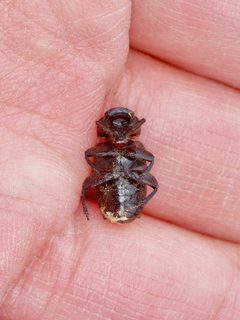
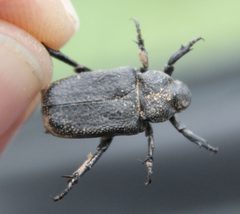
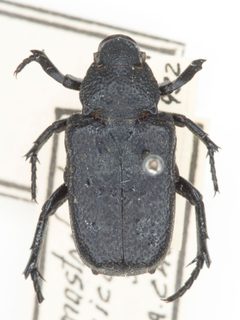
Pronunciation
How to pronounce Cremastocheilus: /krɛˌmæstoʊˈkaɪləs/
These audio files are automatically generated. While they are not always 100% accurate, they are a good starting point.
Identification
Small, flattened beetles approximately 10 mm in length with dull black coloration. Body strongly angular with exceedingly dense, heavily armored bearing pits or wrinkles. normally concealed in grooves beneath the . Hind angle of pronotum bears distinctive trichomes—brushes of glandular hairs of unknown function. enlarged and shield-like, covering modified adapted into piercing structures for feeding on .
Images
Habitat
Found within nests of , particularly mound-building Formica (thatching ants). Also associated with honeypot ants (Myrmecocystus), cornfield ants (Lasius), carpenter ants (Camponotus), harvester ants (Pogonomyrmex, Veromessor), and spine-waisted ants (Aphaenogaster). Greatest diversity in desert southwest, but occurs across North America.
Distribution
Nearctic region; North America north of Mexico. Records from Vermont and throughout United States.
Seasonality
disperse to find new in spring. New adults emerge from pupal in late summer or fall, integrate into nest centers during winter dormancy, and begin feeding on ant larvae the following spring.
Diet
feed as on larvae and pupae of ants. modified into piercing structures to penetrate soft of ; reduced, functioning only to transport liquefied food. Larvae feed on decaying vegetation composted by ants within nest periphery.
Host Associations
- Formica - primary mound-building thatching ants
- Myrmecocystus - honeypot ants
- Lasius - cornfield ants
- Camponotus - carpenter ants
- Pogonomyrmex - harvester ants; southwestern US
- Veromessor - harvester ants; southwestern US
- Aphaenogaster - spine-waisted ants; southwestern US
Life Cycle
Females lay singly in soil around nest periphery. Larvae pass through three instars, feeding on decaying vegetation, capable of defensive striking with jaws and secreting repulsive liquids from mandibular and anal glands. occurs in oval chambers constructed from soil particles. Complete cycle from egg to requires approximately four months. Newly emerged adults migrate to nest center, accumulating colony scent for chemical camouflage.
Behavior
Employs death-feigning () to gain nest entry: remains motionless with legs outstretched in areas trafficked by scouting ants, which carry the apparently dead into the nest. fast-moving fliers that crash-land near foraging areas. Chemical mimicry of colony odor facilitates integration and reduces aggression.
Ecological Role
Myrmecophilous ; within colonies. densities can reach 20-30 individuals per excavated nest, with some nests hosting up to 200 beetles or larvae.
Similar Taxa
- other Scarabaeidaedistinguished by extreme body flattening, antennal grooves, pronotal trichomes, and myrmecophilous lifestyle
- other myrmecophilous beetlesseparated by combination of death-feigning entry , piercing-sucking mouthpart modifications for on , and specific associations with mound-building ants