
Myrmecocystus
Wesmael, 1838
North American Honeypot Ants, Honeypot Ants
Species Guides
8- Myrmecocystus kennedyi(Kennedyi-group Honeypot Ants)
- Myrmecocystus mendax(honey ant)
- Myrmecocystus mexicanus(Mexican Honeypot Ant)
- Myrmecocystus mimicus(Mimicus Honeypot Ant)
- Myrmecocystus placodops
- Myrmecocystus semirufus
- Myrmecocystus testaceus(Brick Honeypot Ant)
- Myrmecocystus wheeleri(Wheeler's Honeypot Ant)
Myrmecocystus is a North American of Formicinae ants comprising approximately 30 described across three subgenera (Myrmecocystus, Endiodioctes, and Eremnocystus). The genus is one of five globally that exhibits the honeypot ant , in which specialized called store large quantities of liquid food in their distended . These living food reserves sustain colonies during periods of resource scarcity. Molecular phylogenetic studies indicate that none of the three subgenera are monophyletic, suggesting repeated of key morphological and behavioral traits.
Pronunciation
How to pronounce Myrmecocystus: /mɪrmɛkoʊˈsɪstəs/
These audio files are automatically generated. While they are not always 100% accurate, they are a good starting point.
Identification
Distinguished from other North American Formicinae by the presence of with massively distended, liquid-filled gasters. Can be separated from other honeypot ant (Melophorus, Camponotus inflatus group, etc.) by geographic restriction to North America and specific nest architecture. Some engage in conspicuous territorial tournaments at nest boundaries. Subgeneric distinctions based on worker and geographic distribution are not phylogenetically reliable. Species identification requires examination of worker pilosity, propodeal shape, and male genitalia.
Images
Appearance
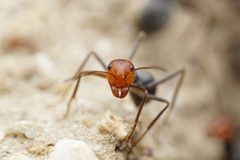
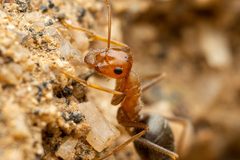
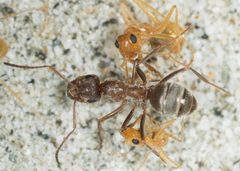
are polymorphic with distinct size classes including minor workers and specialized . Repletes possess enormously distended, translucent gasters capable of expanding to the size of a grape, containing stored liquid . General worker includes a single petiolar node, acidopore at the tip (typical of Formicinae), and 12-segmented with a distinct club. Body coloration varies by from pale yellow to reddish-brown to black. Size ranges from small minors (3-4 mm) to large repletes (10-15 mm when engorged).
Habitat
Primarily arid and semi-arid environments including desert scrub, grasslands, and sagebrush steppe. Nests are constructed in sandy to loamy soils, often with a characteristic crater-like entrance surrounded by excavated soil. Found from sea level to montane elevations. Some occupy desertified grasslands with historical disturbance. Nest structure typically includes vertical shafts leading to chambers where are sequestered.
Distribution
to North America. Range extends from southwestern Canada through the western United States to Mexico. Greatest diversity in the desert southwest (Arizona, New Mexico, Texas, southern California) and adjacent Mexican states. Eastern limits in the Great Plains; northern limits in southern Canada.
Seasonality
Activity strongly tied to seasonal rainfall patterns. Foraging occurs primarily during summer monsoon period (July-September in southwestern US). and foraging predominates during hot periods; some shift to activity in cooler conditions. production and mating synchronized with summer rainfall. Colony founding occurs post-rainfall in summer. Winter in colder portions of range.
Diet
Liquid constitute primary food source: honeydew from homopterans (aphids, scale insects, treehoppers) and floral nectar. Also predatory on small arthropods and scavenging. store dissolved sugars in crops for months without spoilage, facilitated by -specific gut microbiomes dominated by lactic acid bacteria (Fructilactobacillus), acetic acid bacteria, or halophiles depending on species.
Life Cycle
Colony founding occurs in summer following rainfall, typically by single queens (pleometrosis observed in some ). Colonies are long-lived with queens surviving multiple years. Development includes , larva, pupa, and stages; larvae fed liquid food via . are produced from and become permanently food storage vessels. Colony sizes range from hundreds to thousands of workers. Some exhibit intraspecific variation in colony founding (haplometrosis vs. pleometrosis).
Behavior
hang from chamber ceilings, regurgitating stored food to nestmates via when solicited. Foraging navigate using path integration and visual landmarks. Some engage in highly territorial tournaments at nest boundaries, involving ritualized combat that can escalate to intraspecific slavery with raids carrying off larvae, workers, and repletes. Foraging time shows evolutionary lability: transitions between and foraging pass through intermediates. Defensive includes chemical defense via acidopore secretion.
Ecological Role
Significant consumers of liquid in arid , linking (via honeydew and nectar) to higher . Important prey for specialized including horned lizards (Phrynosoma). Soil excavation influences soil structure and aeration. Competitive interactions with other , particularly harvester ants (Pogonomyrmex), structure ant composition. Potential mutualists with homopterans and flowering plants.
Human Relevance
Subject of extensive behavioral and ecological research due to remarkable food storage specialization. Featured in nature documentaries (BBC Natural World: Empire of the Desert Ants). Serve as model organisms for studying evolution, social organization, and microbial . No significant agricultural or medical importance; colonies can be nuisances near human habitation but are not structurally damaging.
Similar Taxa
- MelophorusAustralian honeypot ants with convergent ; distinguished by geographic separation and lack of close phylogenetic relationship
- Camponotus (inflatus group)Australian honeypot ants with ; larger body size, different nest architecture, and geographic restriction to Australia
- Prenolepis imparisNorth American with corpulent storing fat (not liquid); workers are winter-active, not summer-active
- FormicaSome have -like ; lack the extreme distension and liquid storage specialization of Myrmecocystus
More Details
Gut Microbiome
-specific gut microbiomes dominated by lactic acid bacteria, acetic acid bacteria, or halophiles. crops of M. mexicanus and M. depilis enriched in Fructilactobacillus; M. flaviceps and M. wheeleri harbor more halophiles. Microbial composition varies by species, colony, , and organ (crop vs. ).
Phylogenetic History
Nine-locus indicates all three subgenera (Myrmecocystus, Endiodioctes, Eremnocystus) are polyphyletic, with repeated evolution of foraging time, body size, and other traits. estimated to have arisen in the Miocene.
Subgenera
Three subgenera recognized based on : Myrmecocystus (7 ), Endiodioctes (16 species), and Eremnocystus (9 species). These do not reflect evolutionary history but remain in use for species organization.
Sources and further reading
- BugGuide
- Wikipedia
- GBIF taxonomy match
- iNaturalist taxon
- NCBI Taxonomy
- Catalogue of Life
- Bug Eric: Anteater Scarab Beetles
- Formicidae | Blog
- Myrmecocystus honeypot ants have species specific resident gut microbiome
- Using Trees: Myrmecocystus Phylogeny and Character Evolution and New Methods for Investigating Trait Evolution and Species Delimitation (PhD Dissertation)
- Aspects of the Ecology of Three Species of Ants (Myrmecocystus spp., Aphaenogaster sp.) in Desertified Grassland in Southeastern Arizona, 1958- 1993
- Honey Ants (Genus Myrmecocystus ) Macroecology: Effect of Spatial Patterns on the Relationship Between Worker Body Size and Geographic Range Size
- Behavioral Responses of a Predator, the Round-Tailed Horned Lizard, Phrynosoma modestum and Its Prey, Honey Pot Ants, Myrmecocystus spp.
- Correction to: Intraspecific variation in colony founding behavior and social organization in the honey ant Myrmecocystus mendax
- Distribution of <I>Myrmecocystus mexicanus</I> (Hymenoptera: Formicidae): Association with <I>Pogonomyrmex occidentalis</I> (Hymenoptera: Formicidae)
- Intraspecific variation in colony founding behavior and social organization in the honey ant Myrmecocystus mendax