
Veromessor andrei
(Mayr, 1886)
Andre's Harvester Ant
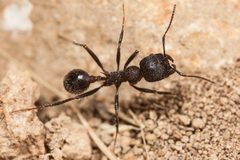
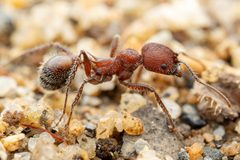
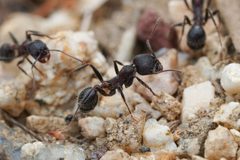
Veromessor andrei is a North American seed- to western North America. Formerly classified in the Messor, it was reclassified to Veromessor based on phylogenetic studies. The exhibits color , with varying in coloration. Like other Veromessor species, it is a granivorous that harvests and stores seeds, playing a significant ecological role as a in arid and semi-arid . The species has been the subject of behavioral and ecological research, though less extensively studied than V. pergandei.
Pronunciation
How to pronounce Veromessor andrei: /vɛrəˈmɛsɔr ˈændreɪ/
These audio files are automatically generated. While they are not always 100% accurate, they are a good starting point.
Images
Habitat
Arid and semi-arid regions of western North America, including rangelands and grasslands. Constructs nest disks—large circular areas cleared of vegetation above underground nests. Nest rims often support enhanced vegetation growth compared to surrounding areas.
Distribution
Native to California, Oregon, and Baja California. Possibly occurs in Nevada, Arizona, and Colorado.
Diet
Granivorous—harvests and consumes seeds from a variety of plants. Also known to be opportunistically predatory and scavenging on arthropods.
Behavior
Forages for seeds, which are transported back to the nest and stored. are and active during warm periods. Colony activities include nest maintenance and seed processing.
Ecological Role
Acts as a in its . Nest disks create 'islands of ' where vegetation thrives along nest rims, enhancing plant diversity and providing refugia during disturbances such as drought and grazing. Serves as prey for various including horned lizards and birds. Contributes to soil nutrient cycling through deposition of detritus in nest soils.
Human Relevance
Generally beneficial rather than detrimental to . Perceived historically as a pest of rangelands due to nest clearing, but research demonstrates net positive effects on vegetation productivity. May occasionally take seeds from ecological restoration plantings, which can be mitigated through seed selection and timing.
Similar Taxa
- Veromessor pergandeiFormerly congeneric (both Messor); similar seed-harvesting and , but differs in colony founding strategy and geographic distribution
- Pogonomyrmex californicusSympatric with similar ecological role; distinguished by -level morphological differences including structure and sting presence
- Messor species (Old World)Formerly classified together; Veromessor is now recognized as a distinct New World based on phylogenetic evidence
Sources and further reading
- BugGuide
- Wikipedia
- GBIF taxonomy match
- iNaturalist taxon
- NCBI Taxonomy
- Catalogue of Life
- Devastating Grasshopper
- Meloidae Holdings | Entomology Research Museum
- Harvester Ant Nest Rims Boost Native, Nonnative Plants Alike
- RNAi Insecticide Offers Promise for Managing Colorado Potato Beetle
- Heroes, Not Headaches: Reframing the Reputation of Harvester Ants
- Bug Eric: Anteater Scarab Beetles
- A taxonomic revision and a review of the biology of the North American seed-harvester ant genus Veromessor (Hymenoptera: Formicidae: Myrmicinae)
- Evolution of the North American seed‐harvester ant genus Veromessor (Hymenoptera: Formicidae)