
Veromessor pergandei
(Mayr, 1886)
black harvester ant, desert harvester ant
Veromessor pergandei is a desert seed- native to the southwestern United States and Baja California, Mexico. The exhibits geographic variation in colony founding : single queens (haplometrosis) in wetter western regions versus cooperative founding by multiple unrelated queens (pleometrosis) in drier eastern areas. Mature colonies contain over 35,000 and construct conspicuous nest disks with vegetation-cleared centers and fertile rims. The species plays significant ecological roles as a seed disperser, soil engineer, and prey species.
Pronunciation
How to pronounce Veromessor pergandei: /ˌvɛroʊˈmɛsɔr pərˈɡændeɪ/
These audio files are automatically generated. While they are not always 100% accurate, they are a good starting point.
Identification
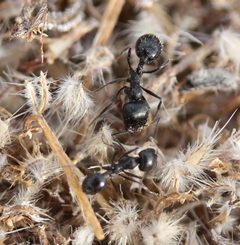
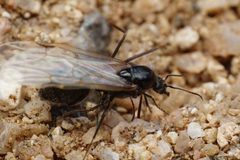
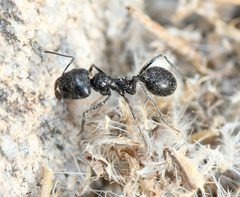
Distinguished from similar harvester ants by its geographic range in the Sonoran, Colorado, and Mojave Deserts. have a of approximately equal length and width with very large , short white or yellow hair, and a large . Males measure approximately 8.5 mm; females approximately 10 mm, though size varies with food availability and competition. Previously classified under Messor, separated based on 2015 molecular study.
Images
Habitat
Sonoran, Colorado, and Mojave Deserts; typically sandy soils below 900 m elevation in creosote bush (Larrea tridentata)—triangle leaf bursage (Ambrosia deltoidea) associations with scattered ironwood and foothill palo verde. Requires open areas lacking vegetation for nest initiation.
Distribution
Southwestern United States (southeastern California, Arizona, southern Nevada) and Baja California peninsula, Mexico. Western range portions (southern California) exhibit haplometrosis; eastern and northwestern portions (central/western Arizona, southeastern California, southern Nevada) exhibit pleometrosis; narrow transition zone in southeastern California.
Seasonality
Mating occur mid-February to late March; foraging activity year-round in suitable conditions; recruitment to new colonies occurs only in years with sufficient rainfall.
Diet
Seed-harvester; collects and consumes seeds, particularly those of shrubs including Larrea tridentata (creosote bush) and Ambrosia dumosa (burrobush). Opportunistic and scavenging of arthropods has been observed in related harvester ants but not specifically documented for this .
Life Cycle
Mating occur mid-February to late March with non- mating 30-50 m above ground. Colony founding by single or multiple queens depending on geographic location; first emerge after approximately 92 days under laboratory conditions. In eastern pleometrotic areas, queens reduce to after worker ; multiple queens persist in northwestern areas. Colony growth phase begins after founding; sexual production likely after 3-4 years; colony lifespan estimated at 10-20+ years. Recruitment in central Arizona documented in only 4 of 20 years, requiring both early (January-March) and late (April-June) rainfall to exceed long-term means.
Behavior
Group foraging with trails extending over 35 m from nest; uses for orientation integrated with path integration and celestial compass navigation. Pleometrotic queens cooperate to produce first with production as linear function of number; additional queens never accepted after first workers emerge. Founding queens accumulate in nests during mating season. Foragers demonstrate ability to counter rotational perturbations of approximately 40°/s during orientation.
Ecological Role
in desert ; mature colonies contain over 35,000 foragers with conspicuous foraging trails. Nest disks create "islands of " with vegetation-cleared centers and nutrient-enhanced rims that serve as refugia for plants during drought and grazing disturbance, facilitating vegetation recovery. Nests diverse associated organisms including mites, beetles, and soil biota. Prey for specialized including the spider Euryopis californica and potentially horned lizards (based on related associations).
Human Relevance
Named after American myrmecologist Theodore Pergande. Occasionally referred to as pest of rangelands due to nest disk vegetation clearing, though this perception is not supported by ecological research; nest rim vegetation typically exceeds cleared area. May take seeds used in ecological restoration, potentially hampering broadcast seeding efforts. Sting not specifically documented but related Veromessor lack the powerful stings of Pogonomyrmex harvester ants.
Similar Taxa
- Pogonomyrmex californicusOverlapping range in California deserts; distinguished by more powerful sting, different nest architecture, and taxonomic separation in tribe Pogonomyrmecini versus Stenammini
- Messor speciesFormerly classified together; separated based on 2015 molecular phylogenetic study; Messor primarily Old World distribution
- Veromessor andreiCongeneric with similar ; distinguished by geographic range and subtle morphological differences
Sources and further reading
- BugGuide
- Wikipedia
- GBIF taxonomy match
- iNaturalist taxon
- NCBI Taxonomy
- Catalogue of Life
- Veromessor Archives - Entomology Today
- Harvester Ant Nest Rims Boost Native, Nonnative Plants Alike
- Bug Eric: OrThoptera Thursday: Eastern Ant Cricket
- Heroes, Not Headaches: Reframing the Reputation of Harvester Ants
- Bug Eric: Anteater Scarab Beetles
- The Painful but Fascinating Stings of Harvester Ants
- Role of the pheromone for orientation in the group foraging ant, Veromessor pergandei
- Desiccation limits recruitment in the pleometrotic desert seed‐harvester ant Veromessor pergandei
- Notes on hunting behavior of the spiderEuryopis californicaBanks, 1904 (Araneae: Theridiidae), a novel predator ofVeromessor pergandei(Mayr, 1886) harvester ants (Hymenoptera: Formicidae)