
Pogonomyrmex californicus
(Buckley, 1867)
California harvester ant
Species Guides
1Pogonomyrmex californicus is a seed-harvesting native to southwestern North America. It is the most widely distributed in the Pogonomyrmex. The species exhibits a striking social : most have single- colonies (), but some California populations show primary where multiple unrelated queens cooperate in colony founding and coexist in mature colonies. It possesses a powerful sting and has been used historically by peoples for ritual and medicinal purposes. The species is a prominent model for studying the evolution of social , cooperation, and epigenetic regulation of aggression.
Pronunciation
How to pronounce Pogonomyrmex californicus: //ˌpoʊɡənoʊˈmɜːrmɛks ˌkælɪˈfɔːrnɪkəs//
These audio files are automatically generated. While they are not always 100% accurate, they are a good starting point.
Identification
Distinguished from other Pogonomyrmex by its combination of size, coloration, and geographic range. Most reliably identified by the structure of the psammophore (seed-carrying basket) on the surface of the , though microscopic examination may be required. In the field, the circular or semi-circular arrangement of loose sand around nest entrances is characteristic. Differs from P. rugosus in having higher mass-specific metabolic rates and from P. occidentalis in geographic distribution and nest architecture.
Images
Appearance
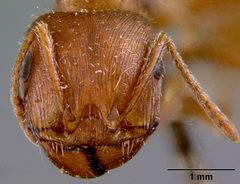
Medium to large-sized with typically 5-7 mm in length. Coloration ranges from reddish-brown to black. is relatively large with strong adapted for seed processing. The is often darker than the mesosoma. Queens are larger and possess wings during the mating phase. Males are smaller with more slender bodies. The sting apparatus is well-developed and functional in workers.
Habitat
Open, warm, sandy areas in arid and semiarid regions. Occupies desert scrub, grasslands, and open woodlands. Tolerates extreme conditions including Death Valley and Anza-Borrego Desert. Nest sites are typically in well-drained sandy or loamy soils with sparse vegetation cover. Colonies are often established in areas with abundant seed-producing plants.
Distribution
Southwestern United States (Arizona, California, Nevada, New Mexico, Texas, Utah) and northern Mexico (Baja California, Chihuahua, Sinaloa, Sonora). The most widely distributed Pogonomyrmex in North America. showing primary are restricted to specific locations in California.
Seasonality
Reproductive activity occurs primarily May to July, with during hot daytime conditions of 80-90°F with elevated afternoon humidity. In some parts of the range, nuptial flights may extend from April to August depending on weather conditions. Foraging occurs throughout the day, with activity patterns influenced by temperature.
Diet
with strong emphasis on seed harvesting. Collects seeds from diverse plant ; known to harvest seeds of Erodium cicutarium and other desert annuals. Preys on arthropods including larvae of the raisin moth (Cadra figulilella). Opportunistically scavenges other animal matter. Seeds are stored in underground granaries.
Life Cycle
Colony founding occurs after , typically via haplometrosis (single ) but pleometrosis (cooperative founding by multiple queens) in some . Queens excavate founding chambers and rear the first of . Colony growth leads to mature colonies of approximately 4,500 individuals on average, with some reaching thousands. Workers exhibit age-associated division of labor: young workers perform in-nest tasks, older workers forage.
Behavior
forager that works individually or in columns. Morning patrollers assess foraging areas before recruitment of foragers begins. Foragers return successfully approximately 90% of the time. Exhibits pronounced territorial : 81% of intercolonial encounters involve aggression, with 7% fatal to one or both participants. Nest entrances are irregular and surrounded by characteristic loose sand arranged in circular or semi-circular patterns. display low agility and remain near nests, making stings avoidable with caution.
Ecological Role
in desert . Seed harvesting influences plant composition and distribution; acts as seed agent for myrmecochorous plants. Nest construction creates 'islands of ' where cleared central disks are surrounded by nutrient-enriched rims that serve as vegetation refugia during disturbances and recovery points after fire, grazing, or drought. Nests support diverse commensal organisms including mites, beetles, silverfish, and springtails. Serves as critical food source for including horned lizards and sage grouse.
Human Relevance
Used commercially in Uncle Milton's Farms as an educational display . Stings are medically significant: painful and long-lasting (rated 3 on Schmidt Sting Pain Index), with venom containing that alter mammalian sodium ion channels. Historically used by Chumash and other peoples of California for ritual initiation and medicinal purposes, including inducing hallucinogenic states through consumption of live ants. Occasionally perceived as agricultural pest, though research shows preference for weed seeds over crop species. May interfere with ecological restoration seeding efforts.
Similar Taxa
- Pogonomyrmex rugosusSympatric in Mojave Desert; similar size and coloration. Differs in lower mass-specific metabolic rate and slightly lower critical thermal maximum. typically earlier in season.
- Pogonomyrmex occidentalisOverlapping range; distinguished by geographic distribution, nest architecture, and subtle morphological differences in psammophore structure. More northerly and montane in distribution.
- Veromessor spp.Sympatric seed-harvesting ants; distinguished by smaller size, different nest structure, and less potent sting. Formerly classified in Messor.
Misconceptions
Historically perceived as pest to range productivity due to vegetation clearing around nests; research demonstrates nest rims support enhanced vegetation growth and serve as recovery points after disturbance, making colonies net beneficial. Sting danger often exaggerated; ants are non-aggressive unless handled and do not enter structures. Threat to crops largely unfounded; prefer weed seeds over crop .
More Details
Social Polymorphism
The exhibits remarkable intraspecific variation in social organization. Most are monogynous (single per colony), but primary has evolved in at least one California population where 2-9 unrelated queens may cooperate in founding and persist in mature colonies. This is maintained by : aggressive queens have survival advantage within nests but cooperative groups have higher between-group .
Epigenetic Regulation
Demonstrates methylation patterns associated with differentiation and behavioral plasticity. Gene body methylation correlates with expression in queens. Experimental demethylation using 5-aza-dC suppresses aggression in founding queens, implicating epigenetic mechanisms in social organization.
Thermal Physiology
Critical thermal maximum of 51.74°C (loss of muscular coordination) and 51.78°C (loss of spiracular control), among the highest recorded for ants. Mass-specific CO2 emission rates twice those of sympatric P. rugosus, reflecting higher metabolic activity.
Genomic Resources
High-quality assembly of 241 Mb with 17,889 annotated genes (15,688 protein-coding). BUSCO completeness at 95%. Serves as model for studying genomic basis of social , aggression regulation, and arid .
Sources and further reading
- BugGuide
- Wikipedia
- GBIF taxonomy match
- iNaturalist taxon
- NCBI Taxonomy
- Catalogue of Life
- Encyrtid Holdings | Entomology Research Museum
- California Has No State Bee--Yet! | Bug Squad
- Heroes, Not Headaches: Reframing the Reputation of Harvester Ants
- Carbo-loading here and there: Odorous house ants, Tapinoma sessile, and harvester ants, Pogonomyrmex — Bug of the Week
- The Painful but Fascinating Stings of Harvester Ants
- Sex Attraction Pheromone Improves Detection of a Threatened Beetle
- Genome assembly and annotation of the California harvester ant Pogonomyrmex californicus
- Copulatory Behavior and Mate Selection in the Harvester Ant, Pogonomyrmex californicus (Hymenoptera: Formicidae)
- Distribution and origin of intraspecific social variation in the California harvester ant Pogonomyrmex californicus
- Effects of60Co-gamma radiation on natural digging and tunneling behavior of the ant pogonomyrmex californicus
- The foundress’s dilemma: group selection for cooperation among queens of the harvester ant, Pogonomyrmex californicus
- Mechanisms of Interference and Foraging Among Colonies of the Harvester ant Pogonomyrmex Californicus in the Mojave Desert
- High-Quality Genome Assembly and Annotation of the California Harvester Ant Pogonomyrmex californicus (Buckley, 1867)
- Epigenetic reprogramming by 5-aza-dC alters gene methylation and suppresses aggression in founding queens of the California harvester ant Pogonomyrmex californicus
- Worker division of labor and endocrine physiology are associated in the harvester ant,Pogonomyrmex californicus
- Thermolimit respirometry: an objective assessment of critical thermal maxima in two sympatric desert harvester ants,Pogonomyrmex rugosusandP. californicus
- Genome‐wide and gene‐specific DNA methylation across developmental stages in Pogonomyrmex californicus : A socially polymorphic ant
- Efficient Allocation of Labor Maximizes Brood Development and Explains Why Intermediate-Sized Groups Perform Best During Colony-Founding in the Ant, Pogonomyrmex californicus
- Division of labor is associated with age-independent changes in ovarian activity in Pogonomyrmex californicus harvester ants