
Pogonomyrmex occidentalis
(Cresson, 1865)
western harvester ant
Pogonomyrmex occidentalis, the , is a seed-collecting native to arid regions of the American West. Colonies construct conspicuous gravel mounds up to 89 cm in diameter, surrounded by vegetation-free nest disks that serve as "islands of " where plants thrive along nest rims. The possesses a painful, venomous sting used defensively, and plays documented roles as a in desert through soil modification, seed , and as prey for specialized .
Pronunciation
How to pronounce Pogonomyrmex occidentalis: //poʊɡoʊnoʊˈmɜrmɛks ˌɑːksɪˈdɛntəlɪs//
These audio files are automatically generated. While they are not always 100% accurate, they are a good starting point.
Identification
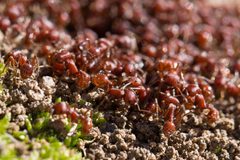
Distinguished from other Pogonomyrmex by its distribution in the interior Western United States at elevations at or below 6,300 feet. are dark red, averaging 6 mm in mature colonies, with size variation but no distinct worker . The irregularly conical gravel mound with surrounding denuded vegetation is diagnostic; nest disks exceed 35 inches in diameter in large colonies. The powerful sting and aggressive colony defense separate it from non-harvester ants in similar .
Images
Habitat
Deserts and arid grasslands of the American West; occupies areas with variable vegetational structure where percent vegetational cover influences foraging patterns. Nests are constructed in sandy or gravelly soils, with mound composition and size varying across plant environments. Nest disks are typically devoid of vegetation and do not burn during fires due to drier soil conditions.
Distribution
Interior Western United States; characteristic of the American West at elevations at or below 6,300 feet (1,900 m).
Seasonality
forage primarily April through September. Foraging occurs throughout the day during cooler months; restricted to 5–11 am and 3–9 pm during summer. Surface activity occurs when mound surface temperatures range 25–53 °C (77–127 °F). Reproductive are cued by rainfall.
Diet
harvest seeds and pollen directly from plants and gather fallen seeds; seeds are stored in nest chambers and depleted during winter. Workers also gather newly dead insects. Given choice, workers select seeds with higher energy content and seed diversity, including novel seed types.
Life Cycle
Colonies are founded by individual queens without or other queens; founding mode varies from claustral to semi-claustral across . First workers produced (nanitics) are stunted at 2 mm, 33% shorter than typical workers. Workers live approximately six months, progressing through different roles as they age, with foraging occurring toward the end of life. Mature colonies contain up to 20,000 workers and one ; queens may live up to 30 years and many colonies survive 20 years. Nest depth reaches 5 meters. Colonies stop producing before .
Behavior
defend foraging territories against neighboring colonies; foragers are lost in territorial encounters. Workers usually forage one item type per day but change specialty daily, often repeating foraging directions across days. Colonies recruit additional workers to productive food sources. Workers relocate themselves and within the nest to capture safe heat levels. Foraging workers kill encountered queens aboveground and occasionally excavate queens.
Ecological Role
in desert . Nest mounds alter soil particle-size distribution and enrich concentrations of CaCO₃, exchangeable K, Na, Mg, and total N, creating favorable conditions for plant growth. Nest rims serve as refugia for vegetation during drought, grazing, and fire, facilitating post-disturbance recovery. Nests support diverse associated organisms including mites, silverfish, beetles, springtails, bacteria, mycorrhizae, and protists. Serves as primary food source for Myrmecocystus mexicanus (honey ant) and horned lizards; preyed upon by tiger beetles and antlions.
Human Relevance
Stings are painful and venomous, rated 3 on the Schmidt Sting Pain Index, with pain lasting up to eight hours; rare cases of anaphylaxis occur. Historically perceived as rangeland pests due to vegetation clearing, though ecological research demonstrates net positive effects on plant productivity. May consume seeds used in ecological restoration, potentially hampering broadcast seeding efforts. peoples of south-central California used stings therapeutically for colds, pain, arthritis, and gynecological disorders, and practiced ritualistic swallowing of live ants to induce visions.
Similar Taxa
- Pogonomyrmex maricopaOverlapping range and similar mound-building ; distinguished by higher elevation preferences and possessing the most toxic insect venom known, though P. occidentalis is also highly venomous
- Myrmecocystus mexicanusSpatially associated with P. occidentalis nests and feeds on its dead , but distinguished by its honey-pot worker and lack of seed-harvesting
- Other Pogonomyrmex speciesShare seed-harvesting and general ; P. occidentalis is specifically characteristic of the interior Western United States at or below 6,300 feet elevation
Misconceptions
Long perceived as pests that reduce rangeland productivity through vegetation clearing; research demonstrates that nest-rim vegetation growth more than compensates for cleared areas and that nest rims serve as critical refugia and recovery points following disturbance.
Sources and further reading
- BugGuide
- Wikipedia
- GBIF taxonomy match
- iNaturalist taxon
- NCBI Taxonomy
- Catalogue of Life
- Bumble Bees: Feeling Impact of Climate Change | Bug Squad
- The Painful but Fascinating Stings of Harvester Ants
- Heroes, Not Headaches: Reframing the Reputation of Harvester Ants
- Bug Eric: Predator and Prey: Ants versus "Lions" and "Tigers"
- Harvester Ant Nest Rims Boost Native, Nonnative Plants Alike
- Good News for the Western Bumble Bee, Bombus occidentalis
- Spatial Distribution of Pogonomyrmex occidentalis: Recruitment, Mortality and Overdispersion
- Colony size and reproduction in the western harvester ant, Pogonomyrmex occidentalis
- Variation in Foraging Patterns of the Western Harvester Ant, Pogonomyrmex occidentalis, in Relation to Variation in Habitat Structure
- NEOICHNOLOGICAL STUDY OF THE TRACES AND BURROWING BEHAVIORS OF THE WESTERN HARVESTER ANT POGONOMYRMEX OCCIDENTALIS (INSECTA: HYMENOPTERA: FORMICIDAE): PALEOPEDOGENIC AND PALEOECOLOGICAL IMPLICATIONS
- The Role of the Western Harvester Ant (Pogonomyrmex occidentalis) in Soil Formation