
Myrmecocystus mexicanus
Wesmael, 1838
Mexican Honeypot Ant, Mexican Honey Ant
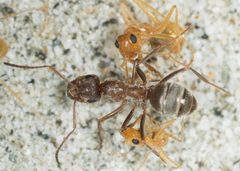
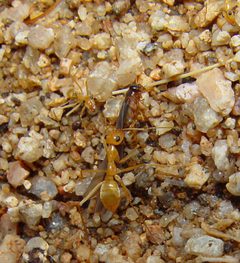
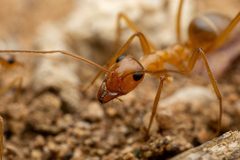
Myrmecocystus mexicanus is a North American honeypot ant notable for its specialized that store liquid food in their distended . The exhibits obligate myrmecophagy through its close association with colonies, which provide carrion as a primary food source. Colonies are long-lived, averaging 8.9 years with maximum lifespans of 23 years. occur in late July following rainfall, with queens founding new colonies in open, sun-exposed locations.
Pronunciation
How to pronounce Myrmecocystus mexicanus: /mɪrmɛkoʊˈsɪstəs mɛksɪˈkeɪnəs/
These audio files are automatically generated. While they are not always 100% accurate, they are a good starting point.
Identification
Distinguished from other Myrmecocystus by coloration patterns and geographic range. differ from M. mimicus in having lighter, more uniform coloration. Males identified by black and thorax with contrasting reddish-brown pronotum. recognized by extreme abdominal distension and hanging in nest chambers. Nest entrance placement in open, unshaded areas contrasts with shaded-nest preferences of some .
Images
Habitat
Arid and semi-arid environments in southwestern North America. Founding queens preferentially establish nests on ridges and mesas. Nest entrances located in open, unshaded areas to facilitate rapid soil cooling for foraging. Colonies frequently associated with nests of Pogonomyrmex occidentalis, typically spaced 5–10 meters apart though sometimes closer than 3 meters.
Distribution
Southwestern United States and northern Mexico. Documented from Colorado, Arizona, New Mexico, Texas, Utah, Nevada, and California. Extends south into Mexican states. Distribution closely tied to presence of Pogonomyrmex occidentalis colonies.
Seasonality
occur in late July, typically the day following rainfall, in evening hours coinciding with foraging onset. Foraging activity extends from March through November, with peak nectar collection during summer months. foraging preferred at temperatures of 0.5–30°C, with optimal range 15–20°C.
Diet
with distinct seasonal and -based components. collect nectar from Yucca glauca, sugary galls formed by Holcaspis perniciosus on Quercus gambelii, flower nectars, cactus fruits, and honeydew. Animal matter derived primarily from dead and Pogonomyrmex occidentalis workers, which constitute the majority of protein intake. Small soft-bodied insects and dead insects supplement diet. store four food types: dark amber and amber (sugars from floral nectar), milky (proteins and oils from insect prey), and clear (water and sucrose for arid-climate water storage).
Host Associations
- Pogonomyrmex occidentalis - carrion source colonies provide dead and dying as primary protein source; spatial association is obligate
- Yucca glauca - nectar sourcePrimary plant-derived source
- Quercus gambelii - indirect via gall waspSugary galls formed by Holcaspis perniciosus provide liquid food
- Holcaspis perniciosus - indirect mutualismGall wasp creates food source through sugary gall secretions
Life Cycle
Holometabolous with complete . lays in clusters of 5–10 approximately five days post-mating. Larvae hatch around 20 days, pupate in cocoons after 10 days. emerge approximately 63 days after egg-laying. First workers are smaller than subsequent broods, an for rapid colony growth. Worker lifespan ranges 11–170 days. Colony lifespan averages 8.9 years, maximum 23 years.
Behavior
Eusocial with distinct : reproductive , winged males, and sterile female . workers represent a specialized storage caste; when removed, next-largest workers develop into repletes within two weeks. Foraging workers exhibit radial search patterns early in season, transitioning to path-following once nectar sources are established. Foraging range extends to 20 meters from nest. Workers returning from foraging regurgitate collected nectar to repletes. Repletes hang immobile from chamber ceilings when fully engorged; become 'flaccid depletes' when drained. Conomyrma bicolor interferes with foraging by dropping stones on nest entrances when colonies are within 3 meters.
Ecological Role
Scavenger and nectarivore in arid . Functions as a living food storage system through , enabling colony survival through seasonal resource scarcity. Facilitates nutrient redistribution through consumption of carrion. Liquid food storage in repletes may provide water function for associated in extreme aridity.
Human Relevance
Historical food source for peoples of the southwestern United States and Mexico; consumed as 'nequacatl'. Used in traditional medicine and fermented for alcoholic beverages by Mexican . Maintained in captivity for educational display; a colony at Devil's Punch Bowl Natural Area, California survived 7 years on brown sugar and fish food flakes. No documented agricultural pest status.
Similar Taxa
- Myrmecocystus mimicusOverlapping range; distinguished by darker, more variable coloration and different nest site preferences
- Myrmecocystus depilisSympatric in parts of range; separated by pilosity differences and coloration patterns
- Myrmecocystus navajoSimilar size and ; geographic separation and male genitalia distinguish
More Details
Replete developmental plasticity
development demonstrates remarkable flexibility: when existing repletes are removed, the next largest rapidly develop into repletes within approximately two weeks, indicating environmental rather than genetic determination of this specialized caste.
Bimodal foraging strategy
The employs distinct foraging patterns seasonally: radial exploration when establishing nectar sources, shifting to trail-based foraging once resources are located. This behavioral flexibility optimizes energy expenditure across varying resource distributions.
Temperature-mediated nest placement
Colony entrance relocation in response to shading demonstrates sophisticated thermoregulatory , ensuring soil cooling rates that permit early evening foraging onset in desert environments.
Sources and further reading
- BugGuide
- Wikipedia
- GBIF taxonomy match
- iNaturalist taxon
- NCBI Taxonomy
- Catalogue of Life
- Field Guide Selected References
- Grasshoppers of Colorado
- Grasshoppers of Colorado
- Bembicid Holdings | Entomology Research Museum
- Bug Eric: Wasp Wednesday: Western Paper Wasp
- Bug Eric: Anteater Scarab Beetles
- Distribution of <I>Myrmecocystus mexicanus</I> (Hymenoptera: Formicidae): Association with <I>Pogonomyrmex occidentalis</I> (Hymenoptera: Formicidae)