
Pogonomyrmex rugosus
Emery, 1895
Rough Harvester Ant, Desert Harvester Ant
Pogonomyrmex rugosus, commonly known as the rough or desert harvester ant, is a seed-harvesting to the southwestern United States. The species is notable for its large colony sizes reaching up to 15,000 , its use of permanent trunk trails for group foraging, and its potent venomous sting rated at level 3 on the Schmidt Sting Pain Index. Research has demonstrated that play a previously unknown role in determination, with larvae developing into workers when fed trophic eggs and into queens when deprived of them. The species serves as a for two workerless parasitic ant species, Pogonomyrmex anergismus and Pogonomyrmex colei.
Pronunciation
How to pronounce Pogonomyrmex rugosus: //ˌpoʊɡoʊnoʊˈmɪrmɛks ruːˈɡoʊsəs//
These audio files are automatically generated. While they are not always 100% accurate, they are a good starting point.
Identification
Distinguished from the sympatric Pogonomyrmex barbatus by occupying sandier, drier soils with lower clay content and moisture retention. P. rugosus females are approximately 8% heavier in dry mass than P. barbatus , a difference visible with precise measurement. The can be separated from Pogonomyrmex californicus by subtle morphological differences in sculpturing and geographic distribution. Workerless Pogonomyrmex anergismus and Pogonomyrmex colei found within P. rugosus colonies can be identified by their lack of and presence of reproductive individuals only.
Images
Appearance
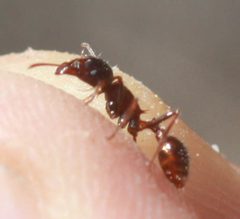
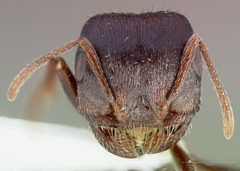
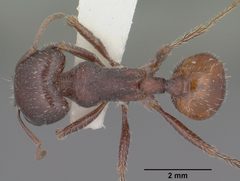
are medium to large-sized ants with a robust, heavily sculptured bearing distinct longitudinal rugae (grooves) on the and mesosoma, giving the its "rough ." The body is typically reddish-brown to dark brown in coloration. The head is large relative to body size with prominent adapted for seed processing. queens and males possess wings and expanded thoracic musculature; males in particular exhibit a characteristic "hump-backed" appearance due to enlarged mesosomal segments.
Habitat
Occupies desert and arid grassland in the southwestern United States, showing strong preference for sandy or sandy-loam soils with lower clay content and reduced moisture retention compared to sister P. barbatus. Nest sites are typically located in open areas with sparse vegetation, often near arroyo edges in Chihuahuan Desert watersheds. Colonies construct large, conspicuous nest disks—circular areas cleared of vegetation that can exceed 10 meters in diameter, with vegetation often thriving on the nutrient-enriched rim.
Distribution
to the southwestern United States, specifically documented from New Mexico, southern Colorado, and Arizona (including collection sites at Bowie and Florence, Arizona). The occurs in the Mojave Desert and Chihuahuan Desert regions. Distribution overlaps broadly with P. barbatus but the two species are sympatric only in localized contact zones where soil texture is intermediate between their respective preferred substrates.
Seasonality
swarms typically occur during late afternoon, at dusk, after dark, or at dawn, often triggered by environmental cues including changes in day length, relative humidity, and air pressure. In the arid southwest, monsoon rainy season onset frequently sparks swarming events. Foraging activity occurs diurnally, with morning patrollers emerging first to assess conditions before main foraging bouts.
Diet
Primarily granivorous, collecting and storing seeds of grasses and other plants in subterranean granaries. Documented seed preferences include the filaree (Erodium cicutarium) and mustard (Brassica tournefortii), as well as native species such as brittlebush (Encelia farinosa) and buckwheat (Eriogonum spp.). Laboratory colonies have been maintained on grass seeds, flies, and honey water. produced by queens serve as a critical food source for larvae.
Host Associations
- Pogonomyrmex anergismus - Workerless parasitic that inhabits P. rugosus colonies and enslaves to raise its own reproductive offspring.
- Pogonomyrmex colei - Workerless parasitic that inhabits P. rugosus colonies and enslaves to raise its own reproductive offspring.
Life Cycle
Colonies are founded by single queens following mating . Queens produce two types of : viable eggs containing embryos and lacking embryos. First instar larval access to trophic eggs determines fate—larvae with trophic egg access develop into , while larvae without access develop into queens. This represents the first documented case of trophic eggs influencing caste determination in social insects. Queens typically cease trophic egg production after the first workers eclose. Colonies can reach sizes of up to 15,000 workers. Hibernation appears important for triggering production in laboratory settings.
Behavior
Foraging occurs via group tactics involving the establishment of permanent trunk trails—distinct several meters long leading from the nest entrance to foraging patches. use trails to recruit nestmates to food sources. Morning patrollers assess conditions up to 20 minutes' travel distance from the nest; their return signals the colony to deploy foragers. Foraging patches are typically abandoned before seed banks are fully depleted. Defensive includes a potent sting evolved primarily for defense against vertebrate seed .
Ecological Role
Major seed and agent in desert , functioning as a . Nest disks create distinct patches that enhance vegetation growth on nutrient-enriched rims, providing refugia for plants during drought and grazing stress. These rim habitats facilitate both native (sunflowers, native grasses) and (bull thistle, tumbleweed). Seed can influence plant composition, though effects on plant abundance appear context-dependent. The species contributes to soil nutrient cycling through detritus deposition and soil disturbance.
Human Relevance
Stings produce intense pain rated 3/4 on the Schmidt Sting Pain Index, described as "bold and unrelenting," with pain lasting up to 8 hours and causing redness, swelling, and persistent welts. Venom contains specialized targeting mammalian sodium ion channels and is particularly effective against mammals, likely evolved to deter rodent seed . Historically, peoples of south-central California used stings therapeutically for colds, pain, arthritis, and gynecological disorders, and ritually swallowed live ants to induce hallucinogenic visions for spiritual purposes—practices now ceased and considered extremely dangerous. Sold commercially as occupants of educational " farms."
Similar Taxa
- Pogonomyrmex barbatusSister with broadly overlapping distribution; distinguished by preference for clay-rich, moisture-retentive soils and approximately 8% lighter female body mass. Sympatry limited to intermediate soil texture zones.
- Pogonomyrmex californicusSympatric Mojave Desert with similar thermal (CTmax ~51.7°C) but differing in foraging and subtle morphological characteristics.
- Pogonomyrmex occidentalisWestern harvester ant with similar and sting potency; geographic separation and minor morphological differences in sculpturing pattern distinguish the .
More Details
Thermal Physiology
Critical thermal maximum (CTmax) measured at 51.57°C by loss of muscular coordination and 51.59°C by loss of spiracular control, among the highest recorded for ants. Post-mortal CO2 emission peaks observed following thermal death.
Trophic Egg Biochemistry
differ from viable in texture, , and contents including elevated protein, triglycerides, , and sugar levels, as well as distinct small and miRNA composition profiles.
Seed Selection Behavior
Despite strong preferences for certain plant seeds (particularly filaree), P. rugosus foraging does not necessarily deplete seed banks or reduce invasive plant establishment, likely due to high overall seed abundance and premature abandonment of foraging patches.
Sources and further reading
- BugGuide
- Wikipedia
- GBIF taxonomy match
- iNaturalist taxon
- NCBI Taxonomy
- Catalogue of Life
- Ants and Moths: Think Noon and Night! | Bug Squad
- Bug Eric: Flying Ants
- Harvester Ants Have a Taste for Exotic Seeds
- Carbo-loading here and there: Odorous house ants, Tapinoma sessile, and harvester ants, Pogonomyrmex — Bug of the Week
- The Painful but Fascinating Stings of Harvester Ants
- Harvester Ant Nest Rims Boost Native, Nonnative Plants Alike
- Trophic eggs affect caste determination in the ant Pogonomyrmex rugosus
- Trophic eggs affect caste determination in the ant Pogonomyrmex rugosus
- Trophic eggs affect caste determination in the ant Pogonomyrmex rugosus
- Trophic eggs affect caste determination in the ant Pogonomyrmex rugosus
- Trophic eggs affect caste determination in the ant Pogonomyrmex rugosus
- Trophic eggs affect caste determination in the ant Pogonomyrmex rugosus
- Soil texture as an influence on the distribution of the desert seed-harvester ants Pogonomyrmex rugosus and Messor pergandei
- The influence of arroyo edges on Pogonomyrmex rugosus nest distribution in the Chihuahuan Desert, New Mexico
- Variability in soils and vegetation associated with harvester ant (Pogonomyrmex rugosus) nests on a Chihuahuan Desert watershed
- Heavy metal distribution and bioaccumulation in Chihuahuan Desert Rough Harvester ant (Pogonomyrmex rugosus) populations
- BEHAVIORAL DIFFERENCES BETWEENPOGONOMYRMEX RUGOSUSAND DEPENDENT LINEAGE (H1/H2) HARVESTER ANTS
- Thermolimit respirometry: an objective assessment of critical thermal maxima in two sympatric desert harvester ants,Pogonomyrmex rugosusandP. californicus
- Habitat segregation based on soil texture and body size in the seed‐harvester ants Pogonomyrmex rugosus and P. barbatus