
Pogonomyrmex colei
Snelling, 1982
Pogonomyrmex colei is a workerless in the Myrmicinae. It is a permanent social that lacks a entirely, with only reproductive queens and males present. The species is native to the southwestern United States, where it parasitizes nests of the Pogonomyrmex rugosus. Its has been sequenced to study the genetic mechanisms underlying the evolutionary loss of the worker caste.
Pronunciation
How to pronounce Pogonomyrmex colei: //ˌpoʊɡənoʊˈmɜrmɛks ˈkoʊlaɪ//
These audio files are automatically generated. While they are not always 100% accurate, they are a good starting point.
Identification
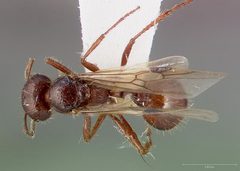
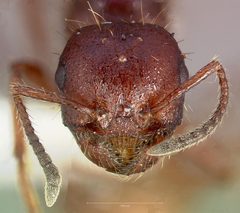
Distinguishing Pogonomyrmex colei from its requires careful examination. As a workerless , colonies contain only winged queens and males, with no present—this absence itself is diagnostic. The species likely resembles its host Pogonomyrmex rugosus in general form, being a medium-sized with typical Pogonomyrmex including a psammophore (beard of long hairs on the underside of the ). Precise identification requires examination of morphological characters described in the original description by Snelling (1982).
Images
Habitat
Found in arid and semi-arid environments of the southwestern United States, specifically within the nest chambers of its Pogonomyrmex rugosus. The host constructs large nest disks in open areas with sparse vegetation, and P. colei inhabits these same underground structures.
Distribution
Native to the southwestern United States. Documented from California, Nevada, and Arizona.
Host Associations
- Pogonomyrmex rugosus - social Permanent workerless ; P. colei queens reside in nests and are fed by host , producing only reproductive offspring
Life Cycle
The is characterized by the complete absence of a . Queens and males are produced and mate, with queens then seeking out established colonies of Pogonomyrmex rugosus to infiltrate. The parasitic queens are integrated into colonies where host workers rear their reproductive offspring. No worker caste develops at any life stage.
Behavior
As a workerless , Pogonomyrmex colei exhibits no foraging or nest-building . Queens remain within nests and are entirely dependent on host for food and care. The has lost all worker-associated behaviors through evolutionary reduction of the worker .
Ecological Role
Acts as a social within . By exploiting the labor of colonies, it represents an evolutionary endpoint of reduction in ants. Its presence may impose costs on host colony through resource consumption by parasitic reproductives.
Similar Taxa
- Pogonomyrmex rugosus ; P. colei can only be distinguished by its workerless social structure and presence within host nests, not by external alone
- Other Pogonomyrmex speciesMost congenes possess complete and are free-living seed harvesters, whereas P. colei is workerless and parasitic
- Other workerless inquiline antsSocially parasitic ants in such as Acromyrmex or Atta also lack , but P. colei is distinguished by its specific association with P. rugosus and its distribution in the southwestern United States
More Details
Genomic basis of workerlessness
The of Pogonomyrmex colei was sequenced to investigate how parasitic ants achieve a workerless state. Contrary to expectations, no gene loss was detected compared to ants with complete . This indicates that caste loss in this results from regulatory changes rather than sequence differences or gene deletion, suggesting that the genetic toolkit for development remains present but is not expressed.
Evolutionary significance
Pogonomyrmex colei represents an extreme of social in ants, having undergone complete evolutionary loss of the . This makes it a valuable model for understanding the genetic and developmental mechanisms underlying caste evolution and reduction in social insects.
Sources and further reading
- BugGuide
- Wikipedia
- GBIF taxonomy match
- iNaturalist taxon
- NCBI Taxonomy
- Catalogue of Life
- Carbo-loading here and there: Odorous house ants, Tapinoma sessile, and harvester ants, Pogonomyrmex — Bug of the Week
- The Painful but Fascinating Stings of Harvester Ants
- Harvester Ant Nest Rims Boost Native, Nonnative Plants Alike
- Harvester Ants Have a Taste for Exotic Seeds
- Platystomatidae | Beetles In The Bush
- Heroes, Not Headaches: Reframing the Reputation of Harvester Ants