
Parcoblatta pennsylvanica
(De Geer, 1773)
Pennsylvania Wood Cockroach, Pennsylvanian cockroach
Parcoblatta pennsylvanica, commonly known as the Pennsylvania wood , is a native North American cockroach found in eastern and central regions of the continent. Unlike many cockroach pests, this species is primarily associated with outdoor woodland and is not considered a significant household pest. The species is notable as a favored for the Ampulex canaliculata, which uses it as prey for its larvae. are attracted to light and may occasionally enter structures, but do not establish indoor .
Pronunciation
How to pronounce Parcoblatta pennsylvanica: /pɑr.kɔˈblæt.tə ˌpɛn.sɪlˈvæn.ɪ.kə/
These audio files are automatically generated. While they are not always 100% accurate, they are a good starting point.
Identification
Distinguished from household pest (Blattella germanica, Periplaneta americana) by its association with outdoor woodland rather than indoor environments. Males are attracted to lights and may enter buildings temporarily, but do not reproduce indoors. The pale yellowish-brown pronotum with darker central markings differs from the more uniform coloration of many other . Can be confused with other Parcoblatta species; precise identification may require examination of genitalia.
Images
Appearance
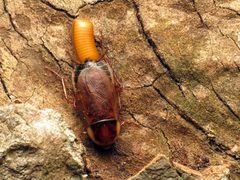
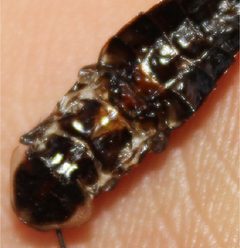
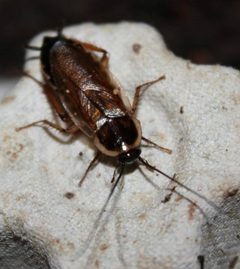
Medium-sized with a flattened, oval body. have fully developed wings that extend beyond the in males; females have shorter wings. Coloration is typically chestnut brown to dark brown. The pronotum (shield-like structure behind the ) is pale yellowish-brown with a darker central pattern. are long and thread-like. Nymphs lack wings and are smaller, darker in color.
Habitat
Deciduous forests and woodlands, particularly areas with dead standing trees, fallen logs, and leaf litter. Associated with oak-hickory forests and similar woodland types. Often found under bark, in rotting wood, and in other decaying organic matter.
Distribution
Eastern and central North America. Documented from Ontario and Québec in Canada, and throughout the eastern United States west to states including Wisconsin, Missouri, Kansas, and Arizona.
Seasonality
are active from late spring through summer, with peak activity in June and July. Males are frequently observed at lights during evening hours in late spring and early summer.
Diet
Decaying organic matter, including rotting wood, leaf litter, and other forest detritus. Feeding habits are not well documented in detail.
Life Cycle
() are deposited in protected locations such as under bark or in decaying wood. Nymphs develop through multiple instars in woodland , feeding on decaying organic matter. Development is slower than in many domestic , with one per year typical in northern portions of the range.
Behavior
Primarily . Males are strongly attracted to light and may fly to lights at night, occasionally entering buildings but not establishing indoor . Females and nymphs remain in woodland . Both sexes are frequently found under bark and in rotting wood. When disturbed, individuals may run quickly or, in males, fly short distances.
Ecological Role
Decomposer in forest , contributing to breakdown of decaying wood and leaf litter. Serves as prey for various including , particularly Ampulex canaliculata, which uses this as its primary .
Human Relevance
Not considered a significant pest . Occasional nuisance when males enter structures attracted to lights, but do not establish indoors. Does not reproduce in buildings. May be mistaken for more problematic species.
Similar Taxa
- Parcoblatta spp. (other wood cockroaches)Other in the share similar woodland habits and general appearance; precise identification requires detailed examination.
- Blattella germanica (German cockroach)Distinguished by (indoor vs. outdoor), smaller size, and different pronotum pattern; P. pennsylvanica does not establish indoor .
- Periplaneta americana (American cockroach)Larger size, different coloration, and preference for sewers and moist indoor environments rather than dry woodland .
Misconceptions
Often mistaken for a household pest due to occasional indoor presence of males. However, this species cannot establish breeding in buildings and does not require pest control measures when found indoors.
More Details
Parasitoid Host
Primary known for the cockroach wasp Ampulex canaliculata, which paralyzes individuals and uses them as living food for its larvae.
Taxonomic Note
placement varies between sources: Ectobiidae (GBIF) or Blattellidae (iNaturalist/Wikipedia); both are currently used in literature.