
Ligia
Fabricius, 1798
rock lice, sea slaters, wharf roach
Species Guides
5- Ligia baudiniana(Central American Seaslater)
- Ligia exotica(sea roach)
- Ligia occidentalis(Western Sea Slater)
- Ligia oceanica(sea slater)
- Ligia pallasii(Sleepy Seaslater)
Ligia is a of large isopods in the Ligiidae, commonly known as rock lice or sea slaters. These crustaceans inhabit intertidal and supralittoral zones on rocky coastlines worldwide, with most showing limited capacity and distribution patterns. Some species have become fully terrestrial in high-humidity environments. The genus exhibits complex phylogeographic patterns in East Asia, with cryptic species and overlapping lineages documented through molecular studies.
Pronunciation
How to pronounce Ligia: /ˈliː.dʒi.ə/
These audio files are automatically generated. While they are not always 100% accurate, they are a good starting point.
Identification
Distinguished from other isopod by the combination of large body size, elongated uropods, and coastal rocky . Separated from Ligia oceanica by uropod length (exceeding 2/3 body length in most versus shorter in L. oceanica). Males of some species possess brush-like structures on the first pair of legs, visible upon close examination. Species-level identification often requires examination of male genitalia or molecular analysis due to cryptic species and affecting size and body proportions.
Images
Appearance
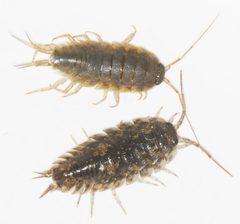
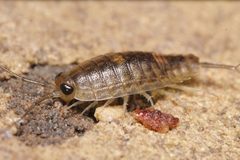
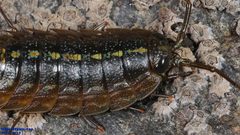
Large, dorsoventrally flattened isopods with elongated, oval bodies. typically measure 25–30 mm in length, with some reaching larger sizes. The body is covered by a segmented with distinct tergites. are large and prominent, positioned laterally on the . are long and multi-segmented, with two pairs present (antennules reduced and barely visible in terrestrial forms). Uropods are elongated, often exceeding half the body length. Coloration varies by species but generally provides camouflage against rocky substrates—typically gray, brown, or mottled patterns. Males often exhibit with longer, wider antennae and brush-like structures on the first pair of legs.
Habitat
Primarily intertidal and supralittoral zones on rocky coastlines, including tidal cliffs, rocky beaches, and breakwaters. Some have colonized fully terrestrial in high-humidity environments near coasts. Avoids sandy substrates, which increase desiccation risk and terrestrial exposure. Requires moist air and proximity to water for .
Distribution
in coastal regions worldwide. Documented from: Atlantic coasts of Europe and North America; Pacific coasts of North and South America; coasts of Africa from Senegal to South Africa; Indian Ocean coasts; East Asia including Japan, South Korea, China, and Vietnam; Hawaiian Islands; Australasia including Australia, New Zealand, and Pacific islands. Ligia exotica has been introduced globally to subtropical and warm temperate coastlines.
Seasonality
Nocturnally active throughout the year in suitable climates. Activity patterns influenced by tidal cycles, humidity, and temperature. More surface-active during humid nights and retreating to crevices during dry periods.
Diet
scavengers. Feed on , detritus, and organic matter in intertidal zones.
Life Cycle
Direct development without larval stages. Females possess a pouch (marsupium) where develop into mancae ( isopods). present: males typically larger but narrower than females, with longer and wider .
Behavior
foragers that hide in rocky crevices during daylight hours. Exhibit limited capacity, leading to isolation and distribution patterns. Poor swimmers that enter water primarily to escape terrestrial or when dislodged by wave action; vulnerable to marine when submerged. Well-adapted to clinging on rocky surfaces.
Ecological Role
Scavengers in intertidal , processing algal and organic detritus. Serve as prey for both terrestrial and marine . Limited makes them useful models for phylogeographic and evolutionary studies.
Human Relevance
Occasionally encountered by coastal visitors; sometimes mistaken for or other pests. Ligia exotica (wharf roach) has become a introduction in port areas worldwide. No significant economic or medical importance.
Similar Taxa
- Ligia oceanicaIntroduced European with shorter uropods (less than 2/3 body length) compared to most native Ligia species
- LigidiumSmaller, fully terrestrial ligiids found in moist woodland away from coasts
- TylosAnother of large coastal isopods with more cylindrical body form and different preferences on sandy beaches
More Details
Phylogenetic placement
Traditional morphological classification placed Ligia in suborder Oniscidea with terrestrial woodlice. Molecular , however, indicates closer relationship to marine isopods in suborders Valvifera and Sphaeromatidea, reflecting their coastal transitional .
Cryptic species
Molecular studies have revealed extensive cryptic diversity within the . In East Asia alone, six genetic lineages have been identified including L. cinerascens, two lineages of L. exotica, and three undescribed species. Speciation events appear associated with Japanese mainland formation from Oligocene to Miocene (30–5 Mya).
Conservation status
Most have not been assessed for conservation status. The recently described Ligia barack from Nihoa, Hawaii is to that remote island and potentially vulnerable due to restricted range.
Sources and further reading
- BugGuide
- Wikipedia
- iNaturalist taxon
- NCBI Taxonomy
- Catalogue of Life
- Super Crop Challenge #8 | Beetles In The Bush
- Isopoda | Beetles In The Bush
- Molecular population genetics and phylogeographic studies of Ligia exotica and Ligia cinerascens in East Asia
- The complete mitogenome of Ligia barack (Crustacea, Isopoda, Ligiidae), a recently described intertidal isopod species from the remote island of Nihoa.