
Ligia exotica
Roux, 1828
sea roach, wharf roach, wharf louse
Ligia exotica is a large intertidal isopod commonly known as sea roach or wharf roach. It inhabits rocky coasts and harbor walls in the supralittoral zone just above the high water mark. The has a complex taxonomic history with uncertain native origins, though molecular evidence points to East and Southeast Asia as the center of diversity. It has spread globally via human maritime activity and comprises multiple cryptic genetic lineages that may represent distinct species.
Pronunciation
How to pronounce Ligia exotica: /ˈliːɡiə ɛkˈsɒtɪkə/
These audio files are automatically generated. While they are not always 100% accurate, they are a good starting point.
Identification
Distinguished from by combination of long uropods exceeding 2/3 body length and absence of brush-like structures on male first legs. L. oceanica has uropods much shorter than 2/3 body length. L. baudiniana males possess brush-like structures on first legs. Large size and in splash zone above high water mark separates it from smaller terrestrial woodlice. Long exceeding body length distinguishes from many other intertidal isopods.
Images
Appearance
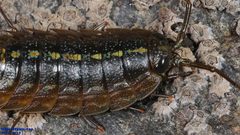
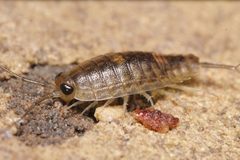
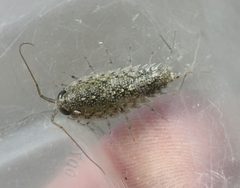
Dorsoventrally flattened body reaching up to 4 cm in length, with males larger than females. Coloration dark grey, sometimes with brown flecks, and pale brown appendages. bears two long exceeding body length and two unstalked, bulging . Seven thoracic segments each with paired legs; six abdominal segments with the first five bearing flat membranous gills and the sixth bearing long forked uropods.
Habitat
Rocky coasts, cliffs, and harbor walls in the supralittoral splash zone just above the high water mark. Occupies damp crevices and fissures in rocks, jetties, and artificial structures. Requires moist microhabitats while remaining above regular tidal inundation.
Distribution
Originally described from near Marseille, France in 1828. Now widespread in temperate and subtropical coastal regions globally including Western Europe, Mediterranean, Red Sea, eastern United States, Hawaii, East Asia (South Korea, Japan, Vietnam, China), and parts of South America. Native range uncertain; molecular evidence indicates East and Southeast Asia as center of origin with two divergent lineages (Lineage N in northern regions, Lineage S in southern regions).
Seasonality
Nocturnally active year-round in suitable climates. structure changes persist in continuous darkness, indicating circadian control.
Diet
Grazer on microalgae and diatoms; scavenger on plant remains and detritus.
Life Cycle
Direct development without larval stages. Females carry using specially adapted appendages. Juveniles undergo multiple before reaching adulthood.
Behavior
Nocturnally active, hiding in crevices during daylight hours. Exhibits changes in structure and function: open type with ordered microvilli and assembled pigment at noon; closed type with irregular microvilli and dispersed pigment granules at midnight. ERG amplitude higher at night than day. Possesses passive water transportation system through open capillaries in legs.
Ecological Role
in supralittoral in parts of introduced range (eastern United States). Role in energetics and not fully evaluated; likely serves as prey for shorebirds and other coastal .
Human Relevance
Unintentionally introduced globally via shipping in ballast water and between planks of timber ships. Considered in eastern United States. Common inhabitant of harbor infrastructure and coastal structures. Subject of physiological and sensory research due to accessible and .
Similar Taxa
- Ligia oceanicaShorter uropods (less than 2/3 body length); introduced from Europe to some regions
- Ligia baudinianaMales possess brush-like structures on first legs; occurs sympatrically in Florida
- Ligia cinerascensOverlapping distribution in East Asia; distinguished by molecular and morphological characters
More Details
Genetic diversity
Comprises at least two highly divergent mitochondrial lineages (Lineage N and Lineage S) in East Asia that may represent cryptic . Only one lineage has spread globally, suggesting potential is phylogenetically constrained.
Visual physiology
exhibits spectral sensitivity maxima at 383 nm (UV) and 520 nm (green), with shifts in relative sensitivity. UV sensitivity relatively higher during day; green sensitivity enhanced at night.
Hemocyte morphology
Possesses seven classes of (prohemocytes, , hemocytes, cystocytes, oenocytoids, spherule , adipohemocytes) similar to insects and millipedes, with hemocyanin synthesized in specialized cyanocytes.
Sources and further reading
- BugGuide
- Wikipedia
- GBIF taxonomy match
- iNaturalist taxon
- NCBI Taxonomy
- Creepy Crawly Crustaceans | Beetles In The Bush
- Super Crop Challenge #8 | Beetles In The Bush
- An extendable handle for insect nets | Beetles In The Bush
- Molecular population genetics and phylogeographic studies of Ligia exotica and Ligia cinerascens in East Asia
- The hemocytes of an isopod Ligia exotica roux
- Aspects of the biology and behavior of Ligia exotica – The Wharf 'Louse'
- Out of Asia: Mitochondrial evolutionary history of the globally introduced supralittoral isopod Ligia exotica
- Diurnal Changes in Structure and Function of the Compound Eye of Ligia Exotica (Crustacea, Isopoda)
- Differences in Microbial Community Structure Determine the Functional Specialization of Gut Segments of Ligia exotica.