
Ligiidae
Leach, 1814
Rock Lice, Sea Slaters
Genus Guides
2Ligiidae is a of large, dorsoventrally flattened terrestrial isopods commonly known as rock lice or sea slaters. These crustaceans inhabit rocky intertidal zones and adjacent coastal , where they hide during daylight hours and emerge at night to scavenge. They represent the sole family within the infraorder Diplocheta and are distinguished from other woodlice by their elongated body form, large size (up to 30 mm), long , and preference for marine-influenced environments. The family exhibits poor desiccation resistance and limited ability, leading to pronounced isolation and cryptic genetic diversity across their range.
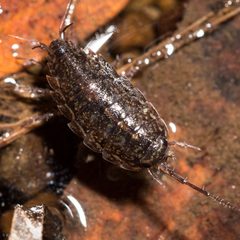
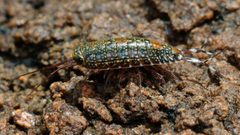
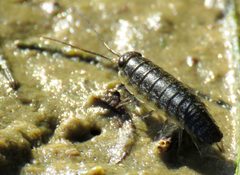
Pronunciation
How to pronounce Ligiidae: /lɪˈdʒaɪaɪdiː/
These audio files are automatically generated. While they are not always 100% accurate, they are a good starting point.
Identification
Distinguished from other terrestrial isopod by combination of large size (exceeding 15 mm), elongated flattened body, long , and intertidal rocky shore . Ligiidae differ from Philosciidae and other small woodlice by their substantially greater size and more elongate form. Within Ligiidae, identification relies on male genitalic characters, particularly pleopod 2 endopod and presence/absence of brush-like structures on male first legs; uropoda length relative to body; and subtle differences in and body proportions. L. oceanica has uropoda much less than two-thirds body length; L. baudiniana has longer uropoda and males possess brush-like leg structures; L. exotica males lack brush-like structures and instead show leg processes.
Images
Appearance
Large, dorsoventrally flattened isopods with elongated oval bodies. typically measure 20–30 mm in length, substantially larger than most terrestrial isopods. Body strongly compressed with distinct segmentation. large and prominent, positioned laterally on the . long and multi-segmented, often exceeding body length. Uropoda ( appendages) elongated, in some exceeding two-thirds of body length. Coloration typically cryptic, matching rocky substrates—shades of gray, brown, or mottled patterns. surface may show subtle sculpturing or punctation. First pair of antennae (antennules) reduced and barely visible, appearing as single antennae pair.
Habitat
Strictly associated with rocky intertidal zones and immediately adjacent coastal . Found on rocky shores, boulder beaches, cobble shores, and rocky outcrops in the supralittoral and upper intertidal zones. Require moist microhabitats with access to marine moisture but protection from direct wave action. Hide in rock crevices, under boulders, and within cliff cavities during daylight hours. Habitat characterized by high humidity, salt spray exposure, and proximity to marine environments. Avoid open water and cannot tolerate prolonged desiccation. Distribution patchy, restricted to suitable rocky substrates along coastlines.
Distribution
Widespread in coastal regions globally. Present on Atlantic and Pacific coasts of North America, including Florida and Gulf Coast. Occurs along southern African coastline from Namibia to KwaZulu-Natal, spanning Atlantic to Indian Ocean. Found in Japan (Tokyo Bay, Hokkaido, Honshu, Shikoku), remote oceanic islands (Nihoa), and European coasts (including introduced ). Records from Denmark, Norway, Sweden. Distribution constrained by availability of suitable rocky intertidal ; absent from sandy or muddy coastlines without rocky substrate.
Seasonality
Activity strongly ; emerge from hiding sites at dusk to forage, returning to shelter before dawn. Seasonal activity patterns influenced by temperature and moisture availability. In temperate regions, active throughout warmer months; may seek deeper shelter during cold periods. Reproductive timing varies by and latitude; some exhibit with single reproductive episode.
Diet
scavengers feeding primarily on and decaying organic matter. Consume various marine and terrestrial organic debris including algal material, detritus, and carrion. Forage nocturnally on rocky surfaces, exploiting accumulated organic material in intertidal zone.
Life Cycle
Direct development without free-living larval stages; young hatch as miniature . Some exhibit —single reproductive episode followed by death—environmentally induced by conditions. Development occurs within moist protected microhabitats. Poor desiccation resistance constrains and survival to humid refugia. time and longevity vary; species complete in one year, species may live multiple years.
Behavior
Strictly , hiding in rock crevices and under boulders during daylight to avoid desiccation and . Poor desiccation resistance necessitates retreat to humid microhabitats when exposed to air. Limited ability; avoid open water, cannot swim, and exhibit strong site fidelity. Constrained movement leads to long-term isolation and genetic differentiation even across short geographic distances. Foraging occurs on exposed rocky surfaces at night, returning to same shelter sites repeatedly.
Ecological Role
Scavengers in intertidal and supralittoral , processing algal and organic detritus. Serve as prey for various coastal including birds, small mammals, and predatory arthropods. Their presence indicates intact rocky intertidal with suitable moisture regimes. isolation and genetic structure make them useful indicators of historical biogeographic processes and coastal connectivity.
Human Relevance
Occasionally encountered by coastal visitors, sometimes eliciting surprise due to large size and unfamiliar appearance. No significant economic importance; neither pests nor commercially exploited. Subject of scientific interest for studies of phylogeography, cryptic speciation, and marine-terrestrial evolutionary transitions. Serve as educational examples of crustacean to marginal terrestrial .
Similar Taxa
- PhilosciidaeSmall terrestrial isopods; distinguished by much smaller size (<10 mm), more rounded body form, and fully terrestrial habits without marine association
- PorcellionidaeCommon pill bugs and woodlice; differ in smaller size, ability to conglobate (roll into ball) in many , and broader terrestrial range not restricted to rocky coasts
- ArmadillidiidaePill bugs capable of complete conglobation; smaller, more convex body form, and inland distribution
- TylidaeAnother of large terrestrial isopods; distinguished by different antennal structure, body proportions, and lack of pronounced intertidal specialization
Misconceptions
Often mistaken for insects due to superficial resemblance and unfamiliarity with crustacean groups. Initial encounters may provoke alarm due to large size and appearance in intertidal zone. Sometimes confused with amphipods (lateral compression vs. dorsoventral compression in isopods). The name 'sea slater' reflects historical confusion with true slaters (woodlice), though Ligiidae are distinct in and .
More Details
Phylogeographic significance
Ligiidae have become important study organisms for phylogeography and cryptic speciation research due to their severe constraints and isolation. Studies in southern Africa, Japan, and North America have revealed extensive cryptic genetic diversity, with deeply divergent lineages occurring in close geographic proximity. These patterns reflect long-term isolation and retention of historical signatures of geological and oceanographic processes.
Taxonomic complexity
-level remains challenging due to morphological conservatism and reliance on subtle male genitalic characters. Molecular studies have repeatedly uncovered cryptic species not distinguishable by traditional . The Ligia contains the majority of species, with Ligidium, Tauroligidium, and other genera restricted to specific regions.
Conservation considerations
While not formally threatened as a , individual and cryptic may be vulnerable due to small geographic ranges and specificity. Coastal development, pollution, and climate change affecting intertidal moisture regimes pose potential threats to localized populations.
Sources and further reading
- BugGuide
- Wikipedia
- GBIF taxonomy match
- iNaturalist taxon
- NCBI Taxonomy
- Super Crop Challenge #8 | Beetles In The Bush
- Isopoda | Beetles In The Bush
- Bibliography | Beetles In The Bush
- Phylogeography and cryptic diversity of intertidal Ligia isopods (Crustacea, Isopoda, Ligiidae) across the southern Africa coastline
- LIFE CYCLE AND ENVIRONMENTALLY INDUCED SEMELPARITY IN THE SHORE ISOPOD LIGIA CINERASCENS (LIGIIDAE) ON A COBBLE SHORE ALONG TOKYO BAY, CENTRAL JAPAN
- Life Cycle and Environmentally Induced Semelparity in the Shore Isopod Ligia cinerascens (Ligiidae) on a Cobble Shore along Tokyo Bay, Central Japan
- Distribution, habitat and food preferences of sympatric high intertidal isopod speciesLigia occidentalisandLigia pallasii(Ligiidae: Oniscidea)
- Phylogeographic analysis of Ligidium japonicum (Isopoda: Ligiidae) and its allied species reveals high biodiversity and genetic differentiation in the Kanto region, Japan
- The complete mitogenome of Ligia barack (Crustacea, Isopoda, Ligiidae), a recently described intertidal isopod species from the remote island of Nihoa.