
Ligia oceanica
(Linnaeus, 1767)
sea slater, common sea slater, sea roach
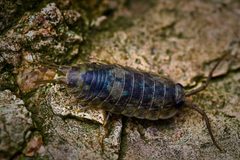
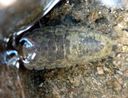
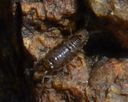
Ligia oceanica is a large intertidal isopod reaching up to 35 mm in length, making it the largest in the suborder Oniscidea. Native to rocky Atlantic coasts of Europe, it has been introduced to eastern North America and Atlantic islands. This species inhabits the supralittoral zone, hiding in rock crevices by day and emerging nocturnally to feed. Molecular suggests closer affinity to marine isopod suborders Valvifera and Sphaeromatidea than to terrestrial woodlice, challenging traditional classification.
Pronunciation
How to pronounce Ligia oceanica: //ˈlaɪdʒiə ˌoʊsiˈænɪkə//
These audio files are automatically generated. While they are not always 100% accurate, they are a good starting point.
Identification
Distinguished from other Ligia by uropods less than two-thirds body length (L. baudiniana has longer uropods exceeding this proportion). Distinguished from terrestrial woodlice by larger size, more elongate body, longer , and strictly littoral . Can be confused with L. exotica, but males of L. oceanica possess brush-like structures on first legs while L. exotica males lack these and instead have a process.
Images
Habitat
Strictly , specifically rocky supralittoral areas from splash zone to a few meters higher. Found on boulder beaches, at base of rock cliffs, on harbor walls and jetties. Especially common in crevices, rock pools, and under stones. Requires moist microhabitats with shelter from desiccation and wave action. Avoids immersion in water; breathes air.
Distribution
Native range: Northeast Atlantic coast from southern Norway to Morocco, including western Baltic Sea (to Bornholm, Denmark and Rostock, Germany), Faroe Islands, and southern Iceland. Introduced to Atlantic coast of North America (Cape Cod to Maine), Azores, and Canary Islands. Rare in North America despite established .
Seasonality
Active year-round in suitable conditions. Breeding occurs in summer (July–August). Juveniles recruit August–September.
Diet
Feeds on green and brown , especially bladderwrack (Fucus vesiculosus), diatoms, decaying seaweed, and plant detritus. with plant material forming main component.
Life Cycle
(breeds once then dies). Lifespan 2.5–3 years. Individuals typically breed in second year, though some may delay to third year. Females 20–120 in marsupium for approximately 4 weeks; larger females produce larger broods. Juveniles (manca stage) lack last leg pair present in . Growth indeterminate but slows markedly after sexual maturity.
Behavior
and furtive, hiding in rock crevices during daylight hours and emerging at night to forage. Fast, nimble, and difficult to capture. Strong in crevices. High site fidelity with limited between . Can tolerate temperatures near freezing in winter. Avoids immersion in water despite littoral .
Ecological Role
Abundant in rocky supralittoral zone; contributes to nutrient cycling through consumption and processing of algal and plant detritus. Serves as prey for shorebirds, rats, and raccoons. stability serves as indicator of quality in upper shore zones. Acts as intermediate for digenean trematode including Maritrema linguilla.
Human Relevance
Accidentally introduced to North America via human transport in cargo or ship ballast. Subject of physiological and ecological research due to transitional between marine and terrestrial isopods. Occasionally encountered by beachgoers and coastal researchers.
Similar Taxa
- Ligia baudinianaSimilar size and ; distinguished by longer uropods exceeding two-thirds body length and male lacking brush-like structures on first legs
- Ligia exoticaOverlapping introduced range; distinguished by male lacking brush-like leg structures and possessing instead a process on first legs
- terrestrial woodlice (Oniscidea)Similar body plan but distinguished by strictly littoral , larger size, more elongate body, longer , and lack of conglobation (rolling into ball)
Sources and further reading
- BugGuide
- Wikipedia
- GBIF taxonomy match
- iNaturalist taxon
- NCBI Taxonomy
- Catalogue of Life
- Super Crop Challenge #8 | Beetles In The Bush
- Isopoda | Beetles In The Bush
- Body Size in Relation to Oxygen Consumption and Pleopod Beat in Ligia Oceanica L.
- Studies On Rhythmical Behaviour in Crustacea. I. Persistent Locomotor Activity in Juvenile Carcinus Maenas (L.) and in Ligia Oceanica (L.)
- Population Dynamics and Life History of Two Contrasting Populations of Ligia oceanica (Crustacea: Oniscidea) in the Rocky Supralittoral
- The roles of colour change and behaviour in the hygrothermal balance of a littoral isopod, Ligia oceanica
- The development of the metacercaria of Maritrema linguilla Jäg., 1908 (Digenea: Microphallidae) in the intermediate host, Ligia oceanica (L.)
- Studies on Ligia oceanica. I. A. Habitat and Effect of Change of Environment on Respiration. B. Observations on Moulting and Breeding