
Valvifera
G. O. Sars, 1883
Valvetails
Family Guides
2- Chaetiliidae
- Idoteidae(Common Valvetails)
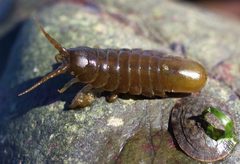
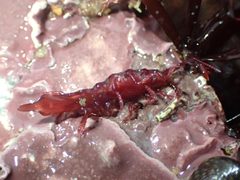
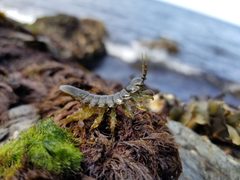
Valvifera is a suborder of marine isopod crustaceans distinguished by their unique valve-like uropods that hinge laterally and fold inward beneath the rear of the body, covering the pleopods. The suborder comprises twelve recognized including Idoteidae, Arcturidae, and Chaetiliidae. Members occupy marine from shallow coastal waters to deep sea environments, with distributions spanning temperate and polar regions as well as Australasia.
Pronunciation
How to pronounce Valvifera: /vælˈvɪfəra/
These audio files are automatically generated. While they are not always 100% accurate, they are a good starting point.
Identification
Presence of laterally hinged, valve-like uropods that fold inward to cover the pleopods distinguishes Valvifera from all other isopod suborders. -level identification requires examination of pleopod structure, particularly the male first pleopod (exopod with lateral secondary ramus in Austrarcturellidae), pleotelson shape (inverted flat-bottomed boat-shape in Austrarcturellidae), and pereopod dactylus .
Images
Habitat
Exclusively marine. occur in shallow macroalgae and sea-grass , particularly in temperate waters, as well as deep-water environments including continental slopes and abyssal depths. Some restricted to specific depth zones: Idoteidae predominantly shallow coastal, Austrarcturellidae spanning shelf and slope depths.
Distribution
Global marine distribution with concentration in temperate Southern Hemisphere waters. Documented from Australia (southern coast between Sydney and Perth), New Zealand (south of Wellington), Japan (Hakodate Bay), Argentina, and deep-water localities in eastern Australia.
Diet
Some are and function as scavengers. Specific dietary composition varies by and species; many shallow-water species associated with macroalgae and sea-grass likely consume plant material and associated detritus.
Behavior
Locomotion by swimming or crawling has been observed in some . Females of at least one species (Arcturella sawayae) carry young on the for a period, though this has not been demonstrated to enhance or survival.
Ecological Role
Effective scavengers contributing to marine nutrient cycling. Shallow-water in macroalgae and sea-grass likely serve as herbivores and within these .
Similar Taxa
- Other Isopoda subordersDistinguished by the unique valve-like uropod structure; all other isopod suborders lack uropods that hinge laterally and fold inward to cover the pleopods.
More Details
Family Diversity
Twelve recognized: Antarcturidae, Arcturidae, Arcturididae, Austrarcturellidae, Chaetiliidae, Holidoteidae, Holognathidae, Idoteidae, Pseudidotheidae, Rectarcturidae, Thermoarcturidae, and Xenarcturidae.
Sources and further reading
- BugGuide
- Wikipedia
- iNaturalist taxon
- NCBI Taxonomy
- Catalogue of Life
- Idoteidae of Australia and New Zealand (Crustacea : Isopoda : Valvifera)
- Behavioral aspects of Arcturella sawayae Moreira, 1973 (Crustacea, Isopoda, Valvifera)
- Austrarturellidae (Crustacea : Isopoda : Valvifera), a new family from Australasia
- The growth, reproduction and body color pattern of Cleantiella isopus (Isopoda: Valvifera) in Hakodate Bay, Japan
- A new isopod species of the genus Edotia (Valvifera, Idoteidae) from Argentina, with a key to South American species.