
Ligia baudiniana
H. Milne Edwards, 1840
Central American Seaslater
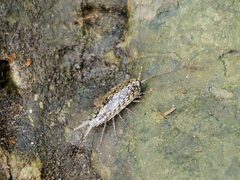
A large intertidal isopod (sea slater) native to the Greater Caribbean region, reaching 25–30 mm in body length. Distinguished from by long uropods exceeding two-thirds body length and brush-like structures on the first pair of legs in males. Exhibits strong fidelity to natural mangrove forests and rocky intertidal zones, with documented sensitivity to coastal development. Serves as intermediate for digenean trematodes.
Pronunciation
How to pronounce Ligia baudiniana: /ˈlaɪdʒiə ˌboʊdɪˈniːənə/
These audio files are automatically generated. While they are not always 100% accurate, they are a good starting point.
Identification
Distinguished from Ligia oceanica by uropods longer than two-thirds body length (L. oceanica has uropods much shorter). Distinguished from Ligia exotica by presence of brush-like structures on first pair of legs in males (L. exotica males lack these, having instead a process). Coarsely body surface with large, closely-set .
Images
Habitat
Coastal mangrove forests and rocky intertidal zones. Found exclusively in natural mangrove ; absent from artificial substrates and developed shorelines even when these are present nearby.
Distribution
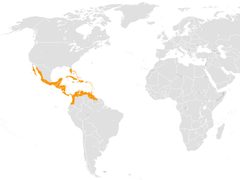
Greater Caribbean region including Caribbean islands, Bermuda, Bahamas, southern Florida (Florida Keys, Everglades), and Gulf of Mexico coast of Florida (Sarasota-Manatee counties, representing ~300 km northward range extension from Florida Bay). Pacific coastlines of Central America to Ecuador.
Diet
Feeds on unicellular green coating intertidal rocks, rasped off with vertical movement of the body.
Behavior
Nocturnally active, emerging in large numbers at low tide to forage on exposed rocks. Retreats as water returns but requires moisture to maintain gill function; never found more than 21 m from shore. Cannot survive extended submersion in seawater. Hydrates by turning away from water and dipping uropods to draw water up via oscillation of uropodal spines. Exhibits color change (lightening or darkening) in response to background substrate.
Ecological Role
Intermediate for digenean trematodes (Megalophallus spp.). for natural mangrove integrity; native displaced by introduced Ligia exotica in areas where coastal development removes mangrove habitats.
Similar Taxa
- Ligia oceanicaIntroduced European with shorter uropods (less than two-thirds body length)
- Ligia exoticaIntroduced with males lacking brush-like leg structures; occupies artificial where L. baudiniana is absent
Sources and further reading
- BugGuide
- Wikipedia
- GBIF taxonomy match
- iNaturalist taxon
- NCBI Taxonomy
- Catalogue of Life
- Super Crop Challenge #8 | Beetles In The Bush
- Isopoda | Beetles In The Bush
- A new species of Megalophallus (Digenea: Microphallidae) from the clapper rail, other birds, and the littoral isopod Ligia baudiniana
- First record of the Ligia baudiniana species complex in the American Gulf of Mexico Coastline, as confirmed by morphological and molecular approaches