
Ligidium
Brandt, 1833
Rock Slaters
Species Guides
6- Ligidium blueridgensis
- Ligidium elrodii(Eastern Rockslater)
- Ligidium gracile(Western Rockslater)
- Ligidium kofoidi(Kofoid's Rockslater)
- Ligidium lapetum(Sierra Nevada Rockslater)
- Ligidium latum(Broad Rockslater)
Ligidium is a of small, forest-dwelling woodlice (terrestrial isopods) in the Ligiidae, containing approximately 46–68 with ongoing taxonomic revision. The genus exhibits exceptional genetic differentiation and cryptic diversity, with often showing high isolation even over short geographic distances. Species are distributed across temperate regions of the Northern Hemisphere, with notable radiations in Japan, Greece, Turkey, the Caucasus, Central Asia, China, Taiwan, and North America. Ligidium has been proposed as a paleogeological marker organism due to its strong correlation between phylogenetic patterns and regional geological history.
Pronunciation
How to pronounce Ligidium: //lɪˈdʒɪdiəm//
These audio files are automatically generated. While they are not always 100% accurate, they are a good starting point.
Identification
Identification to level requires examination of male pleopod 2 endopod , particularly the number and arrangement of denticles at the inner margin. Molecular analysis (COI, 12S rRNA, 16S rRNA) is often necessary due to high morphological similarity among species and presence of cryptic diversity. Geographic origin provides important context given strong regional genetic structuring. Greek and Japanese in particular show extensive cryptic speciation not reflected in external morphology.
Images
Appearance
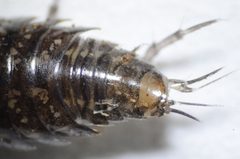
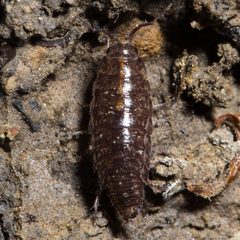
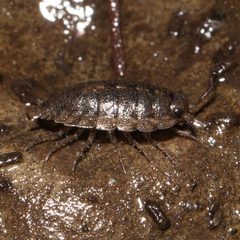
Small to medium-sized woodlice with elongated, somewhat flattened bodies. Members of Ligiidae typically possess long and a body form adapted for moving through leaf litter and soil crevices. Male reproductive , particularly the pleopod 2 endopod with -specific denticle patterns, serves as a key diagnostic character for species identification. Species within the show high morphological similarity, making external characters alone often insufficient for reliable identification.
Habitat
Strictly associated with forest and woodland ; exhibits strong preference for moist, shaded environments with abundant leaf litter and decaying organic matter. Dislikes dry conditions. In Japan, found across diverse forested habitats from Hokkaido to subtropical islands. Greek occupy forested areas including mountain regions and islands. Chinese include high-elevation 'sky-island' .
Distribution
Temperate Northern Hemisphere with disjunct regional radiations: North America (8 ), Japan (6 species), Taiwan (2 species), China (4+ species), Turkey/Caucasus/Central Asia (12 species), and Greece (6 species). European records include Denmark, Norway, and Sweden. Japanese distribution spans Hokkaido, Honshu (northeastern and southwestern arcs), Shikoku, and islands including Sado, Oki, Tsushima, Fukue, and Okinawa.
Behavior
Low mobility; not highly dispersive. exhibit extreme genetic isolation even between nearby localities. Sensitive to environmental disturbances including climate change and volcanic activity. Japanese populations show evidence of repeated range contractions and expansions in response to Quaternary glacial-interglacial cycles, with bottleneck effects in Hokkaido during the Last Glacial Maximum.
Ecological Role
Proposed as a paleogeological marker organism for reconstructing regional geological, geographical, and paleoenvironmental history. The 's low ability, strict specialization, and strong phylogeographic structure make it useful for inferring past landscape changes. Can increase spatial resolution of reconstructed paleoenvironments through dense spatial sampling. Functions as a decomposer in forest floor .
Human Relevance
Subject of phylogeographic and systematic research due to its utility as a model for understanding historical and cryptic speciation. No significant direct economic or medical importance reported. Vulnerable to destruction due to strict forest specialization and limited ability; Greek island identified as extremely vulnerable to extinction.
Similar Taxa
- LigiaBoth belong to Ligiidae and share elongated body form, but Ligia are generally larger, more coastal or littoral in distribution, and more morphologically distinct; Ligidium is strictly forest-dwelling and smaller
- Other Oniscidea genera (e.g., Porcellio, Armadillidium)Ligidium differs in -level characters including body proportions, length, and preference; Ligiidae are more elongate and associated with moist forest habitats versus the more rounded, often drier-habitat forms of many other woodlice families
More Details
Cryptic Diversity
Multiple studies document extensive cryptic speciation within Ligidium. The L. japonicum complex alone contains more than five morphologically distinct, allopatrically distributed . Greek show sympatric differentiation of with mosaic distributions in the Peloponnese.
Phylogeographic Significance
Japanese Ligidium reflects major geological events: separation of the Honshu arc near Fossa Magna (22–7 Ma), submersion of northeastern Japan until 3 Ma, and subsequent glacial-interglacial cycles. Eight monophyletic mtDNA clades were identified with divergence times around 7–3.5 Ma and after 3 Ma.
Conservation Concern
Greek island represent unique genetic pools with extremely high genetic differentiation (NST = 0.96) and are considered extremely vulnerable to extinction due to small population sizes and strict ecological specialization.
Sources and further reading
- BugGuide
- Wikipedia
- GBIF taxonomy match
- iNaturalist taxon
- NCBI Taxonomy
- Catalogue of Life
- History of the terrestrial isopod genus Ligidium in Japan based on phylogeographic analysis
- Integrative taxonomy reveals two new species of Ligidium (Crustacea, Isopoda, Oniscidea) from China
- Molecular phylogeny of the Greek populations of the genus Ligidium (Isopoda, Oniscidea) using three mtDNA gene segments
- Increased genetic diversity in Greek populations of the genus Ligidium (Crustacea: Isopoda: Oniscidea) revealed by RFLP analysis of mtDNA segments
- Phylogeographic analysis of Ligidium japonicum (Isopoda: Ligiidae) and its allied species reveals high biodiversity and genetic differentiation in the Kanto region, Japan
- Uncovering gut microbial diversity in Ligidium woodlice and its correlation with Rickettsiella.
- Integrative taxonomy on the rare sky-island Ligidium species from southwest China (Isopoda, Oniscidea, Ligiidae).