
Tylos
Audouin, 1826
Calloused Beach Pillbugs
Species Guides
2- Tylos niveus(Snowy Calloused Beach Pillbug)
- Tylos punctatus(Spotted Calloused Beach Pillbug)
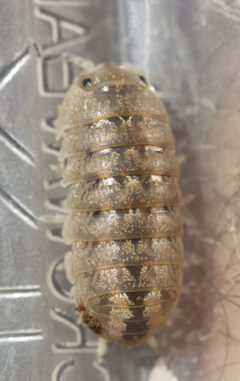
Tylos is a of terrestrial isopods (woodlice) in the Tylidae, commonly known as calloused beach pillbugs. These crustaceans are specialized inhabitants of sandy coastal environments, living in the supralittoral zone above the driftline on ocean beaches. They exhibit remarkable adaptations for life in this harsh , including powerful burrowing abilities, strong desiccation resistance, and behavioral synchronization with tidal and diel cycles. Most are , emerging at night to feed on beach-cast organic material such as kelp and other detritus.


Pronunciation
How to pronounce Tylos: /ˈtaɪ.lɒs/
These audio files are automatically generated. While they are not always 100% accurate, they are a good starting point.
Images
Habitat
Supralittoral zone of sandy ocean beaches; individuals burrow into sand to depths of up to one meter or more, typically above the driftline. Some occur on rocky shores in sympatry with sandy-beach relatives.
Distribution
Coastal regions worldwide; documented from South Africa, Persian Gulf, Red Sea (Sudan, Eritrea), Socotra Island, Chile, and other sandy beach localities. Specific distributions vary by .
Diet
, feeding primarily on beach-cast kelp and other organic debris washed up on shore.
Behavior
Strongly , emerging from sand burrows at night to forage. Exhibits pronounced negative (avoidance of light) and thigmotaxis (preference for contact with surfaces/edges). Activity patterns are synchronized with tidal and diel cycles to minimize risk and desiccation. Burrowing involves specialized division of labor among pereiopods: pairs dig, middle pairs compact excavated sand, and pair pushes material behind the animal. Burrowing is accompanied by clockwise or anticlockwise partial of the body in stepwise progression.
Ecological Role
processing beach-cast organic material, contributing to nutrient cycling in coastal . Serves as prey for various shorebirds and other coastal .
More Details
Physiological adaptations
Tylos possess remarkable water conservation abilities and can survive extended periods of desiccation, an essential for life in the exposed supralittoral zone. Hepatopancreatic concentrations in some species resemble those of more marine isopods despite their terrestrial .
Burrowing mechanics
With a Burrowing Rate Index of 3, Tylos granulatus is considered a powerful burrower. The energy cost of burrowing is surprisingly low at approximately 0.3 J m⁻¹, indicating efficient biomechanical .
Taxonomic notes
identification relies on subtle morphological characters such as pereopod margin structure and pleopod proportions. Molecular studies of Tylos maindroni from the Persian Gulf revealed low levels of population structuring across sampled locations.
Sources and further reading
- BugGuide
- Wikipedia
- iNaturalist taxon
- NCBI Taxonomy
- Catalogue of Life
- Big, black (and red), and beautiful! | Beetles In The Bush
- Belostomatidae | Beetles In The Bush
- Halictidae | Beetles In The Bush
- Burrowing Behaviour and Cost in the Sandy-Beach Oniscid Isopod Tylos Granulatus Krauss, 1843
- ON THE NOCTURNAL BEHAVIOR OF TYLOS GRANULATUS MIERS (CRUSTACEA : ISOPODA)
- Behavioural Adaptions of the Isopod Tylos Granulatus Krauss
- The Biology of Oniscid Isopoda of the Genus Tylos
- Copper Concentrations in the High‐Beach Isopod Tylos Punctatus
- Redescription of Tylos maindroni Giordani Soika, 1954 (Crustacea, Isopoda, Oniscidea) based on SEM and molecular data
- Contrasting Phylogeographic Patterns of Sandy vs. Rocky Sympatric Sister Species of Supralittoral Tylos Isopods in Chile.