
Ligia occidentalis
Dana, 1853
Western Sea Slater
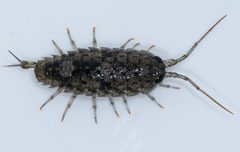
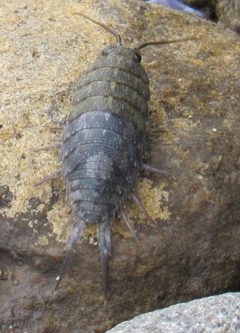
Ligia occidentalis is a supralittoral isopod inhabiting rocky shorelines along the eastern Pacific coast. The occupies the high intertidal zone, hiding in crevices above the high tide line during daytime to avoid desiccation and emerging nocturnally to feed. It is distinguished from the sympatric Ligia pallasii by longer uropods, larger set closer together, and a sleeker body form. The species harbors mycoplasma-like bacteria as hepatopancreas and shows remarkable morphological stasis across highly genetically divergent lineages.
Pronunciation
How to pronounce Ligia occidentalis: /ˈlɪd͡ʒiə ˌɒksɪˈdɛntəlɪs/
These audio files are automatically generated. While they are not always 100% accurate, they are a good starting point.
Identification
Distinguished from Ligia pallasii by three consistent morphological differences: (1) uropods substantially longer relative to body length, (2) larger in size and positioned closer together medially, and (3) overall sleeker, more streamlined body profile. These characters are visible in specimens without magnification. The cannot be reliably identified by body shape alone due to strong stabilizing selection maintaining morphological similarity across genetically divergent .
Images
Habitat
High rocky intertidal zone, specifically the supralittoral fringe above the high tide line. Occupies crevices and spaces under rocks in cliff and boulder fields. Requires moist microhabitats for respiratory function but cannot survive prolonged submersion.
Distribution
Pacific coast of North America from southern Oregon to Baja California, Mexico, including the Gulf of California. Sympatric with Ligia pallasii between southern Oregon and central California; the two partition vertically with L. occidentalis occupying higher intertidal positions.
Diet
constitute the preferred food source, including both microalgae and macroalgae; also consumes detritus. foraging occurs along beaches and rocky cliffs when conditions are cooler and humidity is higher.
Behavior
: hides in rocky crevices above the high tide line during daylight hours to prevent desiccation. to forage when temperature and humidity conditions permit. Exhibits rapid escape response ('bolting') when disturbed. Must maintain moist gills for respiration; will drown if submerged for extended periods.
Ecological Role
Herbivore and in high intertidal rocky shore . Contributes to nutrient cycling through algal consumption and processing of organic detritus. Serves as for mycoplasma-like bacterial in the hepatopancreas.
Similar Taxa
- Ligia pallasiiOverlapping distribution from southern Oregon to central California; distinguished by shorter uropods, smaller and more widely separated , and stockier body form; occupies lower intertidal positions than L. occidentalis where sympatric.
Sources and further reading
- BugGuide
- Wikipedia
- GBIF taxonomy match
- iNaturalist taxon
- NCBI Taxonomy
- Catalogue of Life
- Bumble Bees: Feeling Impact of Climate Change | Bug Squad
- Probing the Molecular Interactions Between Western Flower Thrips and the Tomato Spotted Wilt Virus | Bug Squad
- Flabellate Grasshopper
- Good News for the Western Bumble Bee, Bombus occidentalis
- A sting to kill a cow? Red velvet ant, a.k.a. cow killer, Dasymutilla occidentalis — Bug of the Week
- Super Crop Challenge #8 | Beetles In The Bush
- Chromatophore Behavior in the Isopod Ligia Occidentalis Dana, 1853
- Distribution, habitat and food preferences of sympatric high intertidal isopod speciesLigia occidentalisandLigia pallasii(Ligiidae: Oniscidea)
- Sea-land transitions in isopods: pattern of symbiont distribution in two species of intertidal isopods Ligia pallasii and Ligia occidentalis in the Eastern Pacific
- Constrained body shape among highly genetically divergent allopatric lineages of the supralittoral isopod Ligia occidentalis (Oniscidea)