
Ligia pallasii
Brandt, 1833
Sleepy Seaslater, Rock Louse, Sleepy Sea Slater
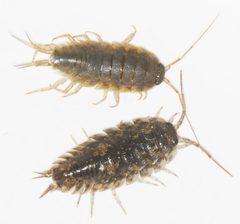
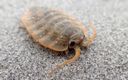
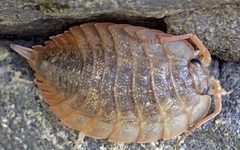
Ligia pallasii is a large, semiterrestrial isopod in the Ligiidae, commonly known as the sleepy seaslater or rock . It is among the largest sea slaters, reaching 25–30 mm in body length. This inhabits the high intertidal zone along the Pacific coast of North America, from the Aleutian Islands to northern California. It exhibits scavenging , feeding primarily on and organic matter, and seeks shelter in moist microhabitats during daylight hours to avoid desiccation.
Pronunciation
How to pronounce Ligia pallasii: /ˈlɪɡiə ˈpælsiˌaɪ/
These audio files are automatically generated. While they are not always 100% accurate, they are a good starting point.
Identification
Distinguished from other Ligia by morphological features including the structure of male first leg pair (brush-like structures present in L. pallasii versus absent in L. exotica) and relative uropoda length (longer than in L. oceanica). In sympatric areas, may be distinguished from L. occidentalis by specific microhabitat preferences and subtle morphological differences. The large size and high intertidal rocky help distinguish it from smaller, more terrestrial isopods like Armadillidium.
Images
Habitat
Strictly associated with the high intertidal zone (supralittoral) of rocky shores. Occupies crevices, spaces under rocks, and vertical rock in the upper intertidal region. Young individuals show strong preference for moist microhabitats, actively seeking sheltered, humid environments with negative and thigmotaxis. Microenvironmental conditions of relative humidity and temperature remain relatively uniform regardless of time of day or weather.
Distribution
Pacific coast of North America, ranging from the Aleutian Islands southward to northern California. Sympatric with Ligia occidentalis in parts of its range.
Seasonality
Active year-round in suitable microhabitats, with foraging activity peaking during favorable conditions. Breeding occurs primarily in spring and early summer, with some females carrying winter .
Diet
Primarily algivorous; feeds on various algal available in the high intertidal . Scavenges on organic matter including seaweed. Feeding activity shows diel patterns, with digestion and absorption peaks in late morning following foraging.
Life Cycle
Lifespan of 1.5 to 2 years. Breeding occurs in spring and early summer, though some females carry winter . Mean brood size is 48±11 . Females brood eggs in a marsupium. Development involves direct development without free-living larval stages. Frequent moulting throughout life, with reconstruction during each moult cycle involving progressive mineral resorption and deposition.
Behavior
Strictly , emerging from shelter at night to forage on exposed rock surfaces and in intertidal pools. Seeks in dark, moist microhabitats during daylight to prevent desiccation. Exhibits thigmotactic (preference for contact with surfaces) and negative . Shows partitioning with sympatric Ligia occidentalis through differential microhabitat use within the high intertidal zone.
Ecological Role
Herbivore and scavenger in high intertidal rocky shore . Contributes to algal consumption and nutrient cycling in the supralittoral zone. Represents a transitional form between fully marine and fully terrestrial isopods, providing insight into terrestrial by crustaceans.
Human Relevance
Serves as a research model for studying crustacean formation, moulting processes, and physiological adaptations to semiterrestrial life. Cuticle structure has been studied extensively using CT scanning and electron microscopy. Also used in studies of osmotic and the evolutionary transition from marine to terrestrial in isopods.
Similar Taxa
- Ligia occidentalisSympatric in parts of range; distinguished by microhabitat partitioning and subtle morphological differences
- Ligia oceanicaIntroduced European with shorter uropoda (less than 2/3 body length versus longer in L. pallasii)
- Ligia exoticaMales lack brush-like structures on first leg pair that are present in L. pallasii
- Armadillidium vulgareCommon terrestrial isopod, much smaller, fully terrestrial, and capable of conglobation (rolling into ball)
More Details
Cuticle Biology
The of L. pallasii is a unique biocomposite and biodynamic material that undergoes constant reconstruction during frequent moults. Cuticle formation involves elaboration of epicuticular connected to an extensive network of nanotubules, establishing anti-adhesive and hydrophobic properties. Mineral components show progressive resorption from to during premoult, during intramoult, and deposition during postmoult.
Physiological Adaptations
As a prototypal land isopod, L. pallasii maintains despite challenges from dietary salt-loading from its seaweed diet. Late-morning peaks in hemolymph osmolality coincide with digestion and absorption activity. The demonstrates how early terrestrial isopods managed osmotic challenges during the transition from marine to terrestrial environments.
Sources and further reading
- BugGuide
- Wikipedia
- GBIF taxonomy match
- iNaturalist taxon
- NCBI Taxonomy
- Catalogue of Life
- Super Crop Challenge #8 | Beetles In The Bush
- Isopoda | Beetles In The Bush
- Microhabitat Preferences of Young Ligia Pallasii Brandt (Isopoda)
- Studies on the growth, reproduction, and life cycle of the supralittoral isopod Ligia pallasii
- Distribution, habitat and food preferences of sympatric high intertidal isopod speciesLigia occidentalisandLigia pallasii(Ligiidae: Oniscidea)
- Sea-land transitions in isopods: pattern of symbiont distribution in two species of intertidal isopods Ligia pallasii and Ligia occidentalis in the Eastern Pacific
- Microscopy of crustacean cuticle: formation of a flexible extracellular matrix in moulting sea slaters Ligia pallasii
- Hemolymph homeostasis in relation to diel feeding activity and microclimate in the prototypal land isopodLigia pallasii