
Mastophora
Holmberg, 1876
bolas spiders, American bolas spiders
Species Guides
8- Mastophora bisaccata(Mastaphora obesa)
- Mastophora cornigera(Southern Bolas Spider)
- Mastophora hutchinsoni(American bolas spider)
- Mastophora leucabulba
- Mastophora phrynosoma(Toadlike Bolas Spider)
- Mastophora stowei(Bolas spider)
- Mastophora timuqua(Bolas spider)
- Mastophora yeargani(Yeargan's Bolas Spider)
Mastophora is a of orb-weaver spiders in the Araneidae, commonly known as bolas spiders. These spiders have abandoned the typical orb-web construction of their relatives and instead hunt using a unique method: they produce a single droplet of sticky silk suspended on a thread (the "bolas") and swing it to capture flying prey. females are that use aggressive chemical mimicry, releasing to attract specific male moth within range of their bolas. The genus includes 15 species in the United States, with Mastophora cornigera being the only species found in California.
Pronunciation
How to pronounce Mastophora: //mæˈstɒfərə//
These audio files are automatically generated. While they are not always 100% accurate, they are a good starting point.
Identification
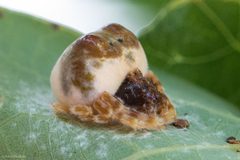
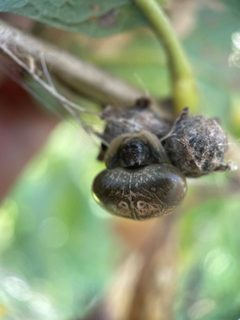
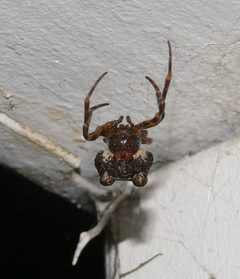
females can be recognized by their cryptic, bird-dropping-like coloration with light streaks mimicking deposits. They possess a pair of lumps on the surface of the opisthosoma (). Males are diminutive and emerge from sacs as penultimates, undergoing only one before maturity, making them much smaller than females. Egg sacs are black and white mottled and often provide the first clue to a spider's presence, as the spiders themselves hide during daylight hours.
Images
Habitat
hunters that hide during daylight on the underside of leaves or camouflaged on upper leaf surfaces with silk splatter. females hunt in open areas, positioning themselves at tree crowns or internally within foliage. Specific hunting substrates include hackberry trees (Celtis sp.) in farmland and fence line areas. Spiderlings position themselves on leaf margins.
Distribution
occurs in the Americas. Fifteen in the United States; Mastophora cornigera is the only species in California. Eastern North American species (e.g., M. hutchinsoni) studied in Kentucky. One Central American species, M. dizzydeani, named for its spinning .
Seasonality
(one per year) in temperate regions. Spiderlings emerge in May; males mature late June to early July; females mature early September; produced late September to early November.
Diet
females exclusively prey on male , specifically few Noctuidae (bristly cutworm, bronzed , smoky tetanolita) and one Pyralidae species (bluegrass webworm). Two species (smoky tetanolita and bristly cutworm) accounted for 93% of 492 prey captured in one study. Spiderlings prey on small arthropods crawling along leaf margins, specifically male humpbacked flies (Phoridae).
Life Cycle
Overwinters in stage. Spiderlings emerge in May and use ambush hunting on leaf margins. Late-stadia and females transition to bolas hunting technique. Males mature earlier than females (protandry).
Behavior
; emerges from hiding at sunset, activity typically ends by 10:30 p.m. Creates solitary capture strand with one large glue droplet (bolas) containing coiled 'windlass' thread. Flicks bolas at approaching prey while dangling from one leg. Exhibits aggressive chemical mimicry: produces compounds mimicking of specific male . Can alter blend throughout evening to match different moth species active at different times (bristly cutworm soon after nightfall, smoky tetanolita between 11:00 p.m. and dawn). Glue droplet exhibits spring-like viscoelastic , stretching during flicking and rebounding to spherical shape when missing.
Ecological Role
of male ; part of Cyrtarachninae that evolved specific adaptations to defeat moth anti-predator defenses (sacrificial that normally allow moths to escape typical orb webs). May influence moth mating dynamics through selective on males attracted to mimics.
Similar Taxa
- Cyrtarachne akiraiAnother - spider in Cyrtarachninae that uses modified orb-web structure, but Mastophora has evolved further to use a single bolas thread rather than any web structure; glue material properties also differ
- Cladomelea debeeriSouth African bolas spider with similar hunting technique, but in a different ; Mastophora is restricted to the Americas
Sources and further reading
- BugGuide
- iNaturalist taxon
- NCBI Taxonomy
- Catalogue of Life
- Bug Spotlight | Entomology Research Museum
- UC Davis Chemical Ecologist Walter Leal Says We're Like Bolas Spiders: Here's Why! | Bug Squad
- Botanizing at Meramec State Park, Natural Wonders Trail | Beetles In The Bush
- Itty bitty tiny little flies | Beetles In The Bush
- Behavior and Bioadhesives: How Bolas Spiders, Mastophora hutchinsoni, Catch Moths
- The Natural History and Behavior of the Bolas Spider Mastophora Dizzydeani SP. n. (Araneidae)
- Ecology of a bolas spider, Mastophora hutchinsoni: phenology, hunting tactics, and evidence for aggressive chemical mimicry
- Contents of Egg Sacs of a Bolas Spider, <I>Mastophora sp</I>. (Araneae, Araneidae), Infested with a Parasitoid Wasp,<I> Arachnophaga sp</I>. (Insecta, Eupelmidae): A Light Microscopy Examination