Mastophora hutchinsoni
Gertsch, 1955
American bolas spider, Cornfield Bolas Spider
Mastophora hutchinsoni is a bolas spider in the orb-weaver Araneidae, notable for its highly specialized hunting strategy that abandons the typical orb web in favor of a single adhesive droplet on a silk thread. females use aggressive chemical mimicry to attract male by releasing -specific blends, then capture prey by swinging this 'bolas' at hovering moths. The species exhibits extreme , with females developing into large, globular spiders while males remain small and retain hunting . It occurs throughout eastern North America and has been extensively studied in Kentucky .
Pronunciation
How to pronounce Mastophora hutchinsoni: //ˌmæstəˈfɔːrə ˌhʌtʃɪnˈsoʊnaɪ//
These audio files are automatically generated. While they are not always 100% accurate, they are a good starting point.
Identification
Distinguished from other orb-weavers by the absence of a typical two-dimensional orb web; females construct only a single horizontal thread with a terminal adhesive bolas. The extreme separates females from males—females are large with globular white-and-brown , males are small and reddish-brown. Distinguished from other Mastophora by geographic range (northeastern North America) and specific mimicry targeting Noctuidae and Pyralidae . sacs are identifiable by their spherical shape with extended stems, black-and-white mottled appearance, and attachment to twigs or branches.
Images
Appearance
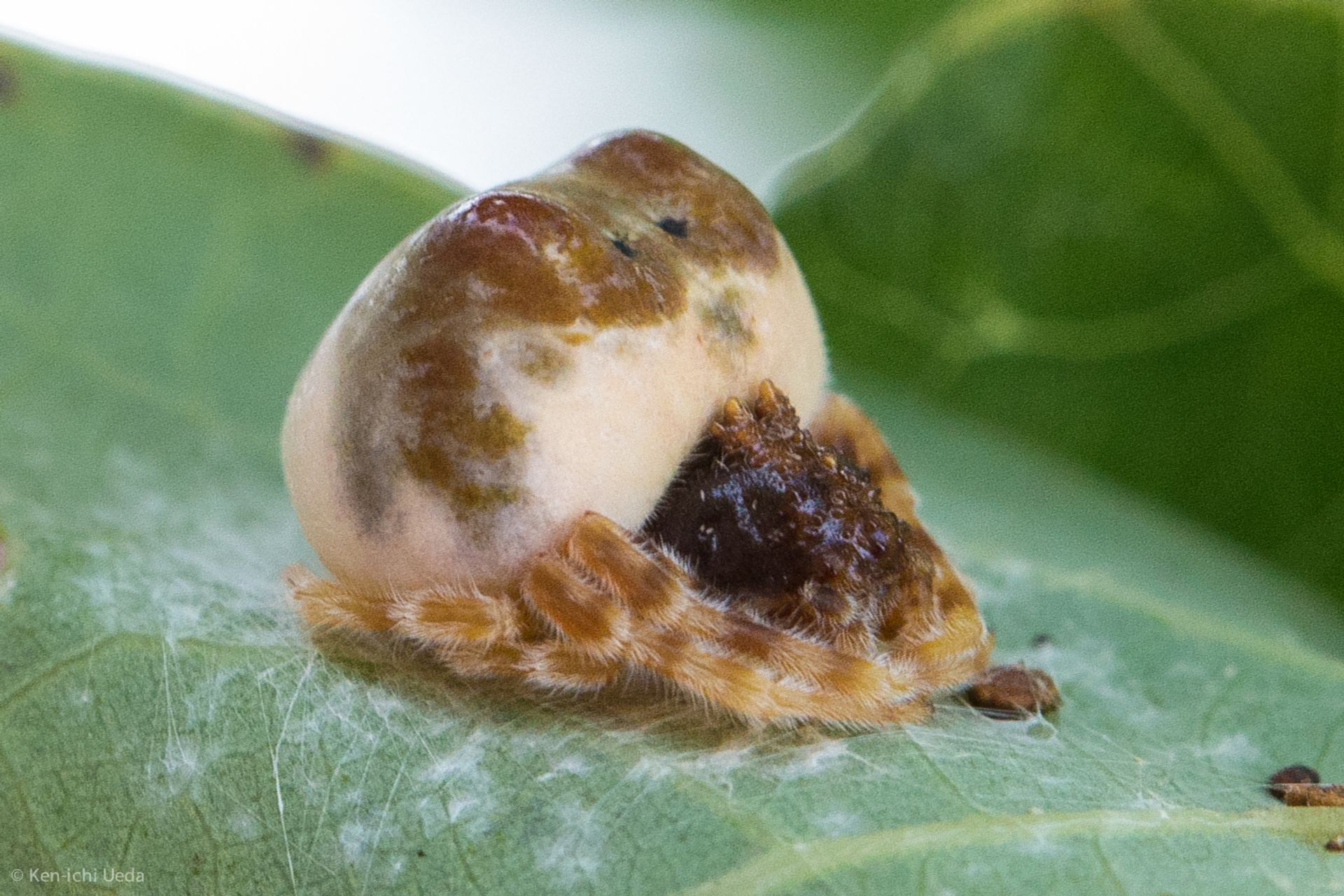
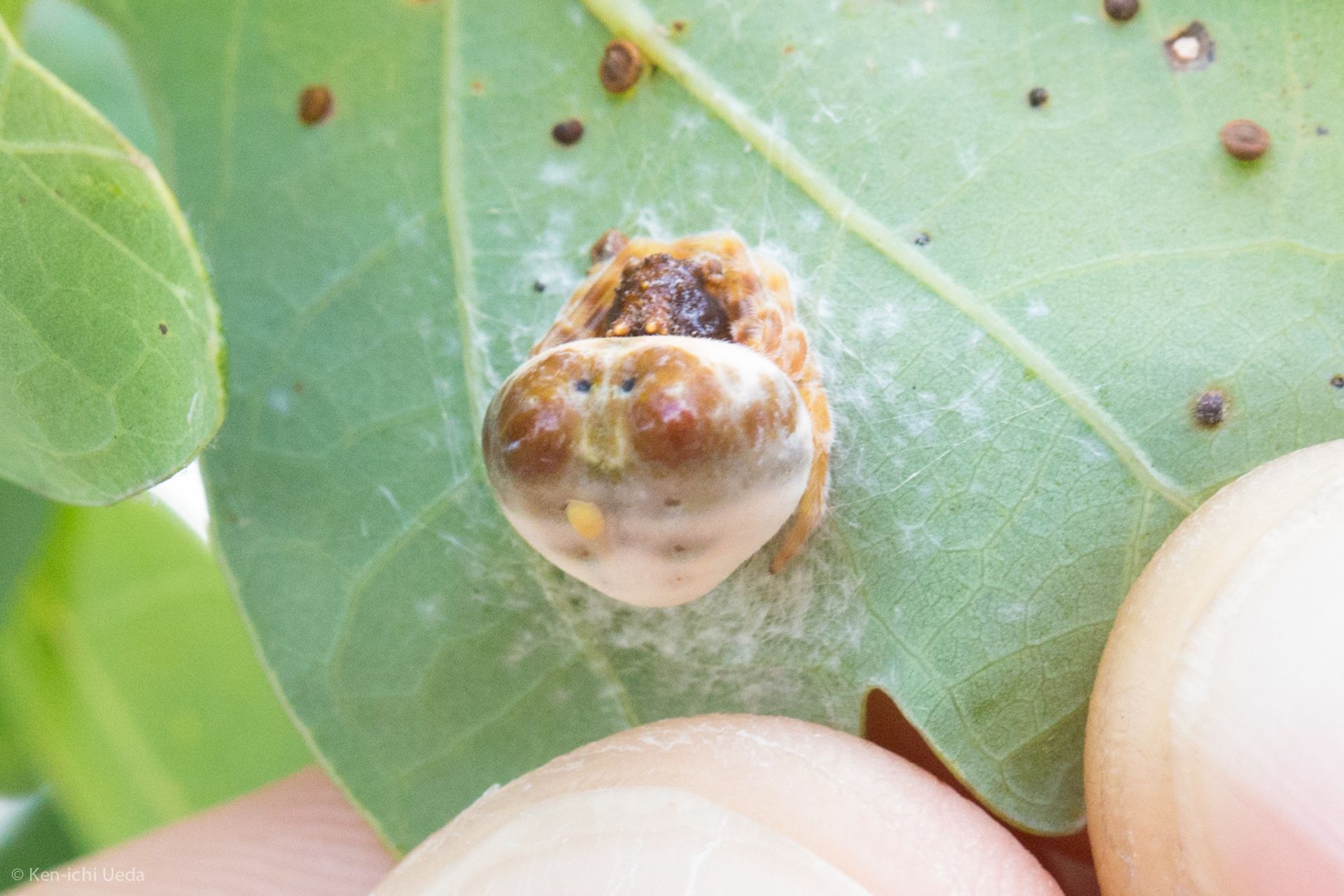
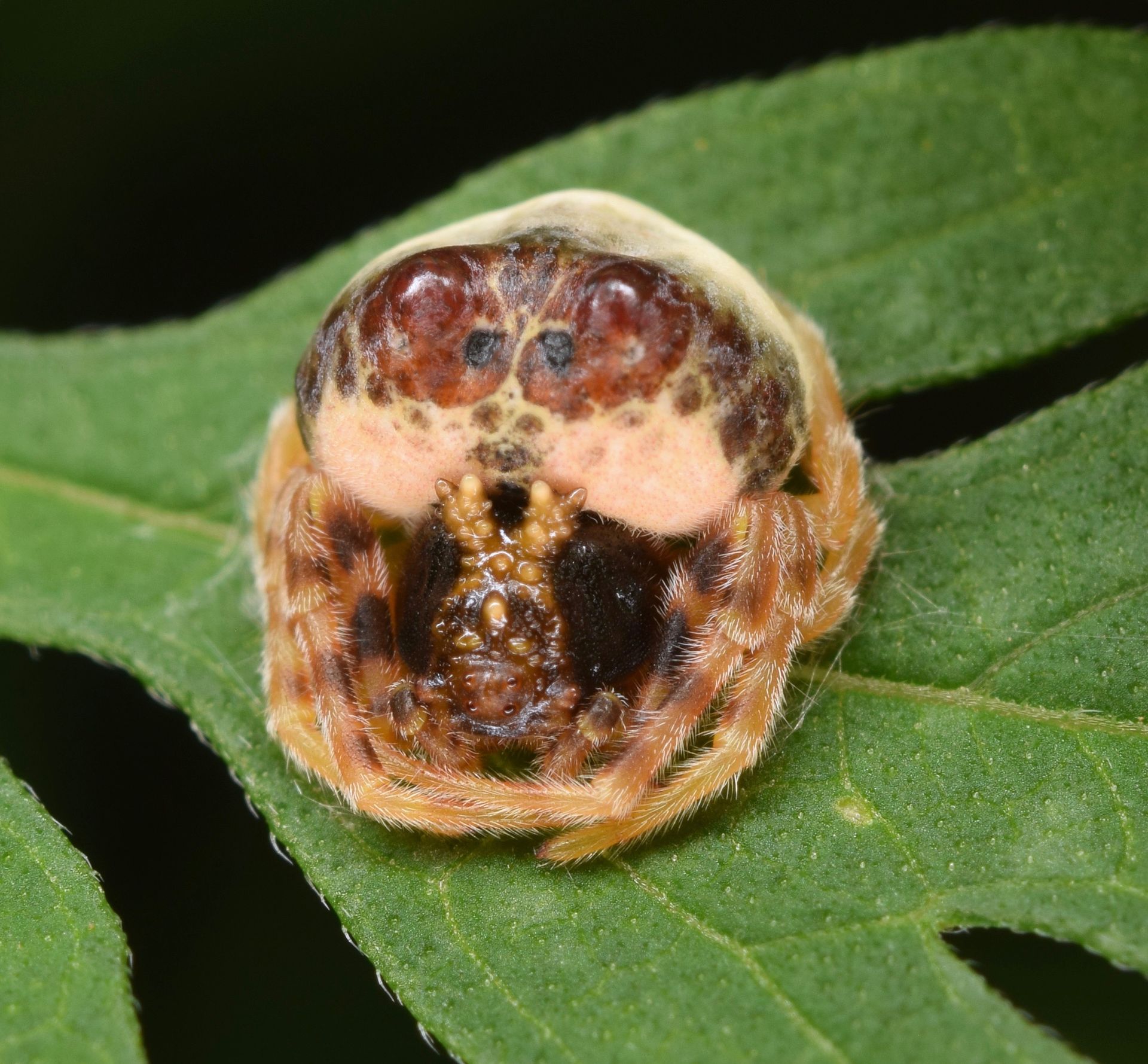
females possess a large spherical with milky white base coloration overlaid with darker brown patterns, combined with a smaller brown . The globular abdomen serves as defensive camouflage, resembling bird droppings on leaves. Males are dramatically smaller, with reddish-brown coloration, and retain bristles on their front legs that females lose after maturation. Both sexes hatch with length around 0.5 mm, but females develop into significantly larger specimens. sacs are spherical with extended stems up to 36 mm long, surrounded by protective layers and off-white silk, with globose vessels approximately 8 mm in diameter.
Habitat
Occupies shrubs and short trees, particularly hackberry (Celtis sp.) in observed . Females position themselves at the crown (outer near sun leaves) or internally (inner canopy near shade leaves), constructing bridge threads between leaf tips or branches. Frequently relocates by riding wind-borne silk threads to follow prey availability. Utilizes leaf undersides or upper leaf surfaces with silk splatter as daytime hiding spots.
Distribution
Eastern North America, ranging from Minnesota to New Hampshire in the northeastern United States. One of five Mastophora documented from the United States. Absent from western North America, where M. cornigera occurs instead.
Seasonality
with distinct phenological stages: spiderlings emerge in May; males mature late June to early July; females mature early September; produced from late September to early November; overwinters in egg stage. females hunt nocturnally, emerging at sunset and remaining active until approximately 10:30 p.m. or later, with hunting periods shifting to match activity patterns of different throughout the night.
Diet
females exclusively capture male using bolas technique, primarily two Noctuidae : bristly cutworm (Lacinipolia renigera, comprising two-thirds of prey ) and smoky tetanolita (Tetanolita mynesalis), together accounting for 93% of 492 documented prey captures; also bronzed (Nephelodes minians) and bluegrass webworm (Pyralidae). Spiderlings and adult males capture small arthropods—spiderlings ambush crawling prey on leaf margins using bristled front legs, while males retain similar hunting tactics and prey on psychodid flies.
Host Associations
- bristly cutworm moth (Lacinipolia renigera) - preyPrimary prey ; active soon after nightfall
- smoky tetanolita moth (Tetanolita mynesalis) - preySecondary prey ; active between 11:00 p.m. and dawn
- bronzed cutworm moth (Nephelodes minians) - preyTertiary prey
- bluegrass webworm moth (Pyralidae) - preyMinor prey component
- hackberry (Celtis sp.) - Observed hunting substrate in Kentucky
Life Cycle
cycle: laid in spherical sacs with extended stems, attached to twigs or branches; occurs in egg stage; spiderlings emerge in spring (May); males develop rapidly, reaching maturity by late June to early July; females develop more slowly, maturing in early September; after maturation gap, males leave their webs and reside in webs of developing females to await mating; eggs produced from late September through late October or early November.
Behavior
females exhibit four distinct behavioral states: questing without bolas, creating bolas and questing with it, capturing with bolas, and consuming prey. Constructs solitary capture strand with single large glue droplet (approximately 2 mm diameter) containing coiled 'windlass' thread; flicks bolas at hovering moths after detecting wing vibrations via leg hairs. Glue droplet exhibits spring-like elastic , stretching during flick and recoiling to spherical shape when missed. Consumes and replaces bolas after each use due to short-term adhesive efficacy. Employs aggressive chemical mimicry by synthesizing and releasing precise ratios of moth components to attract specific male moth ; adjusts blend throughout evening to target different moth species during their respective activity periods. Spiderlings and males use ambush rather than bolas technique.
Ecological Role
Specialized of specific male , with potential influence on moth mating dynamics through chemical mimicry that intercepts males seeking mates. Defensive bird-dropping mimicry reduces pressure on females. Movement by wind-borne silk may contribute to and .
Human Relevance
Venom not dangerous to humans or large animals; sacs sometimes mistaken for plant structures or insect cocoons. Subject of scientific research on chemical , biomaterials, and specialized predatory adaptations. No documented economic importance or pest status.
Similar Taxa
- Mastophora cornigeraOnly other Mastophora in United States; distinguished by western North American distribution (California and southwestern states) versus northeastern range of M. hutchinsoni
- Cyrtarachne akiraiAnother - spider in Cyrtarachninae; distinguished by different bolas material properties—M. hutchinsoni produces thicker, more elastic glue with spring-like versus less elastic bolas of C. akirai
- Typical Araneidae orb-weaversConstruct two-dimensional orb webs rather than single bolas; lack chemical mimicry of ; do not exhibit extreme in hunting
More Details
Pheromone Chemistry
Female M. hutchinsoni synthesizes exact ratios of multiple components: (Z)-9-tetradecenyl acetate and (Z,E)-9,12-tetradecenyl acetate for bristly cutworm; (3Z, 9Z)-(6S, 7R)-epoxy heneicosadiene and (3Z, 6Z, 9Z)-heneicosatriene for smoky tetanolita; (Z)-11-hexadecenal and (Z)-11-hexadecenyl acetate for bronzed . The spider produces substandard blends containing elements of multiple pheromones, adjusting emission rates to match temporal activity patterns of different moth .
Bolas Biomechanics
High-speed video analysis reveals that hover near the spider before capture, minimizing impact kinetic energy and allowing viscoelastic glue time to spread into moth . The aggregate glue adheres effectively to 'dirty' surfaces covered in scales that would defeat typical orb web adhesives. The spring-like elastic recoil of missed bolas allows rapid retrieval and reuse of the capture thread.
Sources and further reading
- BugGuide
- Wikipedia
- GBIF taxonomy match
- iNaturalist taxon
- NCBI Taxonomy
- Catalogue of Life
- Bug Spotlight | Entomology Research Museum
- Botanizing at Meramec State Park, Natural Wonders Trail | Beetles In The Bush
- Behavior and Bioadhesives: How Bolas Spiders, Mastophora hutchinsoni, Catch Moths
- Ecology of a bolas spider, Mastophora hutchinsoni: phenology, hunting tactics, and evidence for aggressive chemical mimicry