
Lacinipolia renigera
(Stephens, 1829)
Kidney-spotted Minor, Bristly Cutworm, Bristly Cutworm Moth
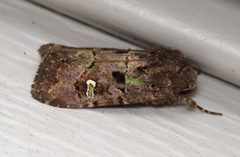
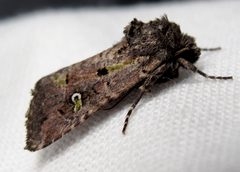
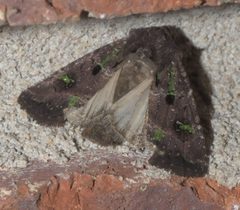
Lacinipolia renigera is a small owlet moth (Noctuidae) with a wingspan of 21–30 mm, smaller than most other members of its . rest with hindwings tucked beneath forewings, creating a tented or arrowhead-like silhouette. The is to most of North America, flying from May to October depending on location. Larvae feed on herbaceous plants and are considered a pest of agricultural crops including cabbage, lettuce, and corn.
Pronunciation
How to pronounce Lacinipolia renigera: /lɑːˌsɪnɪˈpoʊlɪə rɛˈnɪdʒərə/
These audio files are automatically generated. While they are not always 100% accurate, they are a good starting point.
Identification
The combination of small size (21–30 mm wingspan), tented resting posture with hindwings concealed beneath forewings, and the distinctive pattern of three green spots on dark greyish-brown forewings—one spot bordered with white—separates this from similar Lacinipolia species. The whitish gray hindwings with darker margins are also diagnostic. Visual identification to species within Lacinipolia is often unreliable; dissection or genitalia examination may be required for definitive identification.
Images
Habitat
Occurs across diverse terrestrial throughout most of North America. Found in areas supporting herbaceous vegetation and agricultural fields. Absent from the Gulf coastal plain and sparse in the western United States.
Distribution
to most of North America. Present in Canada (Alberta, Manitoba, Saskatchewan, and provinces eastward), and throughout the United States except absent from Yukon, Alaska, and the Gulf coastal plain. Distribution is sparse in the western U.S.
Seasonality
fly from May to October, with timing varying by geographic location.
Diet
Larvae are herbivores feeding on a wide variety of herbaceous plants including chicory (Cichorium), dandelions (Taraxacum), and clovers (Trifolium). They are also documented pests of agricultural crops: cabbage, lettuce, and corn.
Host Associations
- Cichorium - larval food plantchicory
- Taraxacum - larval food plantdandelions
- Trifolium - larval food plantclovers
- Brassica oleracea var. capitata - larval food plantcabbage; agricultural pest
- Lactuca sativa - larval food plantlettuce; agricultural pest
- Zea mays - larval food plantcorn; agricultural pest
Life Cycle
Complete with , larval, pupal, and stages. Larval stage is the destructive '' phase. Specific details of site and stage are not documented in available sources.
Behavior
are and attracted to light. They rest with wings folded in a characteristic tented posture during the day. Larvae are ground-dwelling cutworms that feed on herbaceous vegetation.
Ecological Role
Larvae function as herbivores in natural . In agricultural settings, they act as secondary pests of row crops and vegetables. likely serve as prey for including bats and night-feeding birds.
Human Relevance
Considered a pest of several agricultural crops. The 'Bristly ' refers to the larval stage's destructive feeding habits. No significant positive economic or cultural associations documented.
Similar Taxa
- Other Lacinipolia speciesMany Lacinipolia are visually similar and cannot be reliably distinguished by external appearance alone; genitalia examination is often required for species-level identification.
More Details
Taxonomic history
Originally described as Celaena renigera by Stephens in 1829, later transferred to Lacinipolia.