
Mastophora cornigera
(Hentz, 1850)
Southern Bolas Spider
Mastophora cornigera is a bolas spider in the orb-weaver Araneidae. females are specialized that capture male noctuid using a single sticky silk droplet suspended from a dragline, rather than constructing a traditional orb web. The is the only member of its found in California. Males and females lack this hunting and instead capture prey directly with their legs.
Pronunciation
How to pronounce Mastophora cornigera: /ˌmæs.toʊˈfɔː.rə kɔˈnɪ.dʒə/
These audio files are automatically generated. While they are not always 100% accurate, they are a good starting point.
Identification
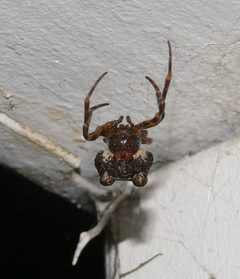
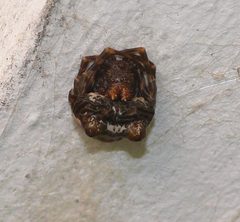
The only Mastophora occurring in California. Distinguished from other Araneidae by the absence of an orb web and presence of a single sticky capture droplet on a dragline (in females). The bird-dropping camouflage and black-and-white mottled sacs are distinctive. Males and juveniles may be overlooked due to small size and direct prey capture without silk structures.
Images
Appearance
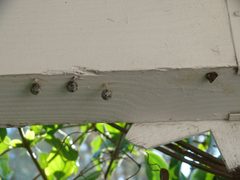
females have a highly cryptic appearance resembling a bird dropping, with light streaks mimicking deposits. The body is compact and irregularly shaped to enhance this camouflage. Males are substantially smaller than females; they emerge from sacs as penultimates and undergo only one before reaching maturity. Egg sacs are black and white mottled.
Habitat
Hides during daytime in concealed locations. Nocturnally active in open situations where bolas hunting can be deployed. Specific microhabitat preferences beyond requirements are not documented.
Distribution
United States to Nicaragua; the sole Mastophora in California. Middle America and North America.
Diet
females: male noctuid of select , attracted by mimicry. females and all males: capture prey directly with legs; specific prey items for these life stages not documented in sources.
Host Associations
- Noctuidae - preyMale attracted by female mimicry
Life Cycle
Males emerge from sacs as penultimates and mature after one . Developmental stages and timing otherwise not documented.
Behavior
females are bolas hunters: they emit chemical signals mimicking female , detect approaching male moths by air vibrations from their wingbeats, and swing the sticky silk globule to capture them. Females remain stationary during hunting, relying on and chemical lures rather than web architecture. Males and juveniles are active hunters using legs alone.
Ecological Role
Specialized of male noctuid . The highly specific prey targeting suggests potential -level effects on select moth , though quantitative impacts are not studied.
Human Relevance
Not documented as having direct economic or medical importance. The specialized predatory strategy is of scientific interest for studies of chemical and behavioral evolution.
Similar Taxa
- Other AraneidaeConstruct traditional orb webs rather than single-droplet bolas; lack bird-dropping and -specific mimicry.
- Other Mastophora speciesM. cornigera is distinguished geographically as the only member of the in California; other occur in different regions of North America.
More Details
Chemical mimicry
The ' ability to synthesize or sequester compounds mimicking female represents a remarkable case of aggressive chemical mimicry. This allows selective attraction of male moths as prey rather than generalized insect attraction.
Prey capture mechanics
The bolas hunting method—swinging a single adhesive droplet on a silk line—represents a derived loss of the ancestral orb-weaving characteristic of Araneidae, replaced by a highly specialized alternative predatory strategy.