
Mastophora yeargani
Levi, 2003
Yeargan's Bolas Spider
Mastophora yeargani is a bolas spider in the orb-weaver Araneidae, found in the United States. females are specialized that capture prey using a single sticky droplet of silk suspended from a dragline, rather than building an orb web. Males and females lack this hunting strategy and instead capture prey directly with their legs. The was described by Levi in 2003 and is one of approximately 15 Mastophora species known from the United States.
Pronunciation
How to pronounce Mastophora yeargani: /ˈmæstəˌfɔrə ˈjɪərɡəni/
These audio files are automatically generated. While they are not always 100% accurate, they are a good starting point.
Identification
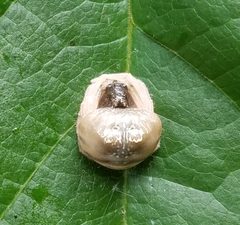
females of Mastophora yeargani can be distinguished from other orb-weavers by their lack of an orb web and their specialized bolas hunting apparatus. Like other Mastophora , females are cryptically colored and resemble bird droppings, with light streaks mimicking . The sacs are black and white mottled and often provide the most reliable means of locating these spiders. Males are notably smaller than females and emerge from egg sacs as penultimates, requiring only one to reach maturity. Specific diagnostic features separating M. yeargani from other Mastophora species are not documented in available sources.
Images
Habitat
Mastophora yeargani is found in the United States, though specific preferences within its range are not documented. Related Mastophora are , hiding during the day in vegetation, and are most often encountered in wooded or shrubby environments where their prey (male noctuid ) are active.
Distribution
United States. Distribution records indicate presence in North America with confirmed occurrence in the USA. Specific state-level distribution is not documented in available sources.
Diet
females are known to prey on male noctuid , which they attract by emitting the of female moths. The diet of males and females, which capture prey directly with their legs rather than using a bolas, is not specifically documented for this .
Life Cycle
Males emerge from sacs as penultimates, undergoing only one before reaching maturity. This results in males that are substantially smaller than adult females. Further details of the for this specific are not documented.
Behavior
females are bolas spiders: they sit at night emitting female to lure male noctuid moths. When a moth approaches, the spider senses air vibrations from its wings and swings the sticky silk globule to strike and capture the prey. Males and females lack this and instead capture prey directly using their legs. The spiders are and hide during the day.
Ecological Role
As a specialized of male noctuid , Mastophora yeargani functions as a predator that may influence local moth . The chemical mimicry of moth represents a notable example of in predator-prey interactions.
Human Relevance
Mastophora yeargani has limited direct human relevance. sacs of Mastophora are occasionally encountered by naturalists and may be mistaken for plant structures or other constructions. The species poses no known threat to humans.
Similar Taxa
- Mastophora cornigeraThe only Mastophora found in California; M. yeargani can be distinguished by geographic separation, though specific morphological differences are not documented in available sources.
- Other Araneidae orb-weaversUnlike typical orb-weavers, Mastophora yeargani does not construct an orb web; females instead use a single bolas line with a sticky droplet for prey capture.
More Details
Bolas hunting mechanism
The bolas hunting strategy of Mastophora represents a derived within the orb-weaver Araneidae. The spider produces a single droplet of sticky silk suspended from a dragline, which is swung to intercept flying prey. This mechanism is accompanied by chemical deception: the spider produces compounds that mimic the of specific female , luring male moths to their capture.
Taxonomic context
The Mastophora was recently revised and includes approximately 15 in the United States. Mastophora yeargani was described by Levi in 2003. One Central American species, Mastophora dizzydeani, was named after baseball pitcher Dizzy Dean in reference to the spider's twirling motion when using its bolas.