
Pandemis limitata
(Robinson, 1869)
Three-lined Leafroller, Three-lined Leafroller Moth
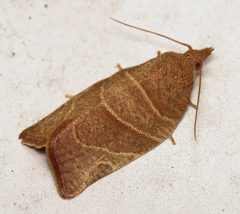
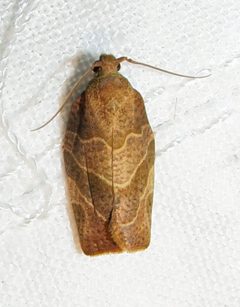
A tortricid commonly known as the three-lined leafroller, found across North America from Nova Scotia to British Columbia, south to Arizona and into northern Mexico. The larvae are leaf rollers that feed on a broad range of deciduous trees and shrubs, with documented spanning more than 20 plant including maple, birch, oak, apple, and willow. have sexually dimorphic forewing lengths: males 7–9.5 mm, females 9–12 mm. The has two annually in at least some parts of its range, with an overwintered generation in spring and a summer generation.

Pronunciation
How to pronounce Pandemis limitata: /pænˈdiːmɪs lɪˈmɪtətə/
These audio files are automatically generated. While they are not always 100% accurate, they are a good starting point.
Identification
can be distinguished from similar tortricid leafrollers by forewing length dimorphism (males smaller than females) and specific wing patterning associated with the "three-lined," though precise diagnostic markings require examination. Males have forewings 7–9.5 mm long, females 9–12 mm. Larvae are leaf rollers, constructing shelters by rolling or folding leaves.
Images
Habitat
Deciduous forests, woodlands, and orchards. Documented from organically managed apple orchards in southern interior British Columbia. plant availability appears to be the primary determinant given the broad host range.
Distribution
North America: recorded from Nova Scotia to British Columbia across Canada, and from the east coast of the United States west to the Rocky Mountains and Arizona. Also recorded from Durango, Mexico. Specific distribution records include Alberta, Manitoba, and Saskatchewan in Canada, and Vermont in the United States.
Seasonality
Two annually where studied: an overwintered generation active in spring, and a first generation in summer. The overwintered generation occurs at higher than the summer generation.
Diet
Larvae feed on leaves of numerous deciduous woody plants. Documented include: Acer negundo, Acer saccharinum, Alnus incana, Alnus rubra, Betula papyrifera, Corylus americana, Euonymus atropurpureus, Cornus racemosa, Myrica gale, Malus domestica, Malus sylvestris, Prunus avium, Prunus virginiana, Populus alba, Populus balsamifera, Populus tremuloides, Tilia americana, Ulmus americana, Ulmus rubra, and additional in Alnus, Betula, Corylus, Viburnum, Vaccinium, Amorpha, Trifolium, Castanea, Quercus, Osmunda, Sorbus, Salix, and others.
Life Cycle
Two per year in studied : overwintered generation in spring, first generation in summer. Overwintered generation occurs at higher . and details not specified in sources.
Behavior
Larvae are leaf rollers, constructing shelters by rolling or tying leaves with silk. Male exhibit oriented toward female , including wing fanning, take-off, plume locking, and upwind flight. Male attraction to sources can be disrupted by atmospheric saturation with (Z)-11-tetradecenyl acetate.
Ecological Role
Larval herbivore on deciduous woody plants. for diverse complex including at least 30 , with recorded parasitoids including Apophua simplicipes, Glypta spp., Macrocentrus linearis, Meteorus trachynotus, Apanteles polychrosidis, Apanteles atra, Microgaster epagoges, Colpoclypeus florus, and Sympiesis sp. Also host for parasitoid Trichogramma platneri. rates vary seasonally, reaching up to 67.9% in summer versus 5.5–24.7% in overwintered generation.
Human Relevance
Occasional pest in apple orchards, particularly in organic management systems. Subject of research on -based for potential management.
Similar Taxa
- Choristoneura rosaceanaCo-occurs in apple orchards and shares complex; distinguished by different and
- Cydia pomonellaCo-occurs in apple orchards; codling moth is a more severe pest with different larval (boring into fruit rather than leaf rolling)
Sources and further reading
- BugGuide
- Wikipedia
- GBIF taxonomy match
- iNaturalist taxon
- NCBI Taxonomy
- Catalogue of Life
- The parasitoid complex affecting Choristoneura rosaceana and Pandemis limitata in organically managed apple orchards
- Attraction of male Pandemis limitata (Lepidoptera: Tortricidae) to natural and synthetic pheromone sources: importance for assessing communication disruption
- Trichogramma platneri (Hym.: Trichogrammatidae): Host choices between viable and nonviable codling moth,Cydia pomonella, and three-lined leafroller,Pandemis limitata (Lep.: Tortricidae) eggs