
Tortricinae
Latreille, 1803
Tortricine Leafroller Moths, Leafrollers
Tribe Guides
6Tortricinae is the nominate of Tortricidae, commonly known as leafroller moths. Larvae construct shelters by folding or rolling leaves of their plants, a that gives the group its . The subfamily includes economically significant agricultural pests as well as employed as agents against weeds. It represents a diverse radiation within the tortrix moths with global distribution.
Pronunciation
How to pronounce Tortricinae: /tɔrˈtɹɪsɪniː/
These audio files are automatically generated. While they are not always 100% accurate, they are a good starting point.
Identification
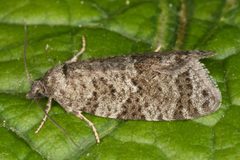
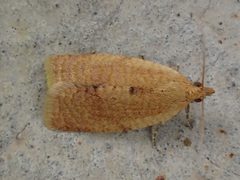
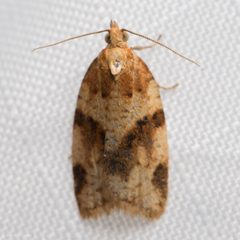
Tortricinae can be distinguished from the other major Olethreutinae primarily by larval : Tortricinae larvae typically fold or roll entire leaves to form shelters, while Olethreutinae larvae more commonly bore into fruits, stems, or roots, or mine within leaf tissue. Tortricinae generally exhibit broader forewings relative to body size compared to many Olethreutinae, though definitive identification requires examination of genitalia structure. The subfamily lacks the distinct wing pattern elements characteristic of some Olethreutine such as Grapholita.
Images
Habitat
Tortricinae occupy diverse terrestrial including forests, woodlands, grasslands, and agricultural systems. Many are associated with specific plant ; for example, Australian Cnephasiini are linked with Proteaceae in southern regions and rainforest vegetation in eastern and northern areas. Some species occur in specialized habitats such as Araucaria forests at elevations up to 1380m in New Caledonia.
Distribution
distribution with documented across all continents except Antarctica. Well-represented in North America, Europe, Asia (including North Korea, Iran, and Korea), Australia, New Zealand, and Caribbean islands. The tribe Archipini shows particular diversity in the Australasian region with likely origin in that area, and has extensively colonized the New World.
Diet
Larvae are phytophagous, feeding on a broad range of angiosperm plants. Documented feeding associations include: leaves and flower spikes of Banksia and other Proteaceae; leaves of Dilleniaceae; bark of Cupressus; leaves of Cissus (Vitaceae); and male cones of Araucaria. Some are pests of cultivated crops, while others show narrow host specialization.
Host Associations
- Proteaceae - larval Australian Cnephasiini, particularly Arotrophora group; includes Banksia flower spikes and Lomatia leaves
- Dilleniaceae - larval Phricanthes group larvae
- Cupressus - larval Tracholena sulfurosa larvae tunnel in bark of Cupressus
- Cissus - larval Taeniarchis larvae feed between joined leaves of Cissus (Vitaceae)
- Araucaria - larval Tracholena nigrilinea reared from male cones of Araucaria in New Caledonia
- Eucalyptus - larval Palaeotoma larvae bore in insect galls on Eucalyptus
- Bursaria - larval Proselena larvae are leaf miners in Bursaria
Life Cycle
Complete with , larva, pupa, and stages. Larval development involves construction of leaf shelters by folding or rolling plant foliage, within which feeding and development occur. Some have been reared from egg through all larval instars to adulthood in captivity, demonstrating the full can be completed on natural or sometimes host plants. typically occurs within or near the larval shelter.
Behavior
Larvae exhibit characteristic shelter-building , folding or rolling leaves of the food plant and feeding from within this protected microenvironment. This behavior is the defining ecological trait of the and the source of the 'leafrollers.' Some show more specialized behaviors: leaf mining in Bursaria (Proselena), bark tunneling in Cupressus (Tracholena sulfurosa), and boring in insect galls on Eucalyptus (Palaeotoma).
Ecological Role
Primary consumers in terrestrial , converting plant to animal tissue. Larval leaf-rolling creates microhabitats that may be utilized by other organisms. Some function as agents, suppressing of weed species. As prey for , , and insectivorous vertebrates, they contribute to higher .
Human Relevance
Several are significant agricultural pests causing economic damage to crops through larval feeding and shelter-building activities. Conversely, some species have been deliberately employed as agents to manage plant species. The has been extensively studied for taxonomic, phylogenetic, and applied entomological purposes, with particular attention to genitalia for species identification.
Similar Taxa
- OlethreutinaeThe other major of Tortricidae; distinguished by larval habits (boring, mining, or fruit-feeding rather than leaf-rolling) and generally narrower forewings, though definitive separation requires genitalia examination
More Details
Tribal classification
Tortricinae contains multiple tribes including Tortricini, Cnephasiini, Archipini, Schoenotenini, Chlidanotini, and Cochylini, each with characteristic distributions and associations. Some remain unassigned to tribes (incertae sedis).
Genitalic morphology
Male genitalia in Tortricinae possess cornuti—spine-like structures on the that show significant morphological variation and phylogenetic signal. These structures are important taxonomic characters for and generic delimitation.
Sources and further reading
- BugGuide
- Wikipedia
- iNaturalist taxon
- NCBI Taxonomy
- Catalogue of Life
- A Gathering of Lepidopterists: Who's Who of the Butterfly, Moth Experts | Bug Squad
- Tortricoidea: Tortricidae: Olethreutinae, Tortricinae, undetermined subfamily
- A revision of the Australian Cnephasiini (Lepidoptera: Tortricidae: Tortricinae).
- Six species of Tortricinae (Lepidoptera, Tortricidae) new to North Korea
- Phylogeny of the tribe Archipini (Lepidoptera: Tortricidae: Tortricinae) and evolutionary correlates of novel secondary sexual structures
- Synopsis of the Cochylini (Tortricidae: Tortricinae: Cochylini) of Iran, with the description of a new species
- An overview of the tribe Cnephasiini (Lepidoptera: Tortricidae: Tortricinae) of Iran with description of a new species
- A taxonomic revision of the Archipini of the Caribbean (Lepidoptera, Tortricidae, Tortricinae)
- Three new species of Tracholena Common, 1965 (Lepidoptera: Tortricidae: Tortricinae: Schoenotenini) from New Caledonia associated with Araucariaceae
- A revision of the Australian Tortricini, Schoeotenini, and Chlidanotini, (Lepidoptera: Tortricidae: Tortricinae)
- A new species of Protopterna Meyrick, 1908 from Korea (Lepidoptera: Tortricidae, Tortricinae)
- Morphological Variation, Taxonomic Distribution, and Phylogenetic Significance of Cornuti in Tortricinae (Lepidoptera: Tortricidae)