
Pandemis
Hübner, [1825] 1816
Leafroller moths
Species Guides
9- Pandemis borealis
- Pandemis canadana(Green Aspen Leaftier)
- Pandemis cerasana(barred fruit-tree tortrix)
- Pandemis coniferana
- Pandemis heparana(dark fruit-tree tortrix)
- Pandemis lamprosana(Woodgrain Leafroller Moth)
- Pandemis limitata(Three-lined Leafroller)
- Pandemis morrisana
- Pandemis pyrusana(apple pandemis)
Pandemis is a of tortricid moths in the tribe Archipini, commonly known as leafroller moths. The genus comprises approximately 60 described distributed across the Holarctic region, with particular diversity in Eurasia. Several species are recognized as agricultural pests, notably Pandemis cerasana (barred fruit-tree tortrix) and Pandemis pyrusana (Pandemis leafroller), which damage fruit trees and other woody plants. Larvae typically feed on leaves of deciduous trees and shrubs, often rolling or folding leaves for shelter.

Pronunciation
How to pronounce Pandemis: //pænˈdeɪ.mɪs//
These audio files are automatically generated. While they are not always 100% accurate, they are a good starting point.
Identification
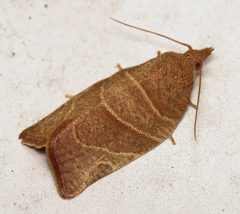
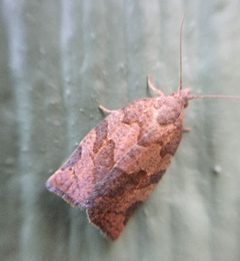
are medium-sized tortricid moths with wingspans generally ranging 15–25 mm. Forewings typically display variable brown, tan, or ochreous ground coloration with darker transverse bands or fasciae. The can be distinguished from related Archipini genera by genitalic characters, particularly the structure of the male valva and female sterigma. Wing patterns are often cryptic and variable, making -level identification challenging without dissection.
Images
Habitat
Deciduous forests, woodlands, orchards, and shrublands. Larvae are associated with broad-leaf trees and shrubs.
Distribution
Holarctic distribution, with primary diversity in Eurasia. Recorded from northern Europe (Denmark, Norway, Sweden), North America (including Vermont, USA), and Asia. Individual show varying ranges: Pandemis cerasana is native to northern Eurasia and was introduced to western North America (first recorded Victoria, British Columbia, 1964).
Diet
Larvae feed on leaves of broad-leaf trees and shrubs; specific associations vary by .
Behavior
Larvae are leafrollers: they fold or roll leaves to create shelters, feeding within these structures. Pandemis pyrusana larval feeding has been observed to be altered by (PapyGV) , which increases mortality and modifies feeding patterns.
Ecological Role
Herbivores on deciduous woody vegetation. Some function as agricultural pests in orchard , causing defoliation and fruit damage. Natural enemies include and , though and pressure were reported as negligible in studied of P. cerasana.
Human Relevance
Several are economically significant agricultural pests. Pandemis cerasana damages cherry orchards and has caused sporadic defoliation of Garry oak in North America. Pandemis pyrusana is a pest of pear and other fruit crops, subject to research using . The has been introduced to new regions through human-mediated transport of plant material.
Similar Taxa
- ArchipsAlso in tribe Archipini with similar leafroller and general appearance; distinguished by genitalic and wing pattern details.
- ChoristoneuraSimilar tortricid leafrollers with overlapping use; distinguished by male genitalia and forewing pattern elements.
Sources and further reading
- BugGuide
- Wikipedia
- GBIF taxonomy match
- iNaturalist taxon
- NCBI Taxonomy
- Catalogue of Life
- Medieval plague pandemis
- The effect of the granulovirus (PapyGV) on larval mortality and feeding behaviour of the Pandemis leafroller,Pandemis pyrusana(Lepidoptera: Tortricidae)
- Biology of the barred fruit-tree tortrix,Pandemis cerasana(Hübner) (Lepidoptera: Tortricidae), causes damage in cherry orchards
- LIFE HISTORY AND IMMATURE STAGES OF PANDEMIS CERASANA (LEPIDOPTERA: TORTRICIDAE)