
Pandemis heparana
(Denis & Schiffermüller, 1775)
dark fruit-tree tortrix, apple brown tortrix
Pandemis heparana is a tortricid with a wingspan of 16–24 mm, recognized by its variable brown forewings with reticulate patterning and dark transverse bands. The is , with active from late May to mid-September in western Europe. Larvae develop within rolled leaves of various deciduous trees and shrubs, and are considered agricultural pests of apple and pear orchards.
Pronunciation
How to pronounce Pandemis heparana: /pænˈdiːmɪs hɛpəˈreɪnə/
These audio files are automatically generated. While they are not always 100% accurate, they are a good starting point.
Identification
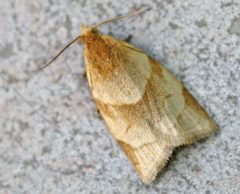
Distinguished from the closely related Pandemis cerasana by forewing pattern details, though separation may require examination of genitalia. The combination of reticulate forewing patterning with two dark transverse bands and triangular spots is characteristic.
Images
Appearance
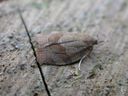
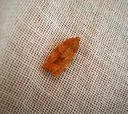
Forewings yellowish brown to reddish brown with a reticulate pattern, dark brown basal fascia, two dark brown transverse bands, two triangular spots, and brown fringes. Hindwings gray-brown with white-yellow fringes. Wingspan 16–24 mm. Larva pale green, reaching 22 mm.
Habitat
Deciduous woodlands, orchards, and shrubby areas where plants occur.
Distribution
Europe (widespread), eastern , Near East, and North America. Documented present in Belgium including Brussels-Capital and Flemish regions, and on Azorean islands São Jorge and Terceira.
Seasonality
. fly from late May to mid-September in western Europe. Two per year.
Diet
Larvae are on deciduous trees and shrubs: oak (Quercus), willow (Salix), birch (Betula), honeysuckle (Lonicera), rowan (Sorbus), apple (Malus), and pear (Pyrus).
Host Associations
- Quercus - larval
- Salix - larval
- Betula - larval
- Lonicera - larval
- Sorbus - larval
- Malus - larval pest in orchards
- Pyrus - larval pest in orchards
Life Cycle
hatch into larvae that feed within rolled leaves. Larvae pupate inside the rolled leaf shelter. Two per year ().
Behavior
Larvae construct and inhabit rolled leaf shelters on plants. are and attracted to light.
Ecological Role
Herbivore; larval defoliator of deciduous trees and shrubs. Agricultural pest in orchards.
Human Relevance
Considered a pest of apple and pear orchards; larvae damage foliage and fruit.
Similar Taxa
- Pandemis cerasanaVery similar forewing appearance; may require genital dissection for reliable separation