
Coenonympha tullia
Müller, 1764
large heath, common ringlet
Species Guides
12- Coenonympha tullia ampelos(Common Ringlet (subspecies))
- Coenonympha tullia benjamini
- Coenonympha tullia california(California Ringlet)
- Coenonympha tullia columbiana
- Coenonympha tullia eryngii(Large Heath butterfly)
- Coenonympha tullia eunomia
- Coenonympha tullia inornata(Inornate Ringlet)
- Coenonympha tullia insulana(Large Heath butterfly (subspecies))
- Coenonympha tullia kodiak(Kodiak Ringlet)
Coenonympha tullia is a Holarctic in the Nymphalidae, found across northern Europe, Asia, and North America. The species inhabits diverse grassy environments including peat bogs, wet meadows, prairies, and arctic tundra. It serves as a flagship species for peatland restoration efforts, with documented reintroduction programs in the UK. The species exhibits poor capability and has been observed seeking new grounds along ditches. Multiple have been described across its broad range, with some forms formerly considered subspecies now elevated to species rank.
Pronunciation
How to pronounce Coenonympha tullia: //sɪˈnɒnɪmfə ˈtʌliə//
These audio files are automatically generated. While they are not always 100% accurate, they are a good starting point.
Identification
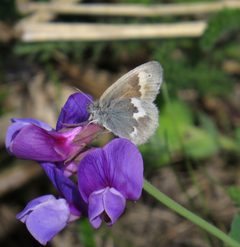
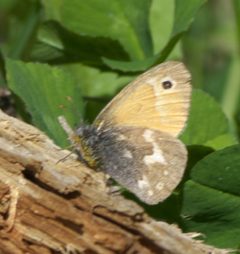
Distinguished from similar Coenonympha by the combination of upperside coloration and underside hindwing pattern—specifically the whitish band formed by joined smears with ocelli positioned distally. C. symphita is similar but C. tullia tends to be duller with more reduced markings. identification requires geographic and morphological analysis: northern forms (philoxenus, isis) are greyer with stronger ocellation; alpine and central European forms (davus/tiphon) are more yellow with reduced markings. The maritime subspecies C. t. nipisiquit is now recognized as a separate species, C. nipisiquit.
Images
Habitat
of open, grassy wetland . Core habitat includes peat bogs, wet meadows, and marshy areas with specific vegetation structure. Research on reintroduced in Chat Moss, UK identified critical habitat thresholds: 14 Eriophorum vaginatum tussocks per 2 m and 13.4% Erica tetralix cover. Also inhabits roadsides, woodland edges and clearings, prairies, and arctic/alpine taiga and tundra. Larval survival is microhabitat-specific, with highest survival in areas containing vegetation and moderate flooding frequency.
Distribution
Holarctic distribution: northern Europe across the Palearctic to eastern Asia; across North America from Alaska to at least Colorado. European range includes British Isles, Scandinavia, Alps, Central and Southern Germany, Danube countries, and Russia. North American range includes subarctic and temperate regions with multiple described (ampelos, benjamini, columbiana, elko, haydenii, inornata, insulanus, kodiak, mackenziei, mcisaaci, mono, ochracea, yukonensis, among others). Reintroduction efforts documented in Greater Manchester, UK (2020-2023).
Seasonality
on wing primarily June and July in central European . period timing linked to thermal accumulation: after approximately 400 degree days above 7°C following snow/ice melt. Single-brooded; larvae overwinter.
Host Associations
- Eriophorum vaginatum - resourceCritical tussock (14 per 2 m²) identified as near-optimal for reintroduced
- Erica tetralix - resourceCritical cover threshold of 13.4% identified for reintroduction success
- Carex - larval Larval food plant documented in historical sources
- Rhynchospora - larval Larval food plant documented in historical sources
- Festuca - larval Larval food plant documented in historical sources
- Spartina patens - larval plant for nipisiquit (now C. nipisiquit), salt meadow cordgrass
Life Cycle
Overwinters as larva. Larval stage lasts from September until May, feeding on rushes, reeds, and grasses. Larvae can survive up to 3 weeks of submergence during flooding events; survival decreases with prolonged flooding. Flooding triggers behavioral changes: larvae move to higher ground or plant stems, with reduced feeding and growth rates. occurs in late spring; pupa pale green with whitish . emerge June-July. Oviposition site selection is microhabitat-specific, affecting offspring survival.
Behavior
Poor flyer, typically remaining near patches but occasionally dispersing along ditches seeking new grounds. is low and weak. Larvae exhibit flood-avoidance : when submerged, move to elevated positions on vegetation. Reintroduced show quantifiable micro-distribution patterns with strong association to specific vegetation structure. not commonly observed in large numbers even at established sites; populations may appear sporadically.
Ecological Role
Flagship for peatland restoration; used as indicator for quality assessment in restoration projects. Presence indicates intact or successfully restored peatland vegetation structure with specific sedge and heath components. herbivore in wetland . Serves as prey for and vertebrate in peatland ecosystems.
Human Relevance
Subject of active conservation reintroduction programs in UK peatlands, particularly Chat Moss, Greater Manchester. Reintroductions in 2020, 2022, and 2023 to North West England. Research on requirements informs peatland restoration management. Threatened by peatland degradation, drainage, and wildfire. Climate change mitigation efforts through peatland restoration align with conservation of this . Historical declines led to local extirpations in parts of native range.
Similar Taxa
- Coenonympha symphitaSimilar upperside sandy yellow coloration; C. tullia distinguished by duller appearance and underside hindwing pattern
- Coenonympha pamphilusSmall form caeca and scotica superficially similar; distinguished by presence/absence and arrangement of ocelli
- Coenonympha nipisiquitFormerly treated as C. t. nipisiquit; now recognized as separate restricted to salt marshes of eastern Canada
- Coenonympha californiaFormerly treated as ; elevated to rank
More Details
Subspecies diversity
Extensive variation described across range, with 30+ named forms including European (tullia, davus, philoxenus, isis, scotica, rhodopensis), Asian (viluiensis, caeca, mixturata, subcaecata), and North American (ampelos, benjamini, columbiana, elko, haydenii, inornata, insulanus, kodiak, ochracea, yukonensis) forms. Some subspecies show dramatic color divergence from yellow to grey.
Conservation status variation
-level assessment complicated by broad range and local . Some regionally threatened or extirpated; others widespread. nipisiquit (now C. nipisiquit) endangered with declining populations in 10 salt marshes in Quebec and New Brunswick, Canada.
Etymology
Specific epithet tullia references Tullia, daughter of Servius Tullius (sixth Roman king) or daughter of Marcus Tullius Cicero.
Sources and further reading
- BugGuide
- Wikipedia
- GBIF taxonomy match
- iNaturalist taxon
- NCBI Taxonomy
- Catalogue of Life
- Burning bogs. - Buglife Blog - Buglife
- Coenonympha nipisiquit Archives - Entomology Today
- Unraveling the mysteries of the Red Sea: A new reef coral species from Saudi Arabia | Blog
- Uncategorized | Blog - Part 21
- Pensoft blog - Part 126
- Endangered Maritime Ringlet Shows Continued Decline in Eastern Canada
- Microhabitat‐specific early‐larval survival of the maritime ringlet (Coenonympha tullia nipisiquit)
- Optimising the reintroduction of a specialist peatland butterfly Coenonympha tullia onto peatland restoration sites
- The effects of flooding on the survival and behaviour of overwintering large heath butterfly Coenonympha tullia larvae
- Patch occupancy in Coenonympha tullia (Muller, 1764) (Lepidoptera: Satyrinae): habitat quality matters as much as patch size and isolation
- Review for "Bringing back the Manchester Argus Coenonympha tullia ssp. davus (Fabricius, 1777): Quantifying the habitat resource requirements to inform the successful reintroduction of a specialist peatland butterfly"
- Review for "Bringing back the Manchester Argus Coenonympha tullia ssp. davus (Fabricius, 1777): Quantifying the habitat resource requirements to inform the successful reintroduction of a specialist peatland butterfly"
- Review for "Bringing back the Manchester Argus Coenonympha tullia ssp. davus (Fabricius, 1777): Quantifying the habitat resource requirements to inform the successful reintroduction of a specialist peatland butterfly"
- Decision letter for "Bringing back the Manchester Argus Coenonympha tullia ssp. davus (Fabricius, 1777): Quantifying the habitat resource requirements to inform the successful reintroduction of a specialist peatland butterfly"
- Review for "Bringing back the Manchester Argus Coenonympha tullia ssp. davus (Fabricius, 1777): Quantifying the habitat resource requirements to inform the successful reintroduction of a specialist peatland butterfly"
- Decision letter for "Bringing back the Manchester Argus Coenonympha tullia ssp. davus (Fabricius, 1777): Quantifying the habitat resource requirements to inform the successful reintroduction of a specialist peatland butterfly"
- Decision letter for "Bringing back the Manchester Argus Coenonympha tullia ssp. davus (Fabricius, 1777): Quantifying the habitat resource requirements to inform the successful reintroduction of a specialist peatland butterfly"
- Decision letter for "Bringing back the Manchester Argus Coenonympha tullia ssp. davus (Fabricius, 1777): Quantifying the habitat resource requirements to inform the successful reintroduction of a specialist peatland butterfly"
- Author response for "Bringing back the Manchester Argus Coenonympha tullia ssp. davus (Fabricius, 1777): Quantifying the habitat resource requirements to inform the successful reintroduction of a specialist peatland butterfly"
- Author response for "Bringing back the Manchester Argus Coenonympha tullia ssp. davus (Fabricius, 1777): Quantifying the habitat resource requirements to inform the successful reintroduction of a specialist peatland butterfly"
- Author response for "Bringing back the Manchester Argus Coenonympha tullia ssp. davus (Fabricius, 1777): Quantifying the habitat resource requirements to inform the successful reintroduction of a specialist peatland butterfly"