
Coenonympha tullia inornata
W.H. Edwards, 1861
Inornate Ringlet, Common Ringlet (inornata subspecies)
Coenonympha tullia inornata is a of the Common Ringlet , a member of the Nymphalidae. This subspecies occurs in North America, where it inhabits peatland and bog . The has been documented in association with blanket bog , where it serves as an indicator of intact peatland conditions. Like other members of the , it is associated with grasses as larval plants.
Pronunciation
How to pronounce Coenonympha tullia inornata: //ˌsiːnoʊˈnɪmfə ˈtʌliə ˌɪnɔːrˈneɪtə//
These audio files are automatically generated. While they are not always 100% accurate, they are a good starting point.
Identification
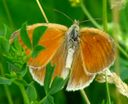
Distinguished from other Coenonympha tullia by reduced or absent ocelli (eyespots) on the hindwing, corresponding to the 'inornata' (unadorned) epithet. The subspecies name refers to the relatively plain wing pattern compared to nominotypical forms.
Images
Habitat
Peatland and blanket bog ; specifically documented from raised bogs and wet heathland in North America.
Distribution
North America; records indicate presence in Canada and the northern United States. The has been specifically noted in eastern Canadian .
Diet
Larvae feed on grasses (Poaceae); specific plant records for this are limited but the is associated with various grass including sedges and rushes in wet meadow .
Life Cycle
Complete with , larva, pupa, and stages. Larvae are grass-feeders; adults are typically single-brooded with period in summer months.
Ecological Role
Serves as an for intact peatland and bog . Associated with specialized bog including shared with the Bog Sun-jumper spider (Heliophanus dampfi) and other peatland .
Human Relevance
Subject of conservation concern due to loss from peatland degradation, drainage, and wildfire. declines have been documented in eastern Canada.
Similar Taxa
- Coenonympha tullia tulliaNominotypical with more prominent ocelli on hindwing; differs in wing pattern ornamentation
- Coenonympha nipisiquitFormerly considered a separate , now often treated as ; occurs in similar bog in eastern Canada
Sources and further reading
- BugGuide
- GBIF taxonomy match
- Meloidae Holdings | Entomology Research Museum
- Burning bogs. - Buglife Blog - Buglife
- Coenonympha nipisiquit Archives - Entomology Today
- Unraveling the mysteries of the Red Sea: A new reef coral species from Saudi Arabia | Blog
- I am an Entomologist | Beetles In The Bush
- Uncategorized | Blog - Part 21