
Celastrina idella
Wright & Pavulaan, 1999
American holly azure, Holly Azure
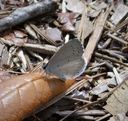
Celastrina idella is a small blue in the Lycaenidae, to the Atlantic coastal plain of the eastern United States. exhibit a single spring period from late April to late May, with pupae undergoing extended through summer, autumn, and winter. The is specialized on holly (Ilex) species as larval , with documented associations with several species. It occurs sympatrically with related azure species but is distinguished by host plant specificity, smaller size, and unique .
Pronunciation
How to pronounce Celastrina idella: //sɛˈlæstɹɪnə aɪˈdɛlə//
These audio files are automatically generated. While they are not always 100% accurate, they are a good starting point.
Identification
Distinguished from sympatric azure by: smaller size than northern azure (Celastrina lucia); later period than northern azure; earlier flight period than summer azure (Celastrina neglecta) summer ; pupal before spring unlike summer azure; spring flight associated with holly rather than black cherry. Spring azure (Celastrina ladon) nearly indistinguishable by sight alone; requires microscopic examination of wing structure for confident separation. Appalachian azure (Celastrina neglectamajor) and cherry gall azure (Celastrina serotina) have ranges west of C. idella's Atlantic coastal distribution.
Images
Habitat
Associated with forests and woodlands containing holly . Larval development occurs within flower buds of male holly plants.
Distribution
Atlantic coastal plain of the eastern United States, from New Jersey south to Georgia.
Seasonality
Single period annually in spring: late April to late May in the northern part of the range. emerge after extended pupal spanning summer through early spring.
Diet
Larvae feed on flowering parts of male plants of four holly : American holly (Ilex opaca), inkberry (Ilex glabra), smooth winterberry (Ilex laevigata), and Yaupon holly (Ilex vomitoria). Possible alternative include tall gallberry holly (Ilex coriacea) and Virginia willow (Itea virginica). nectar from highbush blueberry (Vaccinium corymbosum), sand myrtle (Kalmia buxifolia), chokeberries (Aronia arbutifolia, A. melanocarpa), black cherry (Prunus serotina), red maple (Acer rubrum), and rock cress (Arabis sp.).
Host Associations
- Ilex opaca - larval flowering parts of male plants
- Ilex glabra - larval flowering parts of male plants
- Ilex laevigata - larval flowering parts of male plants
- Ilex vomitoria - larval flowering parts of male plants
- Ilex coriacea - possible larval unconfirmed alternative
- Itea virginica - possible larval unconfirmed alternative
- Vaccinium corymbosum - nectar source
- Kalmia buxifolia - nectar source
- Aronia arbutifolia - nectar source
- Aronia melanocarpa - nectar source
- Prunus serotina - nectar source
- Acer rubrum - nectar source
- Arabis sp. - nectar source
- Camponotus chromaiodes - associateferruginous carpenter ant; ants accompany caterpillars
- Camponotus nearcticus - associateunnamed carpenter ant; ants accompany caterpillars
- Lasius alienus - associateunnamed citronella ant; ants accompany caterpillars
Life Cycle
: white, laid on buds of holly flowers. Larvae: hatch and bore into buds in late spring; attended by ants of several . Pupae: formed in late spring or early summer, light brown; undergo extended through summer, autumn, winter, and early spring until . Adults: single with spring period.
Behavior
exhibit rapid, persistent with skittish , making observation and photography difficult. Larvae bore into holly flower buds and are accompanied by ants, suggesting a facultative myrmecophilous relationship. Pupae undergo extended , with adults emerging only after a full year in the pupal stage.
Ecological Role
of spring-blooming woody plants including Vaccinium, Prunus, and Acer . Larval herbivore specialized on Ilex species. -associated larvae may provide nutritional rewards to attendant ants through secretions.
Human Relevance
Subject of conservation interest due to specialized plant requirements and restricted coastal plain distribution. May serve as for intact holly-dominated forest . Not known to be of agricultural or economic significance.
Similar Taxa
- Celastrina luciaNorthern azure; larger size, earlier period, more vivid coloration, different larval
- Celastrina ladonSpring azure; nearly identical appearance, requires microscopic wing examination for separation
- Celastrina neglectaSummer azure; summer does not , associated with black cherry rather than holly
- Celastrina neglectamajorAppalachian azure; range west of C. idella distribution
- Celastrina serotinaCherry gall azure; range west of C. idella distribution
More Details
Taxonomic history
Described by Wright & Pavulaan in 1999, representing a cryptic split from the Celastrina ladon complex based on plant specialization, , and morphological differences.
Evolutionary significance
Proposed example of through plant specialization; genetically diverged from other azure through to Ilex not used by co-occurring relatives.