
Camponotus ocreatus
Emery, 1893
Carpenter ant
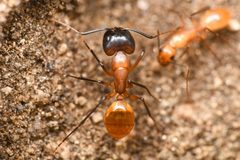
Camponotus ocreatus is a of in the Camponotus, first described by Emery in 1893. It is native to arid and semi-arid regions of northern Mexico and the southwestern United States. Like other members of the genus, it nests in wood and maintains colonies with polymorphic .


Pronunciation
How to pronounce Camponotus ocreatus: /ˌkæmpəˈnoʊtəs oʊˈkriːətəs/
These audio files are automatically generated. While they are not always 100% accurate, they are a good starting point.
Identification
Camponotus ocreatus can be distinguished from other southwestern Camponotus by its geographic restriction to northern Mexico and the southwestern United States, combined with specific morphological characters referenced in its species epithet (leg/tibial features). It may be confused with other black or dark-colored carpenter ants in the region such as Camponotus modoc or Camponotus vicinus; precise identification requires reference to original species description or keys.
Images
Habitat
Found in arid and semi-arid environments of the southwestern United States and northern Mexico. Nests in dead wood, including standing dead trees, fallen logs, and stumps. Moisture availability is important for colony establishment, with primary colonies typically located in damp decaying wood.
Distribution
Native to northern Mexico and the southwestern United States. Specific state and provincial records are not detailed in available sources.
Seasonality
Activity patterns not specifically documented. As with most Camponotus , are likely active during warmer months, with reproductive emerging in spring or early summer.
Ecological Role
Contributes to wood decomposition and nutrient cycling through excavation of galleries in dead wood. Functions as a scavenger and of small arthropods in its native arid .
Human Relevance
May occasionally enter structures in search of food, but specific documentation of structural damage is not available in provided sources. General management practices apply: eliminate moisture sources, remove decaying wood near structures, and prune vegetation to prevent bridge access to buildings.
Similar Taxa
- Camponotus modocAnother western North American carpenter ant with overlapping range; distinguished by specific morphological characters and preferences
- Camponotus vicinusOverlaps in southwestern distribution; requires detailed morphological examination for separation
- Camponotus pennsylvanicusEastern North American counterpart; distribution helps distinguish, though similar general appearance
More Details
Taxonomic Authority
First described by Carlo Emery in 1893, a prolific Italian entomologist who described hundreds of .
Etymology
The specific epithet "ocreatus" derives from Latin, referring to leg armor or greaves, likely describing distinctive tibial characteristics of this .
Sources and further reading
- BugGuide
- Wikipedia
- GBIF taxonomy match
- iNaturalist taxon
- NCBI Taxonomy
- Carpenter ants here and there: Camponotus spp. — Bug of the Week
- Ant bodyguards here and there: Odorous house ants, Tapinoma sessile, and carpenter ants, Camponotus — Bug of the Week
- Big black ants in the home: Carpenter ants, Camponotus spp. — Bug of the Week
- Formicidae | Beetles In The Bush | Page 2
- Bichos Argentinos #10 – Friday Formicine | Beetles In The Bush
- Amped-Up Ants: Caterpillars' Sugary Treats Earn Carpenter Ant Care